












The place that history forgot — until it didn’t
There are parts of London that everyone knows the name of. They appear in novels by Dickens, films, news headlines, and Fodor’s travel guides. You can mention their name and people say, oh yes, even if they have never been there.
And then there are places like Kenton.
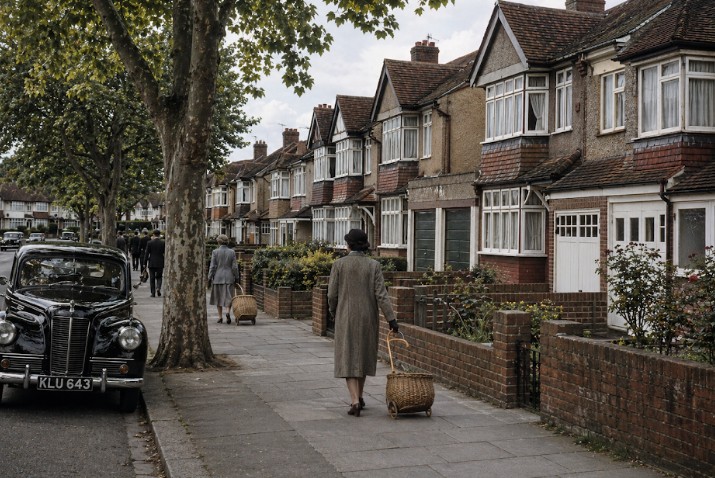
Kenton is a suburb of northwest London, though even saying that feels like promotion rather than description. It was built largely between the two World Wars, when London expanded outward along its railways and Underground lines, drawing clerks, teachers, civil servants, and shopkeepers into new streets of semi-detached houses. These were people in search of space, privacy, and a sense of arrival, all within commuting distance of jobs in central London.
 My grandmother lived at 3 Ashridge Close. I only know this because the address appears on my birth certificate, which gives it a certain authority, but otherwise it might as well have been a private arrangement between family members. However that is not to say that the address was unknown to me, it is just that I had always thought it was my aunt’s house.
When my grandfather died in 1945, his brothers bought out my grandmother from the family business and she moved from rural Suffolk to London and bought that house. It had bay windows in the front room and front bedroom, small panels of art deco stained glass set into the front door to throw a little light into the hallway and up the staircase, a decent-sized garden at the back, and a garage, along with an outside unheated toilet with an overhead tank–which was entirely normal in those days.
The garage was part of the aspiration. Few residents had cars at that time. The garage was a place where you lubricated bicycles, stored suitcases, polished shoes, did small bits of carpentry, and kept things that did not belong in the house.
Each weekday morning the men of Ashridge Close set off for work in dark suits and bowler hats, carrying rolled black umbrellas and briefcases that almost certainly contained sandwiches, an apple, perhaps a slice of fruit cake, and a thermos of tea with a couple of biscuits set aside for elevenses. In our street there was a senior civil servant who had “Sir” before his name, and also a general secretary of a trade union whose name sometimes appeared in the papers, yet neither of them owned a car. The idea of car ownership existed conceptually, but the reality had not yet caught up.
There was a shortage of houses in London back then after bombing in World War II had destroyed so many, so the house filled itself. My aunt and uncle and cousin occupied the back room, while my parents and I had the front room, and my grandmother lived upstairs. Nobody thought this was unusual, because It wasn’t. It was just how it was in the years immediately after World War II.
And there was no television yet. There was nothing to gather around in the evening except the business of living. My parents spent their evenings making a hooked rug, pulling strips of blue and gold wool through hessian with steady concentration, row by row, until it was finished. That rug stayed in service in our kitchen, usually occupied by a dog, until the 1980s, long after the circumstances that produced it had disappeared.
The telephone number of the large black Bakelite phone was Wordsworth 1962. I remember thinking, in 1962, how curious it was that the number matched the year, as if it had some special significance, which it did to me, but to no one else.
Within a twenty-minute walk there was everything you needed. A shopping parade with Sainsbury’s and other shops, where people went on Saturday mornings pulling wicker baskets with handles like a shepherd’s crook on wheels, a contraption of complete practicality and no elegance. Sainsbury’s itself had marble meat counters, staff in attendance, proper weighing scales, and white paper in which sausages and bacon were neatly wrapped, as though the transaction deserved attention.
Not far away there was also Preston Road tube station, which connected you to central London and to the idea of London, which are not quite the same thing. From there you could also reach Harrow-on-the-Hill, or travel out to Stanmore, where we sometimes went to walk in the woods or watch cricket.
My aunt was deputy head of the local primary school, and for one semester, while my parents were moving house, I attended it. That was where I learned to read. I was given a Janet and John book and told to read to the end of the current chapter. Ten minutes later I announced that I had finished the book, which was taken as a promising development.
Later, after I left school at seventeen, I returned to Kenton and stayed again with my grandmother. I found a job coding magazine subscriptions for a computer at a publishing house on the North Circular Road. From base camp at my grandmother’s home I explored London properly, visiting art galleries, museums, football grounds, Buckingham Palace, and Wembley Stadium. Kenton was never the destination. It was the place you started from after breakfast and the place you returned to before supper.
And then I left, and like many such places, it slipped out of view. At some point my aunt sold the house and moved to Cambridge, and my grandmother went to live with my mother in Yorkshire, so I never went back to Kenton again.
For the next fifty years, I did not hear the name spoken or see it written. You heard about Piccadilly, Kensington, Mayfair, Twickenham, Wembley, Chelsea, Wimbledon, Hackney, Putney, Westminster, Ealing, even Gravesend, and of course Harrow itself, because Sir Winston Churchill went to school there. But never, not once, Kenton.
It was as though the place had been removed from the map. Which is why, this week, I paused when I saw the name appear in a news report.
The report concerned an attempted arson attack on a synagogue in north west London. The location was given as the Kenton United Synagogue in Harrow. The damage was minor, there were no injuries, and the incident was contained. The chief rabbi spoke of a sustained campaign of intimidation.
And there it was. Kenton. It still existed, not as a place where my grandmother lived, or where I had been brought home from the maternity hospital, or where I learned to read, or where people pulled wicker baskets to the shopping parade on Saturdays, but as a location in the modern world where shocking things happen and are put on the Internet.
Places we think of as fixed are moving along their own timelines, accumulating their own stories whether or not we are paying attention. Kenton was never the destination, but it was, unmistakably, a place.