











The secret signs of Cuenca: A guide to discovering restaurants and swimming pools
There was a restaurant I used to love in the historic center. It lived inside an elegant old hotel that seemed to have more character than customers. The dining room had tall ceilings, dark beams, polished wood floors, elegant skylights, and the confidence of a place that had no intention of explaining itself to newcomers. It did have a blackboard menu on a small easel across the door to the street, so it was not trying to be completely invisible and you might easily have noticed it, especially if you had tripped over the easel on the narrow sidewalk while consulting the city map on your cell phone.
I found the place by accident, as one does. One afternoon I noticed a small online ad advertising proper cheddar cheese for sale. It may have been the only genuine cheddar available in Cuenca at that time, so worth hunting down. The cheese was being sold on behalf of some gringo merchant who eventually became cheesed off (sorry!) and left town altogether, but the advertisement drew me through the lobby, up the stairs, and into the dining room.
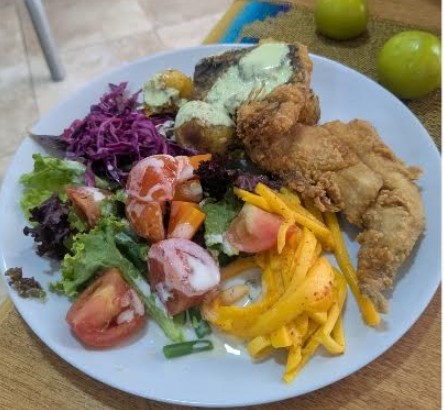
$3.50 almuerzo plate of corvina with reina de Claudia for dessert
That was how I learned they served an almuerzo that remains one of my favorite meals anywhere. I bought the cheese and then I stayed for lunch. I went once a week for months, sometimes twice. The food was not complicated, but it was simple and well done. One of their lunch menu items was one of my favorite meals anywhere – -not just in Cuenca, but anywhere in the world.
But I long suspected that they had some weaknesses in the marketing department. For example, sometimes they had delicious specials available that you would not know about unless you actually interrogated them as to whether they had any secret specials today.
The restaurant was good, but it never quite caught on with the target expat/tourist menu demographic. The blackboard got lost among the other signs on the street and few people ever stepped inside, which was a pity. Now it is gone, or has changed the menu, which seems unfair but also predictable. Cuenca can be hard on the places that are worth discovering, but remain undiscovered.
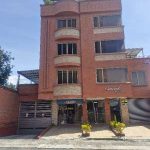
And then I discovered a new lunch place that was even better. Five minutes on foot from the cathedral, there is a restaurant that advertises itself only by half inch lettering on a small sign in a doorway. It is not visible from the street and is up a staircase with no directional sign, and like many of the best and most exclusive restaurants, it offers no menu and no price list If you have to ask the price, it is probably not for you, which may explain why my lunch companion, a Cuencana by birth who works barely a hundred meters away, had never been inside or even heard of it. The soup was real soup and the main plate of corvina and salad and spuds was laid out as if someone expected it to be photographed for a Southern Living spread. Anyway, not wanting to appear to be uncool, we ate first, wiped our mouths, and then asked the price, and it came to $7 for two people.
This week I was reminded of that restaurant when I learned something surprising. After four years of searching for an accessible, warm but not hot swimming pool in Cuenca, it turns out I have been living within walking distance of a very good one all this time. It is outdoors and it is heated and it is super clean. It has a sauna and hot showers and more gym equipment than I will ever use. The membership is forty dollars for a month’s trial and thirty bucks if you then prepay for 90 days all at once.
None of this information appears on any website. The gym does have a name but very little public information. There are a few photos on Instagram, although the posts seem designed more to decorate the internet than inform the public. Prices are not mentioned and schedules are not posted. It has just been hiding in plain sight for years.
I should add that my search for a decent lap swimming pool has not been a straight line. The University of Cuenca pool ($3 for gringo seniors) is too cold and too crowded for anyone who does not enjoy hypothermia and playing dodgems. The stadium pool used to be pleasantly warm, but it is now in long term renovation because of the small problem of the roof falling in, and getting out of it always required the combined skill set of a naked rock climber and trapeze artist.
I have tried hot pools in Baños, which are genuinely pleasant, although I ended up with an amoeba infection after one visit. You are not supposed to put your face in the water, and they are too hot for swimming laps anyway. I also tried a hotel pool in the centro which cost five dollars per swim. It was acceptable but simply too small and too shallow to take seriously as it was difficult to reverse direction without scraping your nose on the bottom.
At the front of the same building as my new pool there is a pleasant café with a large plate glass window, tiled floor, and a few polished tables. I had always assumed it was designed for hotel guests only, but not so! It turns out they serve an almuerzo ejecutivo for eight fifty, or ten dollars if you take coffee and dessert. The fish stew I saw there yesterday looked like something that should have been photographed for an airline magazine feature on New Orleans. I had walked past that café a few dozen times without ever knowing it served almuerzos, but that is how it is in Cuenca. (OK, a bit pricey, but you can be ravenous after swimming fifty laps.)
These local discoveries made me think even further back to an antiques dealer I once knew in North Carolina back in the days before the internet existed, when news traveled by phone, mail, and gossip.
He used to travel to England a couple of times a year to buy furniture. He would rent a truck, hire a driver, and spend a couple of weeks touring mostly rural barns and warehouses that sold used furniture and as he went he filled up a forty-foot container with mahogany sideboards, French-polished wardrobes, solid oak art deco dining tables. and decorative Victorian oil lamps with glass mantles that could be switched to run on electricity.
On one such trip he bought thousands of dollars worth of antique and semi-antique furniture from a rural barn showroom down a muddy single-track road in the south of England far from any highway. The owner was delighted, overjoyed, and said, with great sincerity–once the credit card payment had cleared — that he was so glad that my friend from Chapel Hill, North Carolina had finally discovered their remote warehouse in Hampshire, England. My friend looked at him and asked a simple question. He said: “Did it never occur to you to perhaps drop us a postcard to tell us about your business?”
That question has followed me for years, because it explains so many losses and so many near misses. It explains the vanished restaurant. It explains the gym that hides its prices and its very existence. It explains the café that seems too modest to tell the world what it serves. It explains why you can be in Cuenca for years and still miss half the best stuff.
Cuenca trusts word of mouth and always has. The city behaves as if people still walk around, look inside, and talk to each other like in the dimly-recalled prehistoric era when the internet did not exist and in many ways, this is part of the whole charm of the place. The problem is that word of mouth now competes with phones, algorithms, and the idea that a business does not exist if its opening hours are not displayed in Google.
I have joined the gym and I plan to try the pricey almuerzo at the café next. I know they will not promote themselves. That is not the Cuenca way and they do not see the need. They are waiting for people to discover them like Columbus or Cortez or the exploratory North Carolina antiques dealer. It feels impractical, but it also feels strangely human.
The best places in Cuenca often don’t announce themselves, but they open daily and hope you will discover them. Sometimes they survive long enough to make it, or not, as the case may be. Either way the responsibility falls on us all to keep walking around like explorers and looking for signs, even when the signs are small, handwritten in chalk, and easy to trip over if you are not paying attention.