














Former army intelligence chief questions Noboa’s claim of 2,000 hectares of coca crops
Ecuador’s former director of Army Intelligence Mario Pazmiño says President Daniel Noboa’s claim that there are 2,000 hectares of coca production near the Colombian border was “hasty and lacked solid evidence.” In a Tuesday video, Noboa said the armed forces were in the process of destroying the coca crops.
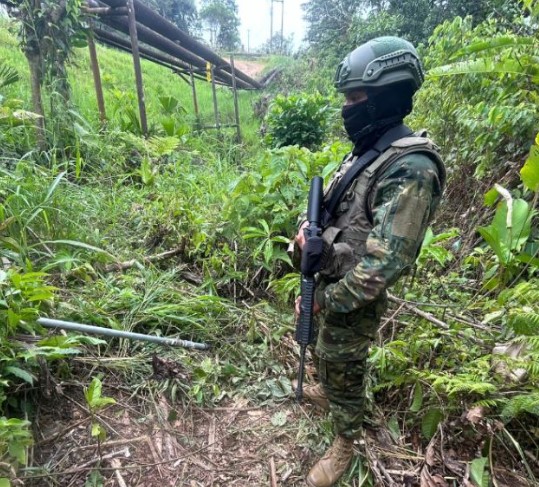
An Ecuadorian soldier oversees the destruction of a small plot of coca plants in northern Esmeraldas Province.
“Yes, it is true there is some small-scale growing in the region, but I am doubtful it amounts to more than a few hundred hectares,” Pazmiño said in an interview with Ecuador Envivo. “The area is well-monitored by the armed forces and there is no information to suggest a rapid increase in crop land.”
Pazmiño also questioned Noboa’s contention that the 2,000-hectare claim was based on a “new” data. “This has been going on for years and the military has been destroying small coca plots for years. This is nothing new.”
Pazmiño also cited a statement from the U.S State Department saying its estimate of coca crop land was preliminary and required further study. “The data that the president mentioned was based on satellite photos, which are difficult to verify. The U.S. drug and law enforcement office said this when they handed the information over to the government.”
Ecuador is a “very small player” in coca growing and cocaine production, Pazmiño says. “Our main role in the drug trade is as a center of collection and international distribution and this is where our efforts should be focused,” Pazmiño said. “Today, there is over-production of coca in Colombia and Peru so there is little need to expand crop land.”
He added that Colombia has about 240,000 hectares in coca production while Peru has 120,000. “This is more than enough to satisfy the world demand.”
When asked by the interviewer if Noboa was “playing politics” with his coca plantations announcement, Pazmiño said the battle against drug trafficking is a “cornerstone” of the government’s appeal to the public. “This fight is obviously popular with Ecuadorians because of the violence it produces, but we must be careful to present credible information,” he said. “If the public begins to doubt the authenticity of government statements, it will doubt the claims that progress is being made.”



Hogar Esperanza News

Fabianos Pizzeria News

The Cuenca Dispatch

Week of September 20
Ecuador turns to industrial power cuts to protect Mazar and keep homes from going dark.

Ecuador raises its 2026 growth forecast, but El Niño could spoil the outlook next year.

Cuenca retirees challenge medical and therapy changes at IESS senior center.
Fund Grace News
