











Corpus Christi festivities begin in Cuenca but what about the indigenous Inti Raymi tradition it replaced?
By Liam Higgins
Corpus Christi begins today in Cuenca and continues until Friday, June 19.

For most Cuencanos and expats, Corpus Christi means fireworks and candy sales in Parque Calderon.
For most Cuencanos and expats, the celebration, or Setenario, as it is sometimes called, means candy sales in Parque Calderon, nightly fireworks, an assortment of craft and food fairs, and dozens of concerts. For the Catholic faithful it is also a celebration of the eucharist, or the symbolic transubstantiation of wine and bread into the body of Christ.
Events begin with the ceremonial procession from Parque San Sebastián to the cathedral. In an “advisory”, the Cuenca Archdiocese advised believers that it is fine to indulge in sweets and enjoy the fireworks, but “don’t forget to take communion every day of this holy week.”
What is often forgotten in Ecuador and throughout the Andean region of South America is the substitution by the Spanish conquistadors of Corpus Christi for the indigenous celebration of Inti Raymi, the festival of the sun. The Spanish priests determined that Inti Raymi was a pagan ritual and insisted, often under the threat of death, that the indigenous population replace it with the Catholic Corpus Christi.
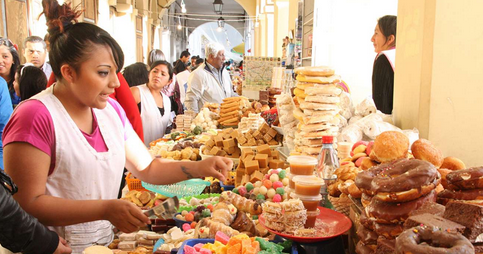
Corpus Christi preparations are being made.
Although Inti Raymi is still widely celebrated in the Andes, it has lost much of its religious significance. “The ceremony continues, especially for older people, but it is largely a spectacle known for its colorful costumes and masks,” says Pablo Ramos, an Inti Raymi scholar in Cuenca. “It is still important for understanding our indigenous roots and I encourage everyone to learn about its history.”
Inti Raymi, which means “sun festival” in the Quechua language, was the Inca celebration of the solstice. For many of the indigenous, it remains the most important event of the Andean culture in the countries that formed the Incan empire, namely Colombia, Ecuador, Peru and Bolivia.
Although Inti Raymi is officially June 24, the festivities begin weeks in advance and continue until the end of the month.
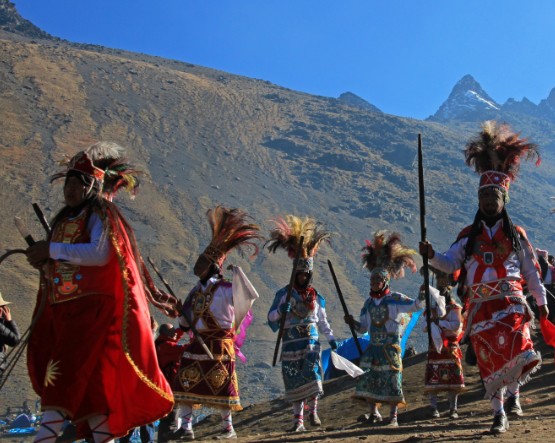
The largest Inti Raymi celebrations are held in Peru, like this one near Cusco.
Inti Raymi celebrates the fertility of the Pachamama (Mother Earth) and gives thanks for the harvests. The festival also has a fundamental purpose that is not well known outside the Andean cultures, where it is seen as a celebration of the approach of light to Earth and, with it, the approach of the spiritual world. It is believed that it is possible to share space and time with ayakuna (spirits) through various activities, such as dancing, eating certain food, and wearing specific clothing. It is also seen as the best time to focus on magnifying or developing the presence of one’s personal spirit (aya), with the goal of entering the spiritual plane.
The spiritual plane is personified in the character of the Aya Huma, who plays a key role in the Inti Raymi celebrations. The Aya Huma wears a mask with two faces; one on the front and one on the back of the head. Many visitors are familiar with it from the knitted versions that are commonly sold as tourist souvenirs. When the Spaniards first arrived, they considered it a devil mask, but in fact the Aya Huma is a mythological Andean figure with a complex symbology that is often misunderstood to this day. Its name roughly translates as “energy head” and the two faces represent 360-degree vision, or wisdom. The role of the Aya Huma is to harmonize, heal, teach, and share.

Events are also scheduled for the Inca ruins at Ingapirca, north of Cuenca.
Not surprisingly, the Spanish conquistadores considered Inti Raymi an unacceptably heathen festival and attempted to merge it with the Christian celebrations of Corpus Christi and the homage to Saint John the Baptist.
In Ecuador, Inti Raymi is celebrated in the Sierra by indigenous people of Kichwa nationality. Making up the Kichwas are a number of different groups, each with its own customs. The Kichwas of Otavalo, for example, are famous for their weaving skills. Traditional dress varies between groups, but often features woolen shawls and ponchos, embroidered shirts and skirts, felt hats and beaded necklaces. Hair is usually long and braided. Many Andean Kichwas are small scale farmers (campesinos), growing crops such as corn, potatoes and beans or keeping cattle for milk. Others make a living with traditional handicrafts such as weaving, embroidery and jewelry making. Every group has its own specific dates and traditions for Inti Raymi, but the festivities generally take place in the days following June 21.
Many communities kick off the celebrations on June 22 with a cleansing ritual known as Armay Chishi, gathering to bathe in sacred lakes, rivers and waterfalls to eliminate negative energies accumulated during the previous year. Visitors are welcome to bathe and will certainly find it invigorating to be immersed in cold water on a chilly Andean morning.

Celebrations will be held throughout the Andean region.
For a less extreme way to participate, join the music and dancing that takes place in indigenous towns and villages across the Sierra. Every evening for the duration of the festivities, troupes of musicians roam the streets playing traditional instruments such as the Andean flute. Throwing in vocal exclamations such as “churay! churay!” and “kulun! kulun!”, the musicians inspire those around them into a dancing frenzy. The troupes, known as san juanitos, enter the homes of local residents, who form a circle of dancers around them. The revelry is intended to wake up the Pachamama, so that she will bestow her blessings upon the people.
During Inti Raymi and other Andean celebrations, meals are often eaten communally from a long strip of fabric on the ground in a tradition known as pampamesa. Food commonly eaten in this way includes the Sierran staples of corn, potatoes and pork.
To understand the significance of some of Ecuador’s best Inti Raymi destinations, it is helpful to know some Incan history.
The Incas, or “Children of the Sun”, are thought to have descended from two great empires that both ended around 1100 AD: Tiwanaku, based around Lake Titicaca between Peru and Bolivia; and the Wari, who occupied the Cuzco area in Peru. The Incas made Cuzco their capital and began to conquer neighboring territories in around 1250 AD. By the 14th and 15th centuries they had built an empire that stretched from what is now northern Chile to the southern edge of present-day Ecuador.
In 1463 the Inca leader, Túpac Yupanqui, began the push into Ecuador from Peru. In the Sierra, the Inca armies met fierce resistance, notably from the Cañaris, centered in today’s Azuay and Cañar Provinces, and Quitu-Caras. It wasn’t until Yupanqui’s son, Huayna Capac, continued his father’s campaign that the Incan Empire finally conquered these territories.
Inca emperor Huayna Capac chose to build the Empire’s northern capital where Cuenca is today, which is believed to be his birthplace. Modeled on Cuzco, the city was called Tumebamba and its temple ruins are visible today at the Pumapungo museum grounds. North of the city, the invaders had enough respect for the vanquished Cañari to add monuments to Ingapirca, a complex with ceremonial, astronomical, political and administrative functions. It is thought that the Inca Temple of the Sun, which was built to complement the pre-existing Cañari Temple of the Moon, was used as a site for rituals and for determining the agricultural and religious calendars, including the date of Inti Raymi.
Both Tumebamba and Ingapirca are thought to have been largely destroyed shortly before the Spanish conquest, in a war between Huayna Capac’s sons, Atahualpa and Huáscar. in 1532. The arrival of the Spanish conquistadors in 1532 coincided with the Inca empire’s weakest moment as the brothers battled each other for control. The Spanish put an end to the 60-year Inca reign in Ecuador.
Though only ruins remain of the rest of the complex, the Sun Temple still stands today at Ingapirca, which is one of the best places in the country to join in the Inti Raymi celebrations. More than a hundred indigenous groups from Ecuador and other Andean countries gather for traditional dancing, music, gastronomy and crafts fairs.