














Energy experts agree: Noboa is ‘MIA’ on the energy crisis and it could cost him the election
By Liam Higgins
Although energy experts don’t blame President Daniel Noboa for Ecuador’s electricity crisis, all agree he has done a poor job managing it. “From the beginning his approach has been one of neglect that has been made worse by terrible communication to the public,” said Fernando Salinas, past president of the Pichincha College of Electrical Engineers. “He has basically been a president missing in action on this issue.”
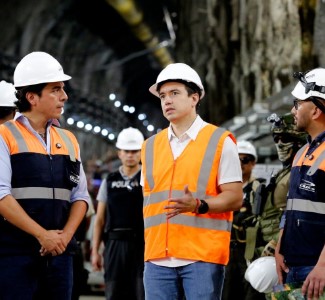
Energy experts say President Daniel Noboa’s response to the energy crisis has been a disaster.
“No, he cannot control the weather and he is not responsible for the worst drought in the country’s history,” Salinas said. “He can also rightfully claim that previous governments allowed the electric generation infrastructure to deteriorate and did not invest in new projects. But, on the other hand, there were steps he could have taken to reduce the impact blackouts have had. He knew we faced a crisis when he became president a year ago because of blackouts during [Guillermo] Lasso’s last year, and he did not make energy a priority. Even after the April blackouts, he did little to prepare for blackouts we are going through today.”
Instead of speaking directly and honestly to the people, Salinas says, Noboa has maintained a “revolving door of energy ministers” who present an unrealistically rosy picture of the crisis, telling “half-truths and outright lies.” His few short comments about the crisis, according to Salinas, are delivered on youth-oriented social media platforms, usually late at night. “Instead of posting videos on Instagram and TikTok, he should address the country live on all the media and give a truthful appraisal of what is happening and what the country can expect in the coming months. He needs to look us in the eye, face to face, and tell us the truth, and this has not happened.”
Alejandro Montalvo, who teaches energy applications engineering at the University of Guayaquil, says his biggest concern is the “disjunction” between reality and government statements. “We have had three energy ministers since the blackouts earlier this year, none of them trained in energy management, spinning fantastic tales about the good times right around the corner,” he says. “We hear about power plants being repaired and coming online, about power barges arriving from Turkey and then we are told no, the barges are not coming, and we are flying in mobile power units instead — and we don’t even know what these units are. We are told there will be 500 additional megawatts coming online and blackout will be over by Christmas. How is the possible when we have an energy deficit of almost 2,000 megawatts?”
Montalvo, Salinas and others say they were “stunned” by Noboa’s video announcement last week that blackout hours would be reduced over the next three weeks. “How can this happen when the power plants at Mazar and Rio Coca are reducing production?” asks Montalvo. “Is the president living in a fantasy land? It is true he is shifting the burden to industries and mining companies, but this is not enough to justify reduced blackout hours for households.”
Montalvo adds: “What is obvious is that the government is playing politics, looking ahead to the election, but it doesn’t seem like very smart politics to me.”
Gustavo Isch, a political consultant trained as an electrical engineer, agrees and says political motivation is now the driving force behind the government’s crisis management. “I believe the decision to impose long power suspensions on mining interests, industry and port operators, and to reduce suspension times for residential customers is a political calculation,” he says. “He is appealing to the broader public for votes at the expense of commercial operations.”
Isch, who was part of the Lenin Moreno government, says Noboa’s strategy could fail dramatically. “He is betting on rain to fill the reservoir and rivers. If the rains don’t come, however, and longer blackouts are reimposed on the public, he loses the bet and probably the election.”



Hogar Esperanza News

Fabianos Pizzeria News

Fund Grace News

The Cuenca Dispatch

Week of September 20
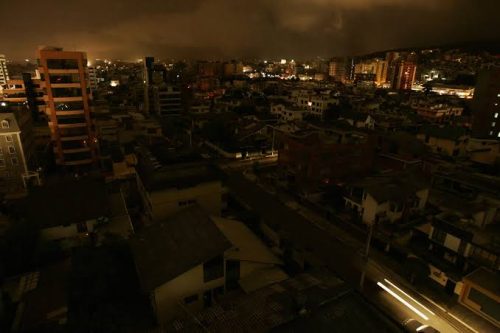
Ecuador turns to industrial power cuts to protect Mazar and keep homes from going dark.

Ecuador raises its 2026 growth forecast, but El Niño could spoil the outlook next year.
Cuenca retirees challenge medical and therapy changes at IESS senior center.