













‘Fito’ will be extradited to the U.S. because Ecuador does not trust the security of its prisons
Ecuador Interior Minister John Reimberg admits that the government’s plan to extradite Adolfo Macías, alias ‘Fito’, to the United States is based on the “unreliability” of security in the country’s prisons. This will change, he says, when construction of two maximum security prisons in Santa Elena Province is completed. “At the present time, we do not have a maximum-security facility where we feel comfortable incarcerating him for the duration of his sentence.”
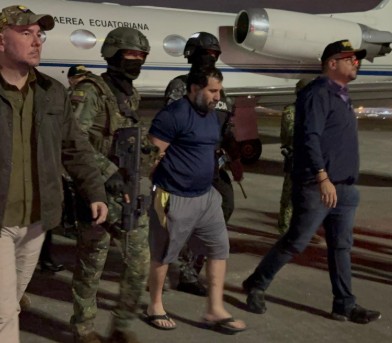
Adolfo Macías, alias ‘Fito’, arriving in Guayaquil Wednesday night following his capture in Manta.
Asked by an Ecuavisa interviewer if the extradition was “an embarrassment” to Ecuador, Reimberg conceded that it is a “regrettable but necessary” action given the condition of the country’s penal system. “Yes, we would prefer to keep him at home, given that most of his crimes were committed here, but our objective is to protect the citizens of Ecuador and we feel the best way to do this is to send the prisoner to the United States,” he said.
He added: “Macías is charged with very serious crimes in the U.S. and he will serve a lengthy prison sentence there in a very secure facility,” Reimberg said. “Justice will be served in both countries.”
In several interviews since Macías’ capture last week in Manta, Reimberg provided more details about the police and military operation that located Ecuador’s number one fugitive. The biggest break in the case, he said, came from the interrogations of Macías’ relatives following their arrests on money laundering charges in earl June. “This led us to the property in Manabí owned by his associate,” Reimberg said.
Police conducted three searches of the property before the capture but did not discover the concealed trap door leading to an underground bunker, Reimberg said. “During the third search, we used sonar equipment and discovered a cavern beneath the house that extended into the adjacent yard, and we knew this was where Fito was hiding.”
On Wednesday, police brought excavation equipment to the property. “Once we began digging, he [Macías] surrendered fearing that the bunker would collapse on top of him,” Reimberg said.
He added: “We knew he was there when his four-year-old daughter told her nannie, ‘Go tell daddy they are here’.”
Reimberg dismissed a report by a Colombian website that Macías’ surrender had been pre-arranged. Noticias Uno claimed that Macías had contacted Reimberg, providing the location of his hideout and agreed to be taken into custody.
“This is a fantasy probably concocted by artificial intelligence,” Reimberg said. “It is total nonsense. Fito’s capture was the result of the hard work of our intelligence officers and police and military personnel who went to the scene. There was no discussion with the fugitive prior to his capature.”