
















From the Trail of Tears to the ICE age
There are certain subjects that one learns to handle the way one handles antique porcelain in a showroom: with care, and with the full awareness that dropping it may lead to an unbudgeted purchase. Immigration, often just called migration, as if people were birds, is one of those subjects. Raise it casually and observe how otherwise genial people begin speaking in the tones normally reserved for religious doctrine, property disputes, and family inheritances.
Watching the American debate from Ecuador provides a perspective that is not necessarily superior but undeniably different. Distance, both geographic and psychological, has a way of softening slogans and revealing the longer historical currents beneath what often presents itself as an argument about paperwork, fences, and administrative compliance. Here in the Andes, history feels less like a chapter and more like weather.
 The United States, that modern champion of border enforcement and visa precision, began life in a fashion that would strike contemporary immigration officials as pure chaos. For a time the Atlantic colonies functioned at least in part as a destination for Britain’s transported convicts, a penal colony of the mother country that was somewhat forgotten until the inconvenience of the American Revolution forced London to expel its unwanted residents southwards toward Australia instead.
Alongside this less romanticised stream of involuntary migration existed another foundational reality that still affects American politics very profoundly. The American colonies were not merely settlements of hopeful apple-cheeked Europeans seeking fresh pastures in the New World, but also slave societies built upon the forced labour of millions of Africans and their descendants. The economic architecture of the young nation was deeply entangled with an institution whose moral and human costs remain almost impossible to exaggerate.
Nor was displacement confined to those forcibly transported across the Atlantic Ocean. As the republic expanded, Native American nations faced a succession of removals, treaties, and wars driven by forces that were rarely mysterious. Land was desired, expansion was relentless, and those already occupying the territory often found themselves negotiating under conditions where refusal existed more in theory than in practice. The Trail of Tears, attached most famously to the forced relocation of the Cherokee and other tribes to what is now Oklahoma, stands as one of the more haunting expressions of that era’s genocidal policies.
Florida, among other regions, witnessed its own violent chapters, including wars fought against the indigenous Seminole people, conflicts reflecting the same uncompromising logic regarding the title to real estate. The Seminoles are commemorated today mainly by the use of their name by the sports teams of Florida State University in Tallahassee and the joke that the same university has its own version of Gatorade which is called Seminole fluid.
These events were not marginal chapters of American history but formed the mainstream narrative of the growth, settlement, and territorial transformation of the young nation.
Chronically unresolved contradictions eventually produced the Civil War, a conflict of extraordinary bitterness whose casualty figures still stagger the imagination, followed by an aftermath that settled certain legal questions while leaving vast psychological, cultural, and political residues. The legacy of slavery, segregation, and regional identity did not politely retire upon the war’s conclusion but instead seeped into institutions, voting patterns, and narratives that remain detectable even now.
When Charlie Larga was young, the Civil War still lingered at the edges of living memory. Musician Eubie Blake, who died in 1983, well into the era of color TV, was born to parents who had been slaves, and my own great-grandmother, whom I vaguely remember from my childhood, was born during the final year of the Civil War, a reminder that history, however neatly packaged in textbooks, is often far closer than it appears.
Against this historical backdrop, modern immigration debates acquire an additional layer of complexity. A nation shaped by transported convicts, enslaved populations, displaced Indigenous peoples, and successive waves of newcomers from Ireland, Scotland, and England, and then continental Europe eventually arrived at a far more rule-structured conception of entry and belonging. That shift was not accidental, nor was it purely philosophical.
In 1996, during the presidency of Bill Clinton, the United States enacted the Illegal Immigration Reform and Immigrant Responsibility Act, legislation passed in a political climate defined by bipartisan competition to appear firm on borders, legality, and enforcement. Republicans controlled Congress at the time, but Democrats held the White House, and the resulting law reflected a convergence rather than a clash: expanded grounds for removal, the formalisation of unlawful presence, and the introduction of three- and ten-year re-entry bars for people who had ever been deported.
The stated purpose of the act was straightforward and seemed innocent enough. Deter illegal immigration and strengthen enforcement. Restore confidence that immigration laws possessed both meaning and consequence. Whether legislation can fully achieve such ambitions, however, remains open to debate.
What is striking, in retrospect, is how relatively ignored legislation of such consequence can pass through the public consciousness. In 1996 many Americans, including my immigrant self were busy going to work, paying bills, doing laundry, ironing shirts, and mowing grass largely unaware that immigration law had undergone a structural transformation whose effects would echo for decades.
Even those dimly aware of that Act could be forgiven for not grasping its long-term significance, since statutes rarely announce themselves with the drama of the consequences they eventually produce. Very likely, many people today remain unfamiliar with how the legislation came about unless they were keen students of immigration policy at the time.
The same observation might reasonably be extended to the United Nations Refugee Convention of 1951, a document of immense humanitarian importance that remains, outside legal and diplomatic circles, curiously absent from everyday conversation. Nations sign treaties, legislatures pass reforms, and citizens continue about their business, only later discovering that the rules governing belonging, protection, and exclusion have shifted beneath their feet.
Enforcement mechanisms were undeniably tightened, removal procedures accelerated, and penalties sharpened, yet visa overstays continued, undocumented populations did not vanish, and the political temperature surrounding immigration rose rather than cooled. Critics argue that certain provisions produced unintended effects, while supporters maintain that the law established necessary deterrents and clearer legal boundaries.
Seen from Ecuador, where identity tends to present itself as layered rather than binary, these tensions are easier to observe than to judge. Indigenous heritage, European inheritance, mestizo blending, and global modernity coexist here in combinations that defy tidy classification. Belonging is lived before it is theorized.
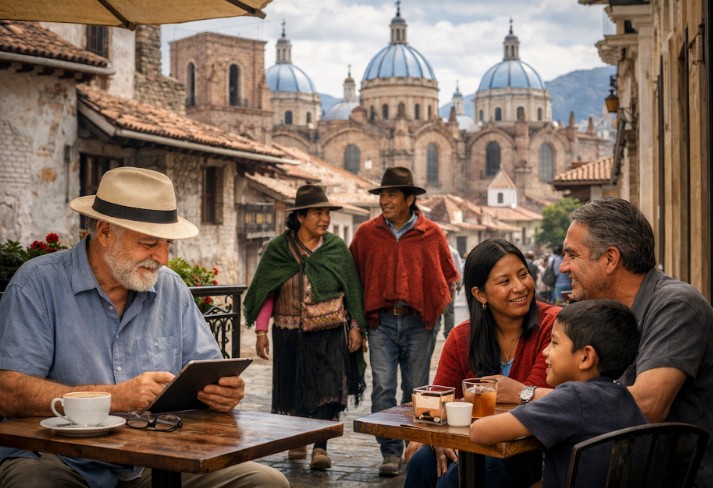
Seen from Cuenca, migration reveals a symmetry rarely acknowledged in more heated debates. The city has developed its own population of North American arrivals, individuals who have voluntarily exchanged one national framework for another. Some integrate enthusiastically, wrestle with Spanish subjunctives, marry into Ecuadorian families, and gradually discover that belonging is something earned through participation rather than mere residence. Others construct small cultural islands, importing habits, media, and expectations from home, engaging courteously with local life while keeping it at a measurable distance. Both approaches are understandable. Both are human.
Charlie Larga, who has lived long enough in multiple countries to distrust confident generalisations about any national character, hesitates to describe Americans as uniquely intolerant. The United States is still one of the world’s largest immigrant destinations and contains within it extraordinary generosity alongside undeniable anxiety, hospitality alongside suspicion, pragmatism alongside legal rigidity. Contradiction, after all, is a fairly universal human condition.
What immigration debates ultimately reveal is the friction between two enduring realities. Nations require membership rules in order to function properly, and human beings possess an equally enduring tendency to move, adapt, seek opportunity, and occasionally disregard regulations when circumstance encourages flexibility. Between these forces stretches a permanent zone of negotiation in which law, economics, history, and human aspiration collide without any realistic prospect of final resolution.
In the modern world, the paperwork does matter. Borders, artificial as they may be, do matter. History also matters, because it explains how we arrived at the place where we now find ourselves.



Hogar Esperanza News

Fabianos Pizzeria News

Fund Grace News

The Cuenca Dispatch

Week of September 20
Ecuador turns to industrial power cuts to protect Mazar and keep homes from going dark.

Ecuador raises its 2026 growth forecast, but El Niño could spoil the outlook next year.

Cuenca retirees challenge medical and therapy changes at IESS senior center.