














‘He wields a hammer in a glass house’; Why Noboa’s war on crime isn’t working
By Luis Córdova-Alarcón
Ecuador is at war. This was decided by the government of Daniel Noboa on January 9, 2024. On that day, after a wave of criminal violence in several provinces, the President issued Executive Decree 111, recognizing the existence of an internal armed conflict and identifying 22 criminal groups as terrorist organizations. 
The justification for the measure was to contain the criminal activity that made 2023 the most violent year in the country’s history: 8,008 murders and a rate of 47 homicides per 100,000 inhabitants. More than a year has passed and the outlook is discouraging. The first quarter of 2025 reached another murder record: 2,361 violent deaths. If this trend continues, this year we could exceed the homicide rate of 2023. The policy of the militarization of law enforcement has not contained violence, and it may have actually increased it.
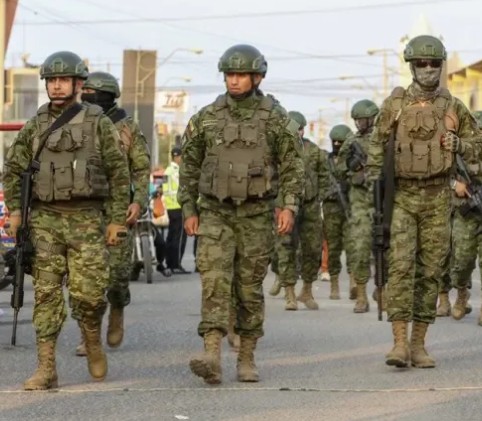
Soldiers march through the streets of Muey in Santa Elena Province in March.
So why, then, is violence and criminality worsening, especially in Ecuador’s coastal provinces?
Noboa’s decree and the subsequent emergency declarations is based on three premises: the government has lost territorial control to criminal organizations; it has failed to control illicit economies by facilitating money laundering, and; it needs more and better human and technological resources to retake control from criminal groups.
The problem with this approach is that it considers criminality in isolation and does not look at the larger social context of what is happening in the country.
For this reason, instead of focusing on the formal dimensions of the government (representation, institutional articulation and capacity for intervention), I will offer a brief analysis based on the bigger picture: the social condition of the country and the government’s hegemonic response to the issue of crime. What I suggest is that the multiplying factors of violence and criminality are much deeper and more complex.
The first factor is the government’s failure to meet its social commitments. A case in point, is the neglect of the education system that has led to an alarming increase in the number of public school dropouts. Since 2023, more than 450,000 children and adolescents, between the ages of three and 17, have dropped out of school. The highest percentage of dropouts, not surprisingly, is in the coastal region where the rates of violence are the highest. According to one survey, the average age of these recruited by criminal gangs is 13.
While the government purchases more guns and ammunition for its “war on terrorists”, on the coast and in the Galapagos, where a new school year is just beginning, 80 percent of public schools, or 7,520 institutions, are in urgent need of major repairs. Add to this the poor economy and the rising poverty rates, and you understand the lure of gangs for school-age children.
It is easy to understand that increase of criminality is not a spontaneous phenomenon. It is, in fact, a result of the systematic neglect of social institutions by the government.
The neglect is not merely a material issue; the symbolic dimension has a specific weight. Without mechanisms for social advancement or policies of inclusion and recognition, the future expectations of young people stagnate, and they move abroad or seeks opportunities outside the law. The government is today paying the price for neglected and postponed investment in social institutions.
Looking at it from this standpoint shows the government has not lost territorial control, it has lost the social base, especially in the poorest areas of the country. Militarization then, has a limited effect in the short term and is counterproductive in the long term.
Without a government that takes seriously its social commitments, criminal organizations will continue to gain recruits and reconfigure the country into a criminal state.
The second multiplying factor of violence and criminality has to do with a crisis of legitimacy of the government. In the absence of a commitment to the broader social project, the government loses the capacity to make changes to the status quo.
In response to rising crime rates, the governments of Lenin Moreno, Guillermo Lasso and Daniel Noboa have opted for a “minimal state” model, shrinking the state apparatus in social projects, and deregulating markets. The draconian agreements with the International Monetary Fund, and the policy of rewards and punishments, which the United States government has imposed to align Ecuador with its hemispheric agenda, have accelerated this reconfiguration.
In this model of the “minimal state,” the military and police forces become the main bureaucratic arm of the state. The constant declaration of States of Emergency (more than 40, since 2018) to restrict civil rights and militarize public order confirms this.
Instead of promoting a program to increase decent employment for all Ecuadorians, the governments of Lasso and Noboa have promoted the recruitment of thousands of young people to train as police or military personnel. In May 2022, Lasso promised to increase the strength of the National Police, from 52,000 to 82,000 troops. Although his mandate was cut short, 12,000 police officers were added. With Daniel Noboa and the declaration of internal armed conflict, the military has continued to grow, displacing the police in many aspects of law enforcement.
In February 2024, the government announced it would quadruple military service, from 9,657 to 36,853 conscripts in 2025.
Militarization is intrinsic to the minimal state project. The military strategy has replaced the old model of law enforcement backed by an independent and even-handed judicial system. Therefore, when the government detects persistent crime problems in the public sector, its only response is to send in the army.
A prominent example is this militarization can be seen at the Teodoro Maldonado Carbo Hospital in Guayaquil, and the Carlos Andrade Marín Hospital in Quito. Faced with the constant threats, murders and kidnappings of hospital officials who obstruct the negotiations in the public purchases of both hospitals, the government’s response was to intervene militarily.
Daniel Noboa only wields hammers, even inside a glass house.
Finally, the third multiplying factor of violence and criminality has to do with the hegemonic vision of the power bloc that runs the country. The reason is simple: blind faith in the deregulation of markets as a means of economic growth has made Ecuador a paradise for illicit economies. The expansion of drug trafficking, illegal mining, smuggling, arms and human trafficking, are facilitated by the vision of the minimal state that the rulers support.
In Ecuador, an oligarchic regime has been consolidated. As the political scientist Jeffrey A. Winters explains, oligarchy refers to the policy of defending wealth by actors who possess the material means to do so. Oligarchs usually fund armies of lawyers and politicians to do the dirty work and protect their interests. But when the crisis of legitimacy of the state also undermines the supposed role of legality, the oligarchs intervene directly in politics to defend their wealth.
The entry into politics of Guillermo Lasso and Daniel Noboa is no coincidence. The former is owner of the third largest bank in the country and head of one of the five wealthiest economic groups. The second is heir to the biggest agro-export group in Ecuador. They are the visible faces of a seasoned and aggressive oligarchy.
The deregulation of the markets is the cornerstone of his government’s action and the oligarchs who direct drug trafficking from Europe, Asia or North America share this vision and profit by it.
With their government decisions, Lasso and Noboa have facilitated the expansion of arms trafficking in Ecuador. The first by making permits for the possession and carrying of firearms more flexible. The other by eliminating tariffs for imports. Today, 8 out of 10 homicides are carried out with firearms. And the preferred route for smugglers is to send them by courier from Miami.
It is no wonder, then, why Ecuador is a country awash in blood.
________________
Luis Córdova-Alarcón is Coordinator of the Research, Order, Conflict and Violence program at the Central University of Ecuador.
Credit: Plan V