












Loving Linda in the summer of 1969
In the summer of ‘69 my younger brother Francis and I arrived in Tucson after a cross-country trip from Philadelphia. In the annals of American history, that summer characterized youthful experimentation with alternative lifestyles. “Peace!” greeted friends and strangers alike, accompanied by two fingers representing the letter “V.” Marijuana appeared at most of our gatherings out of sight of “The Man.” Our economical tour in a sporty white Dodge Charger assigned us by Auto Driveaway had connected us to kindred spirits who shared with us their homes and youthful optimism.
That evening we searched University of Arizona fraternity houses for a place to stay. Bob from Buffalo greeted us at one. Of average height with a slight build his medium length brown hair covered his glasses. Upon learning how Francis served in the Army as a troop-carrier driver in Vietnam, Bob had an idea. “My buddy Dennis lives off campus in a trailer. He’s a Vietnam vet, too. Let’s see if he’ll let you crash.”

Family and friend attend Jeremiah’s University of Maryland Graduation, June 1969. Front-John Reardon, father. Jeremiah. Genevieve Reardon, mother. Middle-Carol Merritt, friend. Lillian Reardon, aunt. Francis Reardon, brother. Back-Rex Reardon, uncle. Alima Dolores Reardon, sister.
We parked on a gravel lot next to a black BMW motorcycle fitted with leather paniers. Our rap on a metal door fitted with a small window echoed inside Dennis St. Germaine’s trailer. Opening the door, the Army vet and journalism major stood a couple of inches shorter than my 6’1’ height. Heavy set and with a full beard, his folksy personality soon put us at ease. My stay with him would extend throughout the coming school year.
Francis had plans to look up friends in Los Angeles. Once settled into a room at a University of California fraternity house, he found a clerical job at the LA airport and commuted by bicycle.
Dennis had a morning route distributing Arizona Daily Star newspapers bundled for neighborhood delivery routes. He also sold advertising for an underground newspaper, the Druid Free Press, popular reading for the city’s counterculture. That summer Dennis and I signed up for a Free University course, “The Medium Is the Message,” taught by his journalism professor. Based on Marshall McLuhan’s 1964 book, “Understanding Media: The Extensions of Man,” we studied how technology shaped society’s values, norms and ways of doing things.
In class, I noticed Linda Abrams. She stood out with her engaging smile and humorous remarks. Her brown eyes shone with curiosity in her freckled-skin face. The Mexican embroidered blouses and loose-fitting Indian print dresses she favored, showed off her tanned skin. She tied her long curly hair into a ponytail. The youngest in our class, nineteen-year-old Linda held her ground when challenged.
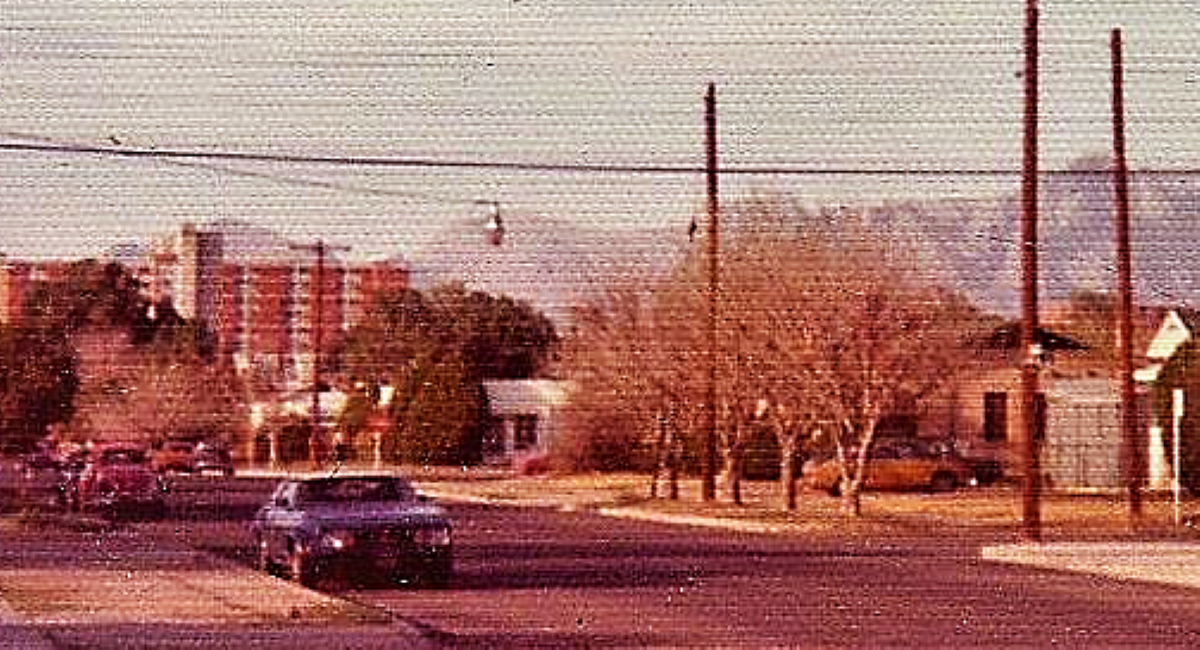
University of Arizon and Tucson’s Catalina Mountians, 1973.
“I’d like to ask Linda for a date,” I confided to Dennis after class a few weeks later.
“Yeah, Jerry? Maybe she’ll say yes. Won’t hurt to ask. She is pretty,” he agreed as we walked across campus under a star-filled sky which twinkled above our city of 250,000 population.
On Fridays, students put on an open mic night at the Student Union. Some sang folk songs accompanied by guitar and others recited poetry. I invited Linda to attend the next show with me. “Sure, Jerry, that sounds like fun. Thanks for asking!” she replied in such a ready manner that made my heart skip a beat.
Centrally located on campus, our student center rose two stories above a block-long mall landscaped with grass and sky-reaching palm trees. A dimly lit room off the lobby had a stage set with a microphone stand and a stool. The audience gathered on the floor and sat at tables. Linda and I placed our drinks on one. Youthful performers impressed us with their songs and poetry. It thrilled me to sit with Linda while hoping we’d soon be holding hands.
Between acts, Linda told me that she returned home that summer after completing her freshman year at Ohio’s Antioch College where she experienced feminism in the heartland. Her parents and two younger sisters had moved from Chicago to Tucson the year before when the U of A hired her father as department head of community medicine.
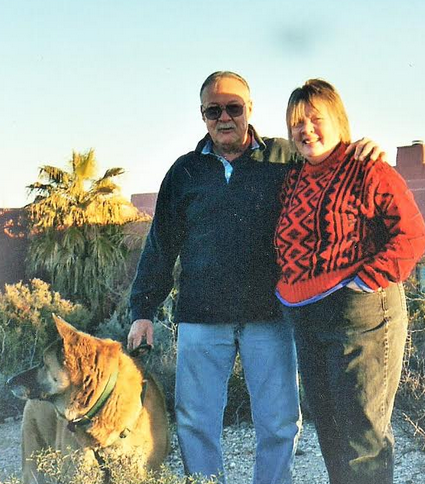
Dennis St. Germaine and wife Tina. January 2004.
For a month in 1968, I harvested squash on Southern California farms with a knife alongside Mexicans. I practiced speaking Spanish with them, visiting a new friend and his family at their Tijuana home on Sundays, our day off.
Linda and her sisters Ellen and Amy all learned Spanish on summer vacations in Mexico City at their grandmother‘s house. Naturally, I appreciated how Linda embraced Tucson’s Hispanic culture, relating positively to its large Mexican American population.
Newcomers to Tucson’s hippie scene, Linda and I soon fell in love. Camaraderie, friendship, and shared experiences drew us together, creating a bond which spanned the rest of our lives. Together we ventured into the Catalina Mountain foothills to the north of Tucson and frolicked in Sabino Canyon’s creek which meandered past sculpted rock walls. Sometimes at sunset, we drove west in the direction of the Tucson Mountains to enjoy stunning desert vistas at Gates Pass. Saguaro cacti stood out in a darkening panorama, resembling humans in silhouette.
That summer I worked at the U of A College of Law library. Already admitted as a law student starting in September, I had the monotonous task of shelving books in newly renovated basement quarters. Stepping into this bedlam one afternoon, my sweetheart invited me to accompany her to the Papago Indian Reservation where she’d attend a women’s meeting.
A major Native American reservation in southern Arizona and northern Mexico, in the 1980’s the tribe renamed it as the Tohono O’odham Nation. Linda drove us for over an hour on my first visit to a reservation. We traveled upward into the Baboquivari Mountains through a barren landscape scattered with cactus where centuries of rain had created tree-filled canyons and exposed blue, green and gray stone walls. When the road passed the Kitt Peak National Observatory, I gawked in amazement at its collection of astronomical instruments, the largest in Earth’s northern hemisphere.
Topping out at a desert plateau, we pulled into a parking lot across from the Sells, Arizona tribal headquarters. Small trees struggling in harsh sunlight lined the lot. I sensed an eerie silence once out of the car. Coyote Mountain cliffs formed a hazy backdrop to the stark landscape of a town whose residents sheltered in shaded quarters.

Linda Abrams. Photo by Amy (Abrams) Persechini, 1972.
At the tribal Legal Aid Office, Linda introduced me to its director, Roger Wolff. “As long as you already work at the law library, perhaps you can do some legal research for us,” he suggested.
“Why, of course, as long as you think I can handle it,” I replied.
“Oh, you’ll just have to note federal cases containing the phrase ‘arbitrary and capricious’ regarding actions and regulations of government officials. It’ll help us with a tribal lawsuit,” he said.
“Sure sounds interesting, Roger, and it will give my legal career a jump start!” I exchanged phone numbers with him before Linda and I departed into the sultry noon air.
We breathed in dust from empty streets and soon met an elder Papago holding the bridle of a brown pony. “May I ride her while my girlfriend goes to a meeting?” To my delight, he agreed and handed over the leather reins to the bare-backed pony.
“Well, I better join my friends,” Linda said. “Have a good ride!”
Getting the feel of my four-footed companion, I gingerly rode past adobe block homes planted with gardens adjacent to primitive corrals. It felt like a dream come true after seeing Westerns romanticized on TV and at theaters. The only other time on horseback, in Queens, New York City, around the age of eight, I rode a pony at a neighborhood stable frequented by me and my brothers.
My friendly pony trotted along packed dirt roads until I turned her into a canyon. The trail ended abruptly at a precipice from which I cautiously backed her away. Closer to town, we encountered a couple of young bucks in a dry arroyo. Also riding ponies, they challenged me to a race. Soon, they overtook me causing them to hoot and holler as their mounts galloped past. Wait till I tell Linda! She won’t believe it, I thought.
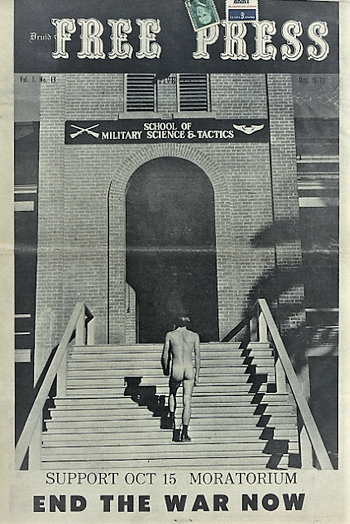
Druid Free Press front page photo by Ed Chamberlain, October 1969.
When an hour had passed, I returned the pony to its owner. Offering to pay, he didn’t accept the bill I extended. As I thanked him, I wondered at this good fortune and his generosity.
Departing from Sells in the late afternoon, I excitedly related to Linda all about my horse ride as she drove past run-down ranch homes and neglected farms of impoverished tribal members not benefiting from public services available to citizens of surrounding counties. “That’s cool, Jerry,” she agreed while keeping an eye on the highway.
“How ‘bout your meeting? How did it go?” I asked.
“Umm, interesting. We began it with a sage purification ceremony,” she said. In the fading light, we descended through darkened canyons onto the desert’s floor as the setting sun burnished shrub covered distant hills in shades of red, green and brown.
When I visited Linda at home where she lived with her family across from Arroyo Chico, we relaxed in the family room. Selecting from a shelf of record albums, we liked to play the Moody Blues’ “Days of Future Passed.” I enjoyed hearing its orchestral interludes through an open slider door while immersed in my search for lizards in their sparse garden dominated by a shimmering blue pool.
Before classes began in early September, the Abrams graciously invited me to their home for dinner where I met family friends, third year U of A law students from Chicago. “It’s great to meet you!” I hailed Ed and Peter when introduced to the casually dressed scholars. “l look forward to seeing you at school.”
The brick ranch home graced with bookend California Fan Palm trees resounded with good cheer and laughter. Linda assisted her mother in preparing a delicious Mexican meal and I helped wash the dishes.
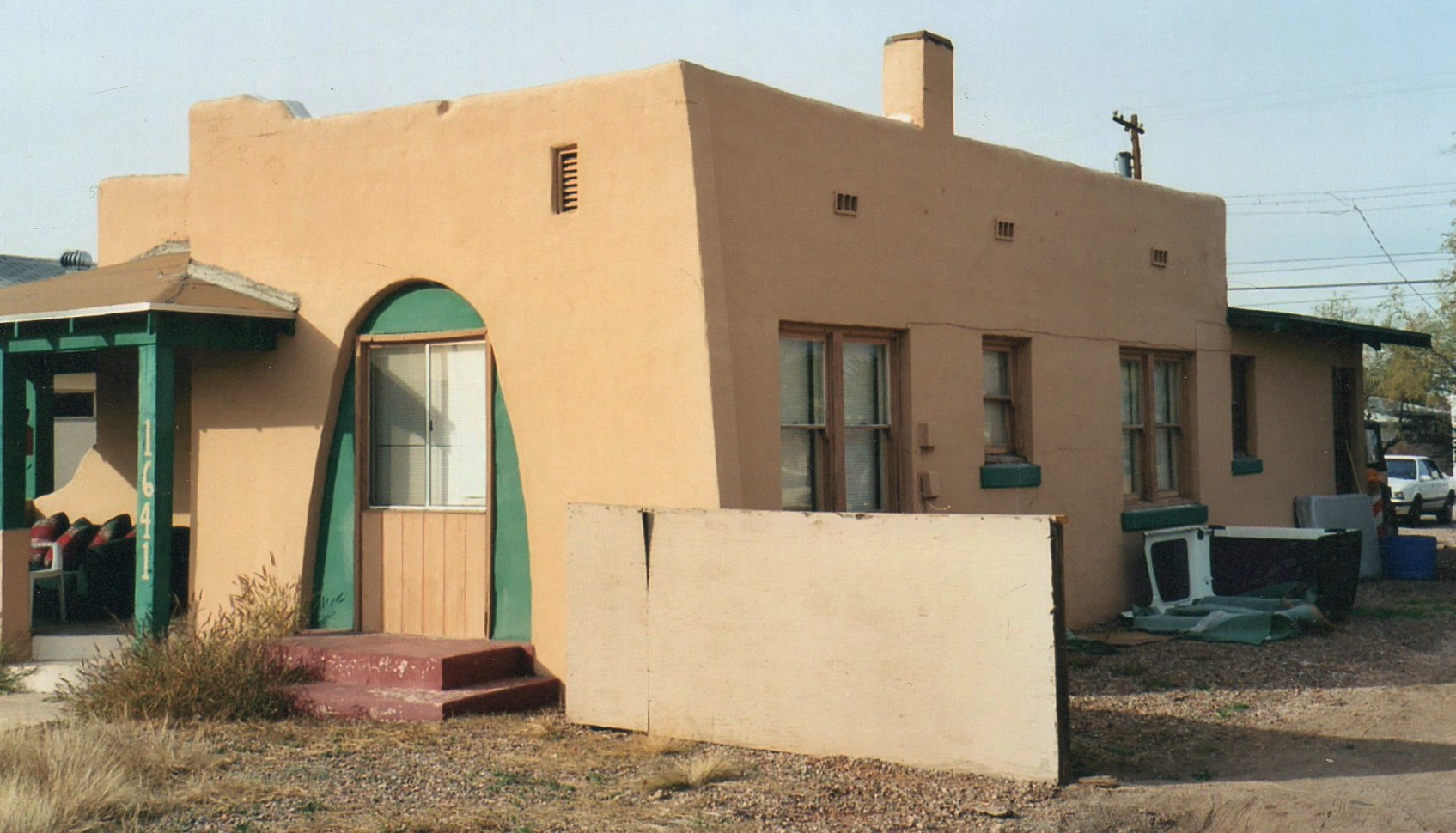
Jeremiah, Dennis and Ed’s home on E. Broadway Blvd, Tucson.
My sweetie and I made plans to attend a rock concert at Arizona State University’s Tempe campus. “What a great lineup of bands tonight, Linda!” I exclaimed while drumming excitedly on the vinyl dashboard. She propelled her desert-faded sedan northward, idly coiling her long brown hair with the slender fingers of her free hand. I passed her a can of soda, while we munched on snacks she had generously prepared for us.
Linda, full of surprises which put me under her spell, had offered to drive us through the desert valley in the direction of Phoenix. The interstate highway by-passed orchards containing endless rows of pecan trees and random service areas outside low-profiled towns. Mountain ranges appeared like ghost ships upon becalmed ocean waves. Golden sunlight angled east from the setting sun through the windows, setting Linda’s face aglow. Crimsons, lavenders and scarlets shimmered upon distant clouds and the sky slowly dwindled into darkness.
So, this must be love, I thought, convinced that Linda was the woman of my dreams. I admired how well she handled the car and joined her in singing along to the radio.
How proud I felt to escort Linda into the concert arena. “Oh, Jerry! I am so happy to be here!” she confided as we took our seats in a sea of tie dye colors worn by long-haired rock fans. We joined excited youth dancing in the aisles and, later, bounced out of the arena to the heavy beat of rock tunes ringing in our heads.
I drove us home and the time passed quickly. We cruised under a ceaseless canopy of stars and remarked upon constellations which stood out in the galaxy. An occasional shooting star delighted us, lovers of travel on the road.

Linda Abrams, Jeremiah Reardon and wife Belinda, Monterey Bay, CA, 2011.
To my surprise, Linda’s parents invited me along with Linda to attend a Sunday afternoon performance of George M. Cohan’s Broadway songs, including “Yankee Doodle Boy”. Held at a community center and attended mostly by married couples, Linda and I represented our city’s youth as we mixed with sophisticated friends of the family. “This is some fancy affair your parents invited me to, Linda. I am starting to feel like a member of your family.”
The show featured one rousing patriotic number after another. For us youthful war protestors the repetition got monotonous, and we eventually sat with unstirred emotions. Instead, we dwelt on concerns about family and friends subject to the Vietnam War draft.
Dennis and his Navy veteran buddy Ed Chamberlain planned a four-day Greyhound bus trip to New York. Tall and lanky with long brown hair and a walrus mustache, Ed installed tile for homeowners and took photos for the Druid Free Press. They had tickets to the Woodstock Music and Art Fair beginning on August 15th. “Say, Jerry, do you wanna come with us?” they asked.
“Thanks, but so soon after arriving here with Francis, I don’t feel up to it. And I need to keep working at the library to pay my tuition. It sounds like an excellent festival with so many great bands, though.”
And what a lineup of West Coast bands whose records we played on the stereo or heard at bars. Santana, Jefferson Airplane, Grateful Dead, Janis Joplin with the Kozmic Blues Band, Joan Baez, Country Joe and the Fish, Crosby, Stills, Nash and Young joined numerous other bands for that storied weekend, performing for an estimated 460,000 youth gathered in peace.
Complaints spread by TV coverage concerned the rain and muddy conditions of the host Max Yasgur’s 600-acre dairy farm. A portion of the fields formed a natural bowl sloping down to a pond. The main stage built at the bottom of a hill had the pond forming a backdrop.
On the other hand, my buddies had a blast! “We camped out in the woods and made friends with our neighbors,” Dennis told me later.
Just before school started, Dennis and Ed found a new home for us closer to the university. Ed joined us as our third roommate in a semi-detached house adjoining an alley which accessed the backyard. The kitchen added at the rear of the house had a basement, rare for Tucson, in which my roomies framed up a partition wall of 4 x 4-inch posts and boards to create two bedrooms in the cool space. My bedroom had French doors opening to busy East Broadway Boulevard. I decorated one wall with a discarded, psychedelic Peter Max poster advertising 7-UP soda.
In the meantime, Bob had moved from the frat house to live with friends in the Bay Area. Receiving an invitation to visit, I looked forward to him showing me Berkeley’s People’s Park.
Situated on a University of California lot, activists established People’s Park as a public park in April 1969. Beginning at noon on May 15th, about 3,000 people, including my friend, appeared in Berkeley for a rally in favor of the park and to protest the school’s plans to convert it into a soccer field.
“Bloody Thursday” escalated into a major confrontation between residents and the police. Bob told me, “Once I got knocked down by a nightstick, I hightailed it out of there, man. Others got it worse.” Over a hundred residents went to hospitals for head trauma, shotgun wounds, and other serious injuries inflicted by police. One victim died from a gunshot and another lost his eyesight.
Coincidentally, Linda also planned to visit San Francisco. So, we arranged to meet up and spend an afternoon together.
I arrived at Tucson’s airport for my flight to San Francisco dressed in blue jeans, a short-sleeved shirt, sandals and a Native American beaded necklace. Prevented at the gate from boarding, I had to find a willing passenger to borrow socks to wear with my sandals. Bennie, in his late twenties, agreed to help. First, the tall guy sat to remove his shoes before handing over the socks.
Once seated with him on the plane in the same row with a young woman, I returned them. Our seatmate Rachel had long straight brown hair. A little on the plump side, her smile conveyed friendliness. To our amazement, Bennie told us how he just arrived on an earlier flight from Tampa, after visiting the stream of consciousness author Jack Kerouac. Jack shared his home in Clearwater with his wife and mother. “We smoked joints in the bathroom because his mother didn’t approve,” he said. That bit of news cracked us up!
Rachel found out that I had to get to Oakland once we landed in South San Francisco. “Jerry, my father is picking me up. I’ll ask him to give you a ride to the city.”
“Thanks, Rachel,” I replied with appreciation for my new friend.
Our plane arrived around 9:00 P.M. After saying goodbye to Bennie, Rachel and I went in search of her dad. We found him parked in a long line of cars near the terminal exit. Rachel introduced us and explained how I needed a lift to the city. “Well, okay, Rachel but I really don’t want to,” he said barely hiding his annoyance.
His obvious dislike of my hippie appearance put an abrupt halt to the good time I shared with his daughter. The car ride involved her calming her father’s nerves while I counted the miles into downtown. It felt great to finally get dropped at the foot of the bridge. “Thank you both, and nice to meet you,” I said, relieved to have arrived in the storied city.
Still getting my bearings after getting away from that negative energy, who should be the first person I meet in San Francisco but a woman of the night. Appearing out of nowhere, she might have stepped out of a dark doorway. She smiled at me and asked, “Looking for a date?”
Oh my God, what’s next? I thought. “Umm, no, thanks. I’m headed to see a friend in Oakland. I’m gonna hitch a ride. Goodnight,” I said as I turned from her in the direction of the bridge. A quick ride to Oakland soon had me calling Bob on a payphone to come get me.
That strange Bay Area evening had played out like a chapter in Kerouac’s On the Road. In October the forty-seven-year-old King of the Beats passed away during emergency surgery to try to repair a hemorrhage due to cirrhosis brought on by his alcoholism.
Linda’s presence in San Francisco made my trip even more meaningful and exciting. She had arrived to retrieve personal items from her former boyfriend. Arriving in the city’s Haight-Asbury neighborhood, I found the apartment he shared with friends. I knocked and Linda answered, greeting me with a big hug and a warm kiss.
Together, we explored tree-lined streets of Victorian-era homes. “It’s simply amazing, Linda, to be walking in the heart of the counterculture!” I excitedly exclaimed. People our age gathered on sun-drenched porches. Local activists sponsored a free medical clinic to attend to the needs of street people panhandling outside shops catering to hippies and tourists. A two-block stroll north brought us to Golden Gate Park.
Once school started, I sat in the lecture hall next to Sidney Wolitzky, of Brooklyn, NYC. A graduate of Boston University, Sid and his wife, Janet Loeb, also from NYC, had just returned from Israel. They had spent the past year at a kibbutz helping to reclaim the desert. Managers of an off-campus apartment complex, they lived in one of the units which overlooked a planted courtyard.
Sid and Janet invited Linda and me to join a potluck Italian dinner prepared by them and their neighbors, two brothers from NYC. We contributed the salad. A native New Yorker, I enjoyed stories shared about growing up in the Big Apple with one leading to the next. Our laughter had us rolling on the floor. Beginning that evening, Linda and Janet remained friends for life.
As our routines of study and work progressed that fall, Linda and I drifted apart. We had made new friends, and our social circles had widened. Occasionally, we bumped into one another on antiwar marches from the campus to the Federal Building.
My last time in Tucson, January 2004, I looked up my friends. Dennis met me after work at the U of A. He edited a magazine for its science department, a glossy periodical with numerous photos. Dennis had bad news for me; our roomie Ed had recently died in Colorado.
Next, I visited Janet Loeb, then a social worker. She invited Linda to join us. Linda, a registered nurse and nursing instructor, lived nearby in a home she shared with her husband Stan Gordon. The following day, I had lunch with Sid, a practicing attorney. He and Janet had divorced, and Sid remarried. His wife joined us for lunch near Sid’s downtown office.
In the summer of 2011, my wife, Belinda, and I invited Linda and her husband to escape the desert heat and stay with us in Monterey, California. Stan was unable to join us, and Linda missed not having his company for the several days that we shared together by Monterey Bay. It would be the last of a half dozen times over the years when Linda and I caught up with each other.
In April of 2015, when living in Cuenca, Janet emailed us. She related the sorrowful news of the death of our dear friend Linda. To conclude this tribute to Linda and that awesome summer of 1969, I hark back to those immortal words of our generation’s beloved bards, John Lennon and Paul McCartney: “Ob-La-Di, Ob-La-Da! Life goes on, brah!”
________________
Jeremiah Reardon lives in Cuenca.



Hogar Esperanza News

Property Manabi

Fund Grace News

Fabianos Pizzeria News

The Cuenca Dispatch

Week of September 06

U.S. sinkings of Ecuadorian fishing vessels trigger court scrutiny after 28 crew members are released.

Cuenca targets a November launch for its first new international link to Chiclayo.

Exports hit a quarterly record, but Ecuador’s import bill is rising even faster.