













More crimes are being committed with high-power firearms; Plan your ‘extreme’ Cajas Mountain adventure; Easter chocolate and squash ice cream
Bored? –
(De El Mercurio del lunes 6/4) Arte religioso y exposiciones en la apertura de las fiestas (Religious art and exhibitions at the opening of the festivities) – There are several exhibits that will kick off the fiestas for the 469th anniversary of the Fundación de Cuenca. From today (lunes) to el 26/4, there will be a show of religious art, ‘Semana Santa’ at the Museo Catedral Antigua (Luis Cordero y Sucre) with hours from 9:30-12:30 and 14:00-17:30 on lunes a sábado, and from 9:30-13:30 los domingos.
‘Arte fusión’ by the Círculo de Artistas Plásticos de Cuenca will be at the Casa Patrimonial Municipal Márquez (calle Juan Montalvo y Calle de la Cruz) until el 13/4 with hours from 8:00-16:00. ‘Mouton, la persistencia del fuego’ by artist Hermes Cordero will be at the Galería de la Alcaldía until el 12/4 with hours from 9:00-16:00.
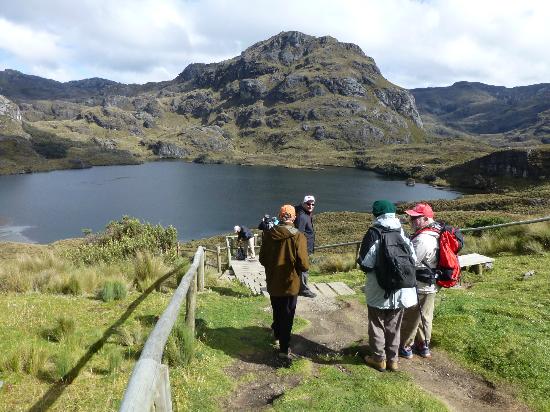
The Toreadora lake in Cajas National Park offers a popular hiking trail.
The exhibit ‘Habitantes del instante’ from the Unidad Educativa CEDFI will run until el 28/4 in the Casa Patrimonial Municipal del Artista (av. Loja y calle Cantón Gualaceo) with hours from 8:00-16:45. Lastly, ‘EMERGER’ will be at the Casa Patrimonial Municipal del Alfarero and will run the whole of abril with hours from 8:00-16:45.
(De El Mercurio del sábado, 4/4) – Cajas, para turistas de experiencias extremas (Cajas, for tourists seeking extreme experiences) – Visiting the Parque Nacional Cajas implies touring an environment of high mountains characterized by páramos, glacial lakes, and a network of trails allowing short, medium and long walks. Basic conditions for exploring this protected region is planning and using marked routes. The fragility of the ecosystem demands responsible behavior by visitors. <The park doesn’t need yahoos competing to see how far they can throw their empty beer cans into the lakes.> You can enter between 8 & 16:30 through control points such as Toreadora at km. 32 on the Cuenca-Molleturo highway or through the Soldados sector in the south. These sites register visitors before their hikes with their planned routes, number of people, and estimated amount of time they will be in the park. This is needed in case of emergencies or if you get lost. There are 14 sites you can visit in the park. One of the most accessible is the Toreadora lake which has a trail around the lake that can be walked in an hour and half or two hours. Another frequently visited site is Tres Cruces which has splendid views and is also the South American Continental Divide. Other routes include García Moreno and Naturaleza e Historia Humana which take between 2 and 3.5 hours. If you’re looking for a bigger challenge, there are climbs like Cerro San Luis with steep slopes that take about 3 hours. Longer routes can take over 4 hours and up to 2 days.
The park is between 3,200 and 4,500 meters above sea level so conditions can change rapidly. Fog, rain, snow and low temperatures can modify the duration of hikes or limit visibility. Because of this, you should check the weather. Proper equipment is fundamental. Wearing warm, waterproof clothing, shoes good for irregular terrain, and bringing sufficient water and energy providing food <gorp?> is recommended. For longer routes, you should consider additional gear such as for camping. Use of guides is mandatory for groups organized by travel agents, schools, and those who don’t know the routes. For visits by families and individuals, using marked trails and avoiding unknown routes is suggested. <Do you really want me writing about you being rescued in the Cajas because you decided you to leave the trail to get that perfect photo from way up there and then got yourself stuck way up there?> It is not allowed to enter with pets, light campfires, leave garbage or leave established trails.
Hungry? –
(De El Mercurio del domingo, 5/4) Delicadas creaciones de Pascua (Delicate Easter creations) – From classic chocolate eggs to innovative desserts and artisanal ice cream, there are businesses in our midst where talent and creativity fuse to create irresistible golosinas (goodies). In the Gaby Lazo Atelier, located on the lower floor of the Casa del Parque, Gaby has created beautiful works of art in her desserts. Trained as a fine pastry chef, she remembers the magic of Easter and offers different options at her Atelier. They include decorating kits for kids, colorful eggs made with chocolate and light fillings, and showcase desserts that combine technique, flavor and looks. One of her greatest sources of pride is working with chocolate made from cacao fino de aroma, a product that represents the richness and identity of Ecuador.
Easter symbolizes new beginnings, and in the Piaro Heladería at Agustín Cueva 7-35 y Padre Julio Matovelle, Easter Week represents an opportunity to continue innovating without losing tradition for chef/owner Víctor Rojas. He wanted to take a representative ingredient such as zapallo (orange squash) which is a part of fanesca, and turn it into something different without losing its essence; and he invented creamy zapallo ice cream which is served with a pepa de sambo (white squash seeds) crisp. This ice cream was inspired by one of the most significant times of the year – Holy Week and Easter, which are filled with tradition as well as reflection and gratitude.
Dikaty, owned by Catalina Tamayo, has several branches in Cuenca including Gran Colombia 12-57, Remigio Tamariz and Lorenzo Piedra, Bolívar 9-29 and Benigno Malo. Dikaty has been in business for 25 years and the stores offer a large selection of chocolate eggs in different sizes in eye-catching and colorful presentations made with cocoa beans and cocoa butter. The eggs are made with the finest chocolate from the Calceta zone. Prices range from $.40 to $13.85. <So do you think you could eat a $13.85 egg in one sitting?>
Curious? –
(De El Mercurio del domingo, 5/4) Destruyen arsenal hallado en Cuenca (Arsenal found in Cuenca destroyed) – The minister of the Interior, John Reimberg, published photos of the arsenal which included rifles, pistols, bladed weapons, 6 hand grenades, and clothing resembling a police uniform. A stolen car was also found on the property in the Ricaurte sector in Cuenca. The raid was part of an investigation into killing el pasado jueves in Ricaurte. The grenades were detonated at a safe site by the Grupo de Intervención y Rescate (GIR) who were brought from Guayaquil to Cuenca with the help of the Aeropolicial service.
(De El Mercurio del lunes 6/4) Las armas de alto calibre marcan a muertes violentes (High-caliber firearms are linked to violent deaths) – 11 of the 12 violent deaths in Cuenca this year were committed with firearms, including cases where long-range arms were used that are authorized only for the military and police special forces. Also. there were similarities in 8 cases of hitman-style killings. This and other aspects show an evolution of the use of firearms in the city. On el 2/4, a systems engineer was shot at av. De las Américas and Gonzáles Suárez just after he had bought a car from a used car lot. The car had been reported stolen in Guayas. The next day, police raided a house in the ‘La Dolorosa’ sector in Ricaurte, finding two 9 mm. pistols and two 5.56 caliber rifles used in the attack on the engineer. On sábado, agents conducted another raid in Las Orquídeas where they caught 2 suspects allegedly involved in that attack and other crimes such as arms and drug trafficking and vehicle theft.
Another case showing the evolution of the use of firearms by criminals in Cuenca was a hit style attack in the Las Peñas barrio el 2/3 where unknown persons used long range rifles to attack 2 people, killing one and injuring the other. Added to that, is the frequent seizure of arms and ammunition in the prison at Turi. Ángel Esquivel, police commander of the Azuay Subzone, said that the recent criminal acts were committed with arms that were inside safe houses in the city and the killers came from other cities and used those guns. René Yebra Núñez, a professor of Criminology at the U. Católica de Cuenca, said use of firearms is synonymous with power, effectiveness and speed in their modus operandi, and better arms in terms of sophistication and caliber, signifies more power for the gang. Yebra could not say for sure if the arms came from corrupt police or military, but he couldn’t rule it out even though it would be very difficult and rudimentary. He said that gangs have enough resources to get high caliber arms from anywhere in the world, and for that reason wouldn’t use the armed forces as a source.
Omar León, an ex-police official and ex-director of the Turi prison, said that one of the usual routes for arms to enter Ecuador is through Perú. The most common countries of origin are Brasil, Argentina and Perú, including foreign military and police units. He believes the creation and execution of a security plan for the city is urgent since the lack thereof creates conditions in which criminal gangs can operate.
(De El Mercurio del lunes 6/4) Aumento uso de armas de fuego para cometer femicidios (Increased use of firearms in femicides) – The use of firearms to commit femicide has increased according to data from Aldea, an organization that collects national gender violence data. In its quarterly report, it said that 8% of femicides in 2019 were committed with firearms. The percentage rose to 78% in 2025. Between 1/1/2026 and 15/3/2026, it counted at least 78 violent deaths of which 78% or at least 60 were caused by firearms. This data exposed the “Estado de Deceptión” for the rights of women and girls since one is a victim of femicide every 22 hours. In the sphere of deaths reported from sexist violence, 5 were trans women, 7 were under 18, 21 were domestic femicides, and 52 in criminal systems.
<What a post – articles about Easter juxtaposed with articles about firearms and death.>