
















Plant experts urge city to develop a tree plan; Police make arrests ahead of Noboa campaign visit; Strong earthquake causes damage; ‘Country risk’ drops
The Azuay College of Agricultural Engineers is urging the city to adopt a more “sophisticated” approach tree and plant management in parks and other public areas. The recommendation follows the Thursday’s deaths of two children in Parque de la Paz after they were struck by falling Eucalyptus trees.
The group, which includes landscape architects, said it was not blaming the Municipal Cleaning Company of Cuenca (EMAC) for the children’s deaths. “What happened Thursday was a freak event that could not have been foreseen,” the college said in a statement. “However, a deeper knowledge of the trees and all flora planted in public spaces would have both public safety as well as aesthetic benefits,” the group said in a statement. It also urged the city to develop a master plan for the planting and maintenance of trees and other plants based on suitability in different settings.
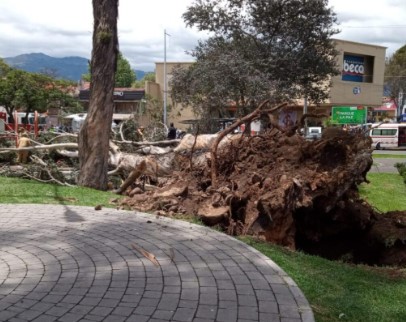
Landscape architects and agronomists are recommending that the city adopt a more “sophisticated” approach to tree and plant management in parks and public spaces following Friday’s accident in which two children were killed by falling trees in Parque de la Paz.
It added that some tree species, such as Eucalyptus, should be planted away from areas of high public use, due to weak root systems.
According to the college, the master plan should involve “training that leads to a deeper knowledge” of various species of plants. It also promoted the reintroduction of native plant species whenever possible as well as the development of “biological corridors” within the city.
The college also recommended that EMAC adopt mulching practices in public spaces. “The concept of mulching planted areas is well established in most of the world but, unfortunately, it is rarely used in South America. Mulching keeps moisture in the soil near ornamental and agricultural plantings and reduces evaporation, which happens at a high rate in Cuenca due to the high elevation.”
Strong earthquake causes minor damage
A magnitude 5.8 earthquake cracked walls and knocked items from store shelves late Friday in northern Ecuador. Centered in western Napo Province, the effect of the quake was intense in Tena and Latacunga and caused moderate shaking in Quito.
The main earthquake, which occurred at 6:02 p.m at a depth of 11 kilometers, was followed by a series of aftershocks, the strongest 4.2 magnitude. As of Saturday night, 25 aftershocks had been recorded.
The national Risk Management office said early reports indicated some structural damage to buildings, including to the public hospital in Tena, and at least two schools and dozens of private residences.
Stores in Tena and Latacunga reported widespread damage due to the breakage of bottles falling from shelves. The Tena mayor’s office said losses in grocery stores alone could amount to “thousands of dollars.”
Police make arrests ahead of a Noboa campaign visit
National Police on Saturday arrested 12 men wearing military and police uniforms in Manabí Province hours before campaign stops by President Daniel Noboa. Police said the men had planned to infiltrate crowds at the events and then attack Noboa.
It is the second time in three days that an attack during a presidential campaign event was suspected. On Wednesday, Andrea González cancelled a caravan in Machala following reports that an attack was planned from a bridge on the caravan route.
In a statement following the arrests, Noboa thanked police for their efforts to prevent a possible assassination attempt. “We are on our way to Manabí to continue with our campaign and have received news of the arrest of 12 people with police and military clothing, rifles, ammunition and a surveillance drone,” he said on his X account. “The narco-terrorists continue their efforts to cause destabilization and stop our progress to restore order.”
Ecuador’s ‘country risk’ drops
Ecuador’s economic country risk has fallen to 923 points, the lowest in two-and-half-years, according to the Central Bank. The country risk is a rating maintained by international credit rating agencies indicating the risk and uncertainty of investing in particular countries.
Since 2022, Ecuador’s country risk has been as high as 1,150 points, according to the bank.
The improvement, says Central Bank President Carlos Avellán, is a result of the country’s efforts to put public finances in order and improve conditions for multilateral investors. It is also based on the expectation that President Daniel Noboa will be reelected, according to credit rating company Standard & Poors.