
















‘Power imbalance’ is blocking a strike resolution
Why are the government and the Confederation of Indigenous Nationalities (Conaie) not talking to each other? Why is the strike in its third week when the strikes of 2019 and 2022 ended through negotiation within two weeks?
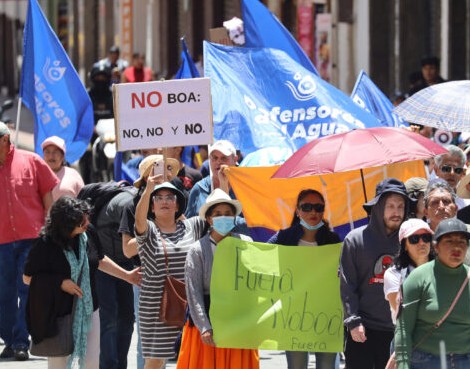
Strike supporters marched Sunday in Quito.
According to Central University of Ecuador political science professor Juan Tricerri, the answer is an “imbalance of power” between the two sides. “In the earlier strikes, the number or protesters was much greater and there were more communities affected,” he said. “Even though Conaie regretted the violence in 2019 and 2022, the impact of it and the threat of more violence, gave Conaie a much stronger hand in negotiations.”
With the exception of Imbabura Province, the current strike has created far less disruption, says Tricerri. “In 2019 Quito and Cuenca and other cities were under siege, their roads blocked and supplies unable to get through. In 2022, the same happened in Quito, Riobamba and Ambato. There was extreme hardship in the country, and the government was desperate for a resolution, as was Conaie.”
According to Tricerri, since the government holds the upper hand in the current strike, it has less incentive to come to the negotiating table. For Conaie, he says, there is the realization that its central demand, the restoration of the diesel subsidy, will probably not be met. “This is frustrating for indigenous leadership, as is the lack of support from the public. 2019 and 2022 left a bad taste in the country’s mouth, especially as a result of the roadblocks and violence.”
Despite the differences from the earlier strikes, Juan Fernando Páez of the Pontifical Catholic University of Ecuador says the government should be open to talks. “Many of their (Conaie’s) demands are legitimate and are supported by the public,” he says. “There may be limited space for comprise regarding the diesel issue, but there needs to be a discussion about public health care, education and other topics. One way to resolve this strike is for the president and the government to admit that many of Conaie’s points are valid.”
Páez criticizes the government for depicting protesters as “terrorists,” claiming they are supported by criminal organizations. “This may be true in some cases, but there needs to be recognition of the real needs of the indigenous and the poor in the country. These are not the drug criminals that are terrorizing the coast.”
César Ulloa, retired social sciences professor, agrees and says the government should take the lead in de-escalating the conflict. “It is true that this is not as bad as 2019 or 2022, but it is still very disruptive for the country, not just Imbabura,” he says. “For the good of the country, the government should agree to dialog and encourage it. It should listen to the complaints from the leadership of the indigenous and campesino organizations.”
Ulloa adds: “There is absolutely no benefit to the government for prolonging this strike and, like the other strikes, it can only be resolved at the conference table.”



Hogar Esperanza News

The Cuenca Dispatch

Week of September 20
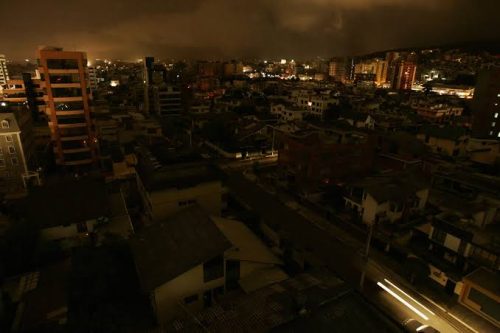
Ecuador turns to industrial power cuts to protect Mazar and keep homes from going dark.
Ecuador raises its 2026 growth forecast, but El Niño could spoil the outlook next year.
Cuenca retirees challenge medical and therapy changes at IESS senior center.
Fabianos Pizzeria News

Fund Grace News
