












Retirement with missiles
Ever since John Milton wrote his famous poem ‘Paradise Lost’, something about the word “paradise” that should make a normal person hesitate, because it nearly always comes attached to a brochure, a visa category, a casino in the Bahamas, and a silence about how things actually work.
Dubai perfected this arrangement to an almost theatrical level, offering a version of life that looks, from the outside, like a permanent hotel stay in Las Vegas with better lighting.
The pools are blue, the brunch buffets are endless, with champagne and oysters circulating as if they were basic items in the food pyramid, and the skyline appears to have been assembled by a committee of architects who were told to imagine the future but with no budget constraint and no memory. It has, at times, the feel of how people who would like to make America great again might imagine it to be, Las Vegas without casinos or any history, or Bermuda rebuilt vertically and at scale.
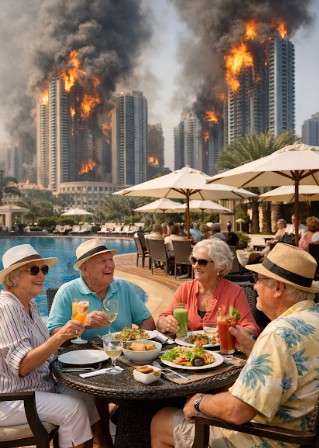 Before going any further, it is worth pausing over the word itself, because “paradise” has always been a flexible concept, adjusted to suit the expectations of whoever is doing the imagining. For some, particularly in traditional Islamic descriptions, it evokes gardens, abundance, and 20,000 virgins; for a retired Westerner, it is more likely to involve virgin olive oil on a fresh green salad with diced vegetables beside a clubhouse pool after eighteen holes from the forward tees, followed by a cappuccino from a grand machine that occupies a place of honor on a kitchen countertop made from granite composite. The important point is not which version is correct, but that both are carefully constructed pictures of ease, comfort, and the absence of friction.
For a while, Dubai managed to supply something that looked very much like that absence.
Influencers arrived, as they tend to do, and discovered that one could live in an air-conditioned island of prosperity built in a desert, while posting evidence of it to the rest of the world. The cars gleamed, the drinks sparkled, and the background never contained anything inconvenient unless it was carefully cropped out.
What was being sold was not Dubai exactly, but the idea of Dubai, which is a slightly different product and considerably easier to export.
Then something awkward happened. Missiles arrived.
It turns out that “the safest place on Earth” is still located in the Middle East, and geography has a habit of ignoring marketing campaigns. The same expats who had been enjoying the benefits of low taxation and high spectacle suddenly found themselves asking questions that are rarely included in relocation guides, such as who, exactly, is responsible for getting you out when things go wrong.
This has not produced a great deal of sympathy among the non-expat population.
There is, perhaps, a lingering suspicion that a place built on selective attention cannot expect universal concern when the selection process fails.
Dubai, to its credit, never really hid what it was, although it did not advertise it either.
The towers were built by migrant labor under a system that would not pass inspection in most countries that its residents originally came from, and the social contract required a certain discipline of thought, which is to say, not thinking too much about how the machine operates. Behind the polished surfaces and the towering towers are hordes of low-paid laborers, rather like stagehands shifting scenery during an intermission, coming largely from Pakistan and the Philippines, bunking up in shared rooms that do not appear in any influencer video and are not meant to.
A well-traveled friend of mine once described Dubai as a place where everything is available except a sense of belonging, which is an observation that sounds flippant until you consider how many people are there temporarily, performing a version of themselves for an audience that may or may not exist. So, in that sense, it is a city of mirrors (and you can reflect on what that means.)
Now, if we turn to Cuenca, we find another “expat paradise,” although one that would struggle to produce a convincing helicopter video and where the only drones are those operated by video influencers who want aerial shots of Parque Calderon.
There are no seven-star hotels, unless someone has quietly upgraded Hotel Oro Verde without telling me, and the brunch situation is generally limited to coffee, eggs, and a roll that may or may not have been baked that morning. The skyline is not attempting to impress you, and the most common form of transport does not involve a Maserati but a Kia taxi that has seen better days.
Yet people come and go, and more importantly, they stay.
The difference is not difficult to identify once you stop looking at the surfaces and start looking at the structure.
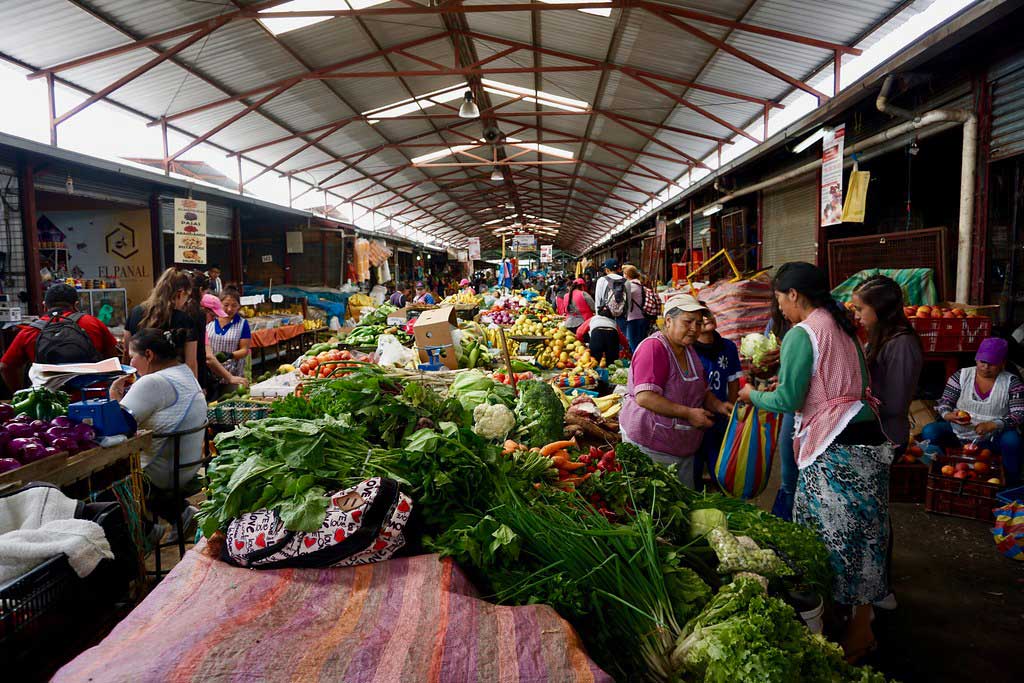
Cuenca does not require you to ignore how it functions. The markets are visible, the buses are visible, the people who cook your lunch are standing a few feet away, and the person who built your apartment probably still lives somewhere in the same city. There is no need for a theory of selective blindness because nothing is being particularly hidden.
It is, in a modest way, an honest place.
You will not be invited to forget where you are, and indeed it would be difficult to do so, given the altitude, the weather, and the occasional dog that takes a strong interest in your daily routine. If something goes wrong, it will go wrong in a recognizable way, involving a queue, a conversation, and possibly a return visit tomorrow.
There is a comfort in that, although it does not photograph especially well.
The expatriate experience in Cuenca is therefore less about performance and more about adjustment, which is a less glamorous process but a more durable one. You learn where to buy your vegetables, how to pay your bills, and which bakery produces bread that reminds you, faintly, of somewhere else.
No one is pretending that it is the center of the world.
Dubai, by contrast, depends on the idea that it might be and many people had never even heard of it until they Googled something like “Retirement best place”.
This is not to say that one is morally superior to the other, because both are, in their own ways, products of global movement and economic opportunity. People go where they can live better, or at least differently, and that instinct is not likely to disappear.
But there is a difference between a place that asks you to participate in its reality and a place that asks you to suspend it.
When the suspension fails, as it inevitably does, the results can be unsettling.
The recent events in Dubai have not so much destroyed the dream as revealed its operating instructions, which were always there but written in small print. Safety, like luxury, is conditional, and the conditions are not always under your control.
In Cuenca, the conditions are simpler.
You will not be evacuated to Las Vegas or London by a military aircraft, a) because there will be no reason to evacuate you, and b) because no one would think to organize such a thing. If you want to leave, you will take a taxi to the airport, assuming the road is not blocked by a parade, a protest, or a bus that has broken down.
It is not paradise, but then again, Dubai has its drawbacks too.