














Roundabouts improve walkability and traffic flow but they started a political firestorm in this Kentucky town
By John Surico
Almost every night, after he helps put his kid to bed, Joshua Blanton drives across his hometown of Ashland, Kentucky, to look at a roundabout.
 Five were installed along one of its main commercial stretches this year, replacing five stoplights and reducing four traffic lanes to two. The project is part of a larger downtown revitalization effort to boost walkability and safety in the city of 20,000 people. But for Blanton, it’s become much more than that. “It’s habit,” he said of his frequent drives. “We were so involved in it, it’s just hard to break away.”
Shortly after Election Day, Blanton posted a thread on Reddit’s r/urbanplanning forum, under the heading “Improving walkability cost me the election.” Blanton, a city commissioner and Ashland native, had run for mayor and lost by about 200 votes. According to his account, it was his avid support for the roundabout installation that helped sink his candidacy.
He wasn’t the only city official to lose in November: Only one of four commissioners went on to win reelection.
“We don’t have a lot of data to know how much of a role [the project] played,” Blanton told me later. “I think that there are more reasons than just this. But this project, no doubt, played a role.”
The bulk of his evidence, for what it’s worth, is vibes: hostile encounters at community meetings; scores of angry comments on social media criticizing the roundabouts’ rationale and $9 million price tag; even a video that went semi-viral of a local weatherman chuckling at footage of a car cruising straight through a newly installed circular intersection. Businesses blamed road construction for revenue drops and traffic snarls. The roundabouts were a cause célèbre, the icing on the proverbial cake, perhaps, for an electorate primed to be skeptical of government interventions, Blanton said.
His thread attracted more than 200 comments before he deleted it — some of his local critics had latched on to the post, he said, and he didn’t want to further fuel the controversy. On Reddit, users commiserated with Blanton’s tale: Some blamed a bad year at the ballot box for incumbents; others said it was telling of a deeper backlash to street changes, even minor ones, that appeared to inconvenience drivers. In an intensely polarized era, the roundabouts of Ashland looked like a hyperlocal casualty in a national, if not global, culture war, one that painted any effort to improve walkability as an assault on personal freedoms.
A Learning Curve
By just about all measures, the modern style of roundabout — where cars are meant to seamlessly yield in a circular pattern — are an easy win: They save lives, reduce traffic delays and cut emissions. But foes of free-flowing circular intersections seem to find something viscerally upsetting about the concept, as proposals to replace traffic lights with roundabouts in US cities are routinely met with community opposition.
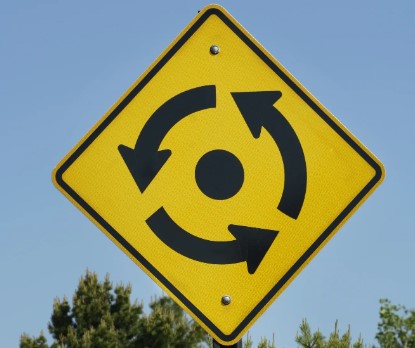 Part of the American roundabout resistance may be simple unfamiliarity: The US lags far behind roundabout-crazy countries like France, the Netherlands and the UK, which launched a national roundabout-building campaign in the 1960s. Studies have found that public hostility tends to melt away once construction ends and drivers can see the benefits (though older drivers continue to be less enthusiastic than younger ones). Modern roundabouts are also distinctly easier to negotiate than larger-diameter variants like traffic circles and rotaries, which often have multiple lanes and higher speeds.
Still, compared to the stop-go binary of a standard stoplight, a roundabout does demand more of a driver — an awareness that there are other road users who must be accommodated. Its design forces you to contend with the fact that you’re not alone out there, and trusts that you’ll yield in return.
You can’t talk roundabouts without mentioning Carmel, Indiana. The Indianapolis suburb is home to more than 150 of them, by far the most of any US city, and more seem to arrive each year. America’s self-proclaimed roundabout capital has made them a point of local pride; when I visit my sister, who lives there, traffic circles often come up in conversation among neighbors, but in an invariably positive light. It’s common to hear locals gleefully share how much gas they save because of them: “I never have to stop!”
That recognition is largely thanks to Jim Brainard, a Republican who served as Carmel’s mayor for almost three decades. The story goes that Brainard visited the UK as a graduate student and came away much impressed by the traffic-calming power of the local roundabouts. But when he returned to the US, he looked around and saw few. His first month in office, he drove to the engineering library at Purdue University, photocopied some pages about roundabout design, and took them back to Carmel.
“I gave them to one of our consulting engineers. I said, ‘Just read these before you tell me you won’t put your professional stamp on one of these.’ And he did,” he recalled. “Now he’s an expert, 30 years later.”
The first couple of projects were met with opposition, but residents gradually warmed to the new layouts. What helped, according to Brainard, was public outreach and education: The city aired informational videos on a cable television channel, held meetings at neighborhood associations and printed newsletters, all extolling the benefits of roundabouts.
Though retired, the former mayor remains a walking encyclopedia of roundabout-related statistics: When we spoke, he reeled off facts on the danger posed by cars at 45 miles per hour versus 20, the amount of contact points at a stoplight versus a roundabout, and the vulnerabilities of a left turn. “People don’t know this in the beginning, so you have to tell them,” he said. “You have to make clear how it saves lives and accidents.”
 That’s a role the feds are filling as well. Nationwide, the US now has more than 10,000 roundabouts, a figure that’s doubled in a decade. Several state departments of transportation are also distinctly pro-roundabout. In September, the Federal Highway Administration held its sixth annual National Roundabouts Week, where officials trumpeted successful designs and lent materials to states and municipalities to promote their benefits. It’s a PSA battle they’ve been waging for more than 20 years, an agency spokesperson said in an email: FHWA has produced videos, flyers, and brochures for use by state, local, and tribal agencies to explain roundabouts to community members and help ease the path to adoption.
The Circle Game
In Ashland, that narrative began to erode early in the process, said Amanda Clark, one of the city commissioners who lost in November.
For over a decade, local officials like Clark wanted to do something to improve safety and walkability on a roughly quarter-mile stretch of Winchester Avenue that coursed through Ashland’s historic downtown. This was the backbone of the classic Appalachian city, which sits just south of the Ohio River. For much of the 20th century, the town boomed around its now-shuttered steel mill, where Blanton, his father, and his grandfather worked. But when jobs started to leave in the 1960s and ’70s, so did people.
Clark, whose background is in economic development, and her team saw potential for revival, and that included a more appealing streetscape. The downtown stretch of Winchester Avenue “was literally a highway where people were just speeding down, and nobody wanted to walk down it because it really was unsafe,” she said.
To tame traffic, city officials wanted to reduce travel lanes and add curb extensions to make crossings shorter. But like so many main streets in the US, Winchester Avenue is controlled by the state, so street changes needed to be approved by the Kentucky Transportation Cabinet, the agency that oversees state roadways. “Everything we do there has to go through them,” Clark said.
KYTC was all-in on building roundabouts, which had been effective in bringing crashes and injuries down elsewhere in Kentucky: 11 new roundabouts recently installed in Hardin County had resulted in a 31% reduction in total crashes and 81% reduction in injuries, according to the agency. And the state’s traffic studies concluded that small roundabouts would be needed to keep Winchester Avenue from getting congested if the number of travel lanes were halved.
But Clark describes a less-than-ideal process of developing and implementing the streetscape improvements along the route. The plan kept shifting: Three roundabouts became four, and then five. Although the city didn’t love the final proposal — which included $8 million from the state, with the city chipping in another $1 million — they accepted it. A bureaucratic version of the “telephone game” emerged, according to Clark: The city would tell the contractors to do X, but the contractors would then do Y, in accordance with the state’s advice.
In a statement, a KYTC spokesperson said that responsibility for construction and communications rested with the city, with the state agency sharing information resources and engineering know-how as needed.
One thing was clear: When construction gummed up roads and sidewalks, the city was left having to explain why to local residents and businesses, who grew frustrated and looked for something to blame. And the five new roundabouts were very prominent targets.
“Because it wasn’t our road or our project, we weren’t really in control,” Clark said. “That’s the biggest part of all of this, and that’s the exact reason why we’re not in those seats anymore: We couldn’t control the messaging.”
Communication Breakdown
Lee Rodegerdts, an engineer and expert on US roundabouts in Portland, Oregon, hadn’t heard of the specific situation in Ashland. But he said planners and elected officials have to remain responsive to rising doubts, or support for streetscape changes can quickly collapse.
“I’ve seen this with many projects, where the communication plan is to tell what we’re going to do and pay lip service to what we hear as feedback,” said Rodegerdts. “Now obviously, in terms of the design, you need that feedback. But the notion that the project is still going forward, and it’s almost locked as a mindset going into the public information process, with few alternatives proposed, the public just digs in.”
It doesn’t help that public faith in government is sitting near all-time lows, according to the Pew Research Center, which has been tracking this metric since 1958. We’re now sitting at about 20% of Americans who think the government does what’s right. At the municipal level, though, the figure is much higher. Nearly 70% of Americans said recently they have a “great deal” or “fair amount” of confidence in their local reps.
That says something about towns’ and cities’ ability to lead in an era when democratic institutions appear shaky. But the Ashland story is a vivid reminder that it’s not always that straightforward. Every person I spoke with mentioned the crisis-level rates of faith in government.
For that reason, Rodegerdts argued that municipalities shouldn’t always see themselves as the sole messenger. Instead, it’s worth thinking through who is trusted in the community to speak on one’s behalf.
“One of the keys to getting a project through the process is to build allies along the way,” he said. “If it’s coming from a business owner, or the PTA, or the school district, it might have a different reception. If it’s coming from multiple places, you start to get this support built up. That’s important.”
Blanton said that the city of Ashland had a robust outreach plan for their streetscape project, with regular stakeholder meetings and a hefty social media presence (featuring drone videos that he would shoot himself). A detailed website provided street closure schedules, maps and other materials on construction progress. But there was a lack of outside voices supporting the project through its hiccups. That allowed misinformation to thrive.
“There was this perception that the project shut down businesses. That was tough because we had no real data to go off of that, and we’re not going to ask them for proof,” said Blanton. “We also had some businesses who actually saw an increase in sales in 2024. But you never heard from those businesses.”
It was a treacherous field to navigate as a politician. After all, you couldn’t call out the businesses that opposed the project out of fear of sounding accusatory, he explained, and you couldn’t come off as too insensitive to real economic challenges, especially during an election year. When faced with that conundrum, Blanton’s response remained the same: He and his fellow commissioners were elected to improve their town — at any cost, as they’d learn later. Even out of a job, he still holds to that argument.
“Like a lot of towns in Appalachia, we have to transition to things that work,” said Blanton. “One thing that works is making yourself better from the inside out and being willing to learn from ideas that work in other places. That’s exactly what we did here.”
Today, the project is almost complete — there’s still some landscaping and electrical repairs to do, but the street changes are finished, and Winchester Avenue boasts spiffed-up sidewalks, reconfigured street parking and a quintet of roundabouts. When Blanton cruises through the area, which he does almost every night, he can see how the experience for both drivers and pedestrians has been improved, and how the changes should help attract people back downtown. Already, several new businesses opened this fall, he points out.
“What I’ve really wondered in the past year is how many towns and communities in this country have just not done projects like this — how many places could be more walkable right now — if it wasn’t for public officials being afraid of this,” he said. “It’s going to take people running for office and losing to have that discussion.”
________________
Credit: Bloomberg



Hogar Esperanza News

The Cuenca Dispatch

Week of September 20
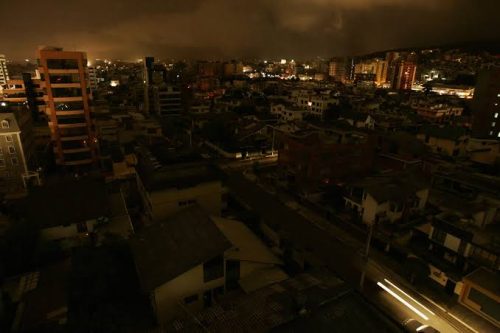
Ecuador turns to industrial power cuts to protect Mazar and keep homes from going dark.

Ecuador raises its 2026 growth forecast, but El Niño could spoil the outlook next year.
Cuenca retirees challenge medical and therapy changes at IESS senior center.
Fabianos Pizzeria News

Fund Grace News