











Strikers agree to lift roadblocks for the holidays; Conaie denies involvement in Cañar attack; Imbabura officials and businesses plead for strike resolution
Transportation Ministry bulldozers were busy Thursday clearing rocks and other debris from the Pan American highway after the local indigenous groups agreed to suspend roadblocks over the four-day holiday weekend. As of late Thursday, the ministry reported that the highway was open from the Peruvian border in the south to Imbabura Province in the north, where several blockages were being maintained by protesters.
A blockage at the San Miguel del Común – Guayllabamba intersection, north of Quito, was the last to be cleared late Thursday.
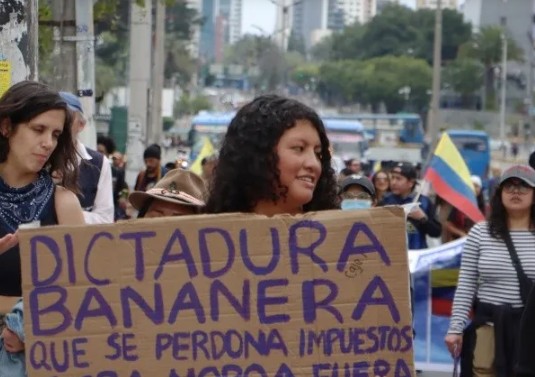
Anti-government protesters marched through downtown Ibarra on Tuesday.
The Confederation of Indigenous Nationalities (Conaie) said roadblocks were abandoned by its local affiliates “in the interest of allowing Ecuadorians to participate in holiday events.” Conaie said that protests in Pichincha, Cotopaxi, Chimborazo and Cañar Provinces would resume Monday, October 13.
In the southern central valley, roadblocks were dismantled at Alausí and Chunchi, allowing tourists to ride the Devil’s Nose train in Alausí and attend craft fairs in other towns in Chimborazo Province.
Conaie denies involvement in Cañar attack
President of the Confederation of Indigenous Nationalities (Conaie) Marlon Vargas said Thursday that its member organizations did not participate in the rock-throwing attack on President Daniel Noboa’s motorcade Tuesday in Cañar Province. “From the first day of the strike, we have been clear that this is peaceful strike and our members have agreed to avoid violence unless provoked by forces of the government,” he said.
He added that “some violent people” have joined the protests but said actions by police and the armed forces also incite violence. “There is an ongoing campaign by the government to stigmatize and dismantle the historic struggle of the indigenous people and this is demonstrated on the streets by the unnecessary use of force by armed state agents.”
Imbabura officials and businesses plead for a strike resolution
Elected officials and business organizations in Imbabura Province are pleading with indigenous groups and the government to end the national strike. “This is killing us,” says Ibarra restaurant owner and business leader Rolando Navarrete. “We are losing millions of dollars a day as the strike goes on and we see no effort by the opposing parties to begin a dialog to bring this to an end. Our streets are empty, even on holidays and weekends, and businesses like mine are threatened with bankruptcy and our workers with losing their jobs.”
According to Ibarra Mayor Álvaro Ramiro Castillo, the strike has cost Ibarra businesses more than $30 million in the last two weeks. “The loses are more than $80 million for the province since tourism has stopped almost completely,” he said. “With the highways closed, no one can enter or leave our communities.”
The Imbabura Chamber of Industries and Production said the craftspeople and vendors in Otavalo have been especially hard-hit by road blockages. It estimates financial loses in Otavalo alone at $40 million since the strike began.
Navarrete criticized Conaie for not controlling “violent strikers” who attack small businesses and employees attempting to go to work. “These people, many of them indigenous, are simply trying to make a living to feed their families and they are being attacked and intimated for attempting to carry out their daily routines,” he said.