













Ten great Latin American artists showcase the region’s rich cultural themes
By Agnes Theresa Oberauer
Given its history of colonization, South America is a place that brings together the culture of its European colonizers with rich Indigenous culture and African traditions. While many places in South America continue to grapple with poverty and violence, this cultural melting pot has given rise to an incredibly diverse range of artists.
Here are ten extraordinary artists from ten South American countries.
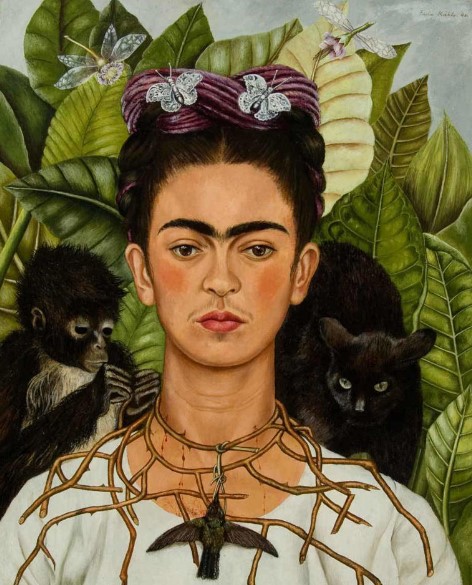
Self-Portrait with Thorn Necklace and Hummingbird, by Frida Kahlo, 1940, Source: Philadelphia Museum of Art
1. Frida Kahlo (Mexico)
The Mexican artist Frida Kahlo is probably as well-known for her tumultuous life story as she is for her art. Born in 1907, the feminist icon’s life was marked by pain and tragedy. She was diagnosed with polio at the age of 6. At the age of 18, she was in a bus accident that left her bedridden with various body fractures. She was able to walk again after 3 months, but she never fully recovered.
As it turns out, her physical ailments did not stop her from leading a passionate life full of ups and downs. Her marriage to the painter Diego Rivera was marked by jealousy, fights, dramatic break-ups, and passionate reconciliations. On top of her tumultuous love life and prevailing health issues, the reality of being a female artist in the first half of the 20th century came with its own set of challenges. Frida produced over 200 paintings during her life and gained a certain level of recognition, but she was still living in the shadow of her husband. It was only after her death that she gained greater artistic acclaim.
Today, her name is more well-known across the world than her husband’s. This is partly due to her unique aesthetic, which is easily recognizable due to her unique blend of vibrant colors and underlying pain. Both her name and face have become iconic symbols of feminism, and her life story has been immortalized in a prize-winning motion picture featuring Salma Hayek.
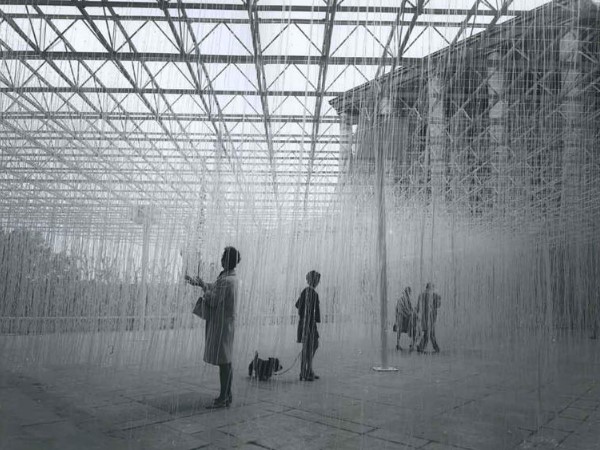
Soto, by Jesus Rafael Soto (Photo by André Morain), 1960, Source: Jesus-Soto.com
Jesus Rafael Soto (Venezuela)
The sculptor and painter Jesus Rafael Soto was an experimental artist whose work plays with the dissolution of the line between the viewer and the object. Born in 1923, the Venezuelan artist is best known for his immersive art installations. Many of his sculptures invite visitors to enter them, turning people into a crucial part of the artwork. By doing so, Jesus Rafael Soto challenges the colonially imposed worldview that separates the subject and the object. Instead, Soto´s artworks form the physical manifestation of a worldview wherein everything is one.
Soto himself expressed this sentiment by saying: “We are not observers but constituent parts of a reality that we know to be teeming with living forces, many of them invisible. We exist in the world like fish in water: not detached from matter-energy. INSIDE, not IN FRONT OF. No longer viewers, but participants.”
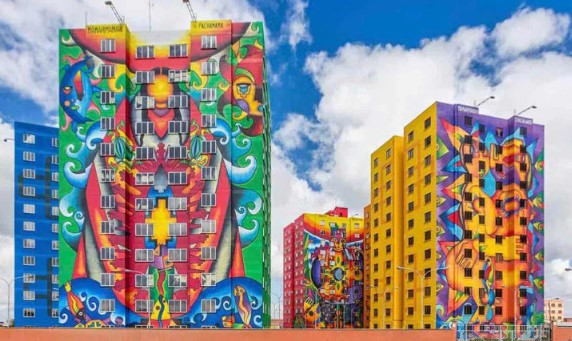
Buildings and Murals, Roberto Mamani Mamani
Roberto Mamani Mamani (Bolivia)
The Bolivian artist Roberto Mamani Mamani is an Indigenous Bolivian artist. His colorful artwork is heavily influenced by the aesthetics of the Aymara people. Ever since the colonization of the South American continent, Indigenous culture and art has been suppressed and undervalued, making his international success all the more significant. But Roberto Mamani Mamani´s art is not limited to the world of art galleries and museums. He has also painted several murals covering entire buildings in various cities across the world.
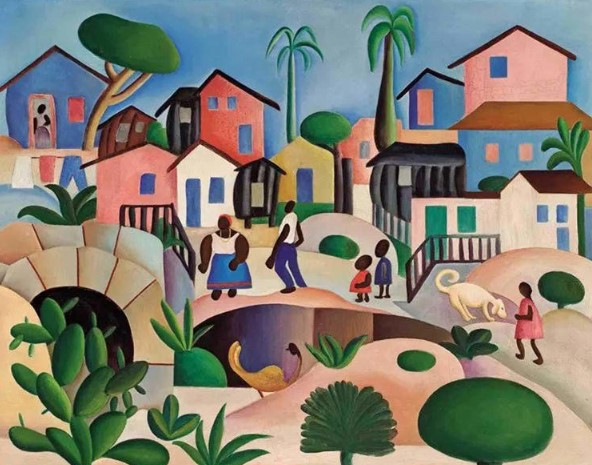
Morro Da Favela, Tarsila do Amaral, 1924
Tarsila do Amaral (Brazil)
Tarsila do Amaral was born in 1886. She has influenced the national identity of Brazil’s art world like no other artist. While her artistic style went through numerous phases, she is best known for her painting Abaporu, which shows a human being with huge feet. This painting, which some see as the most famous painting in Brazil, gave rise to an artistic movement her circle of friends came to call the Anthropophagia movement.
Anthropophagia means cannibalism and refers to the Brazilian incorporation of various cultures. In the view of the artists who sparked the movement, the unique blend of Indigenous, European, and African influences resulting from its history of slavery and colonialism has carved Brazil into what it is today. By figuratively eating up cultural practices from across the world, Brazil has created a unique identity that can no longer be controlled by colonial power structures.
While her contribution to Anthropophagia already earned Tarsila do Amaral a firm place in the Brazilian art world, she continued to experiment with various artistic styles until her death in 1972. Her body of work pays homage to the fluidity and diversity of Brazil´s colorful national and artistic identity.
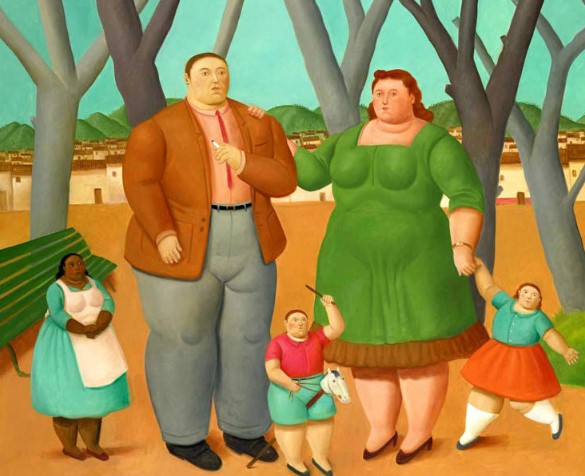
A Family, by Fernando Botero, 2006
Fernando Botero (Colombia)
The self-proclaimed most Colombian of Colombian artists was born in Medellín in 1932. Fernando Botero´s signature style has not only gained the Colombian artist international acclaim but even earned its very own name—Boterism. The artist’s sculptures and paintings are defined by the exaggeratedly fat features of his subjects, giving a dimension to his work that is both critical and humorous.
Today, his paintings are found in galleries across the world, and you will come across his sculptures in places like Yerevan, Singapore, and Jerusalem. While Botero continued to visit his hometown of Medellín until his death, he spent the last decades of his life living in Europe. He died in 2023 at the age of 91.
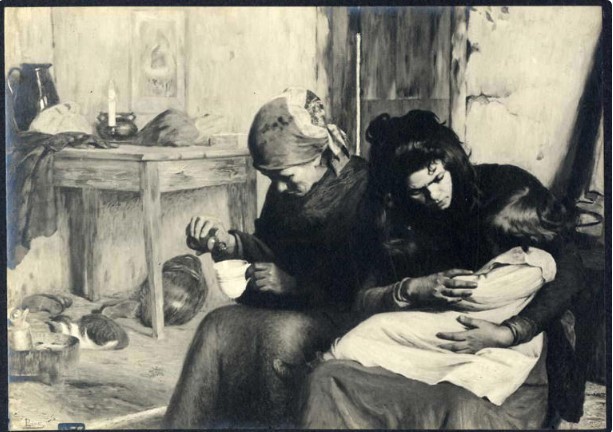
The Sick Child, by Pedro Lira.
Pedro Lira (Chile)
Pedro Lira has not only gone down in history as a painter of women but also as a key figure in the creation of Chile’s artistic scene. Born into a wealthy family in 1845, his portraits of women from different social classes document the reality of 19th-century Chile. He also co-founded Chile’s National Museum of Fine Art, proving his commitment to his home country.
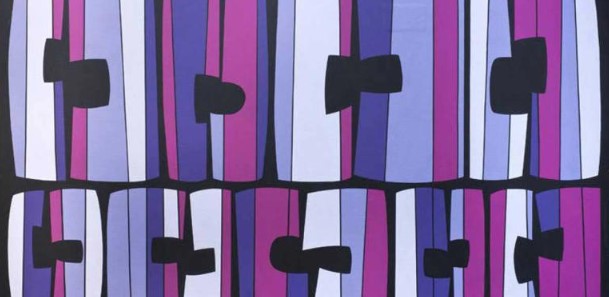
Forms, by María Freire, 1971
María Freire (Uruguay)
The Uruguayan artist María Freire was born in 1917 and is best known for her colorful, nonfigurative paintings. Her style is influenced by her study of African masks and the art of Indigenous South American populations, giving rise to a unique artistic language that transcended the colonially imposed aesthetic of the time. Together with her husband José Pedro Costigliolo, she founded the Grupo De Arte No Figurativo, which has influenced the world of art in Uruguay and beyond. She died in 2015.
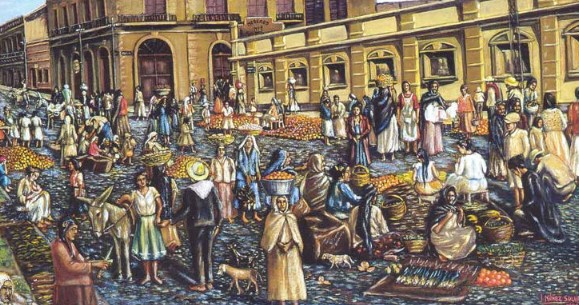
Asunción Mercado, Ignacio Núñez Soler, 1940
Ignacio Núñez Soler (Paraguay)
Born in 1891, the Paraguayan artist Ignacio Núñez Soler’s artwork was marked by his concern with social justice. Being a firm believer in worker’s rights, he created paintings showing the reality of life in Paraguay. He also refused to submit himself to the patriarchal societal standards, which is why he decided to use his mother’s last name when signing his paintings. Until his death in 1983, the artist continued to document the street life and culture of Paraguay, depicting markets, public squares, and folkloric scenes.
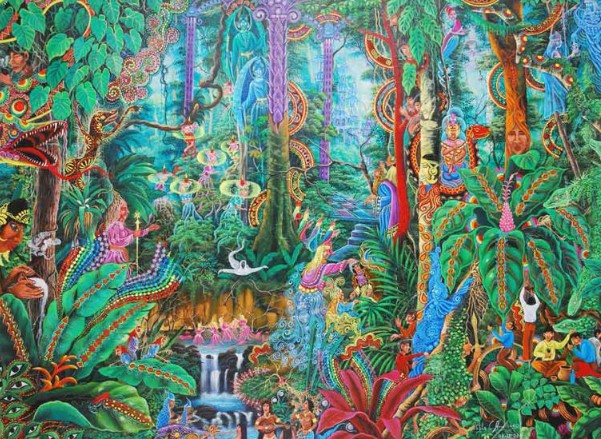
Untitled, Pablo Amaringa, Date Unknown
Pablo Amaringo (Peru)
Born in 1938, Pablo Amaringo was both a shaman and an artist. His depictions of hallucinogenic landscapes are as colorful as they are hypnotic. His intricate paintings were inspired by his experience with the shamanic plant medicine ayahuasca. The Peruvian painter started drinking ayahuasca at the age of ten, and his work as a shaman places him at the intersection of art and spirituality. His paintings are based on his visions during Peruvian plant medicine ceremonies, giving the viewer a visual taste of Indigenous cosmology and spiritual wisdom.
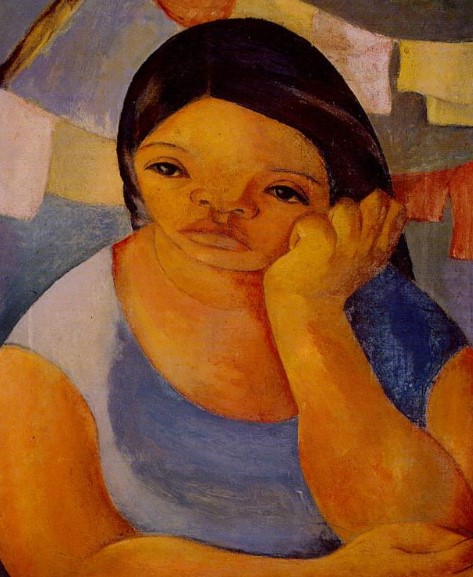
An indigenous woman
Araceli Gilbert (Ecuador)
Araceli Gilbert is considered the most important Ecuadorian painter of the 20th century. She was born into a wealthy family in 1913 and she spent several years studying and working abroad, which exposed her to various artistic influences. Upon her return to Ecuador during the 1950s, she quickly became one of the key figures in Ecuador’s intellectual scene. Like many artists of the time, she identified with left-wing politics. She is mainly remembered as the first artist who introduced nonfigurative art to Ecuador. She died in 1993 and left behind a legacy as one of the pioneers of Ecuadorian modern art.
________________
Credit: MSN