










The day I picked a peck of pickled beef in Cuenca
There are certain dishes that arrive not as recipes, but as recollections, and Sauerbraten is one of them, because I did not so much learn it as absorb it, at the age of fifteen, in a part of Germany where the forests were black, the food was serious, and the map had a sinister border.
It was my first time on an airplane, one of those British European Airways liners with propellers that seemed to pause and hang forever before taking off, and I remember the vibration more than the view, as if the whole enterprise was being held together by optimism and rivets. Jets already existed, of course, but not for me on that day, and I landed in a country that felt older than the one I had left, even though it was only a short distance away.
 I had gone to study German, or at least that was the official explanation, and I was placed with a family in the Harz Mountains, a region of wooded slopes and old silver mines and town halls with glockenspiels, where the landscape carried both beauty and a certain historical unease.
From some of the higher points, you could look across toward the barbed wire frontier of East Germany and be told that beyond it lay another world, but one that was close enough to see and far enough to be unreachable. At the age of fifteen, one does not fully grasp geopolitics, but one notices when a field is being plowed with a carthorse on one side of the barbed wire fence and a Ford tractor on the other.
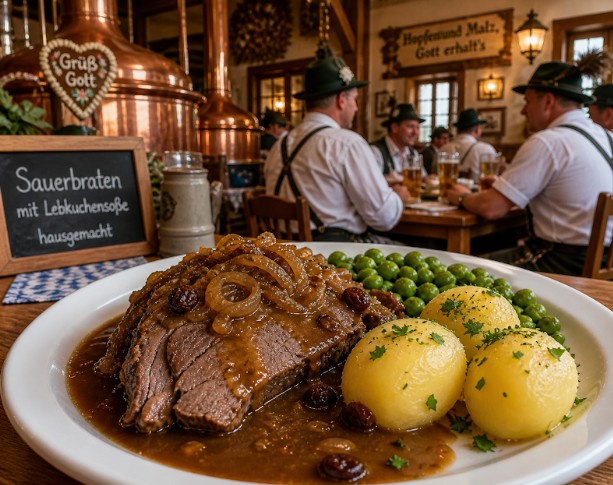
The food, however, required no translation. Sauerbraten appeared with a regularity that suggested it was not a special dish but simply what one ate when one intended to eat properly. It arrived sliced, in a dark, slightly glossy gravy, accompanied by potatoes and fermented cabbage, and it had a taste that was neither sweet nor sour, but somewhere in between, as if it had been thinking about both options and declined to choose.
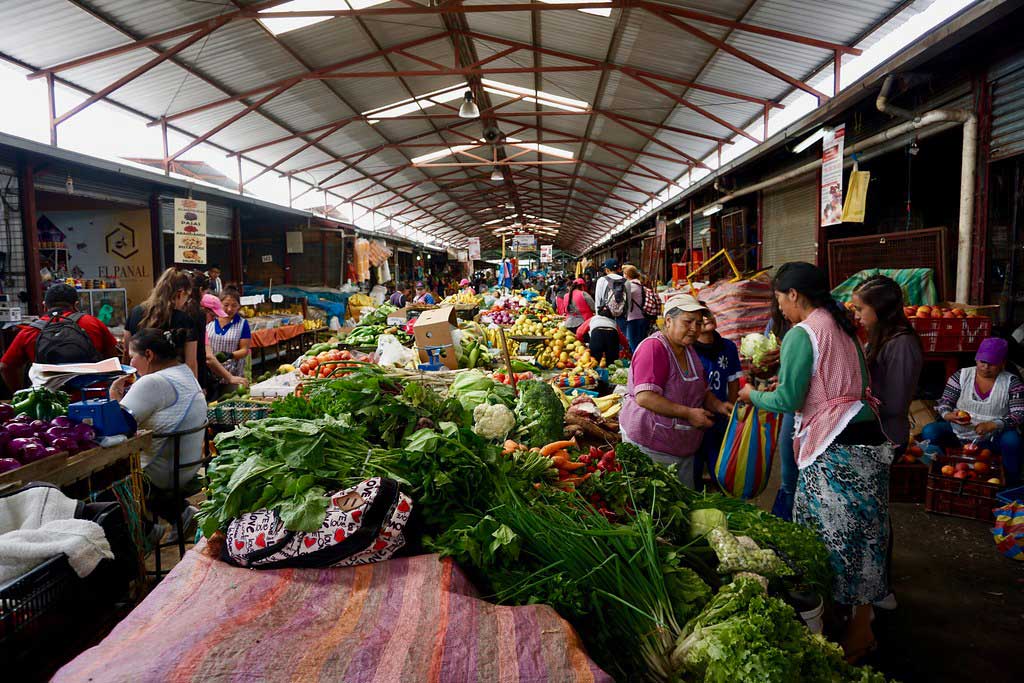
For reasons that I cannot entirely explain, I decided recently to make it in Cuenca, which is not a city that encourages the pickling of large pieces of beef, although it does not actively discourage it either. The supermarkets here, such as Supermaxi, Coral, and Tuti, will sell you everything you need, provided you are willing to improvise, which is to say, provided you are willing to cook the way that most people cook in the real world.
The first step is to submerge the meat in a bath of apple or wine vinegar, water, onions, and spices, and to put it in the fridge and leave it there for several days with a daily flip–not so much cooking as an act of patience. There is something faintly disconcerting about this stage, because it feels less like preparing a meal and more like conducting a chemistry experiment, and one is never entirely sure how it will turn out.
After three or four days, the beef emerges, having taken on a faintly altered character, and is browned in a pot before being returned to its own marinade to cook slowly for a couple of hours. The kitchen fills with a smell that is not immediately inviting, but not unpleasant either, and one begins to understand that this dish is not about instant gratification.
The moment of truth comes with the gravy, because this is where tradition collides with practicality. In Germany, one might use gingerbread or spiced biscuits, but in Cuenca one reaches for whatever is at hand, which in my case meant crushing a few plain biscuits and adding a pinch of ginger in an effort to recreate something that was never precisely defined to begin with. Sugar or panela is added to soften the vinegar’s edge, and the whole thing is left to simmer until it finds its balance.
What emerged was probably not identical to what I remember, which would be an unreasonable expectation after several decades and a change of continent, but it is recognizably related, in the way that a distant cousin might share certain features without inviting immediate identification. The sauce has that same hesitant quality, neither fully committed to sweetness nor to acidity, and the meat, having endured its days of immersion in an acid bath, is soft and tasty.
I served it with buttered potatoes, parsley, and minted peas, because some habits are difficult to abandon, although rice and avocado would have worked just as well, and I briefly considered adding fried plantains, which would have horrified my fifteen-year-old self. The result was a meal that felt both foreign and familiar, which is perhaps the most one can hope for in a place like Cuenca, where so many of us are engaged in the business of reconciling past and present.
It occurred to me, as I was eating, that Sauerbraten is not really about flavor in the modern sense, but about allowing something to become what it is over time, and about accepting that the result will never be entirely under your control.
In that respect, it may be the most appropriate dish I could have chosen.