











The weirdest bird in the world lives in Ecuador but don’t try to eat one
By Frances A. Hogg
Do you remember that thrilling scene in Harry Potter and the Chamber of Secrets when the phoenix, Fawkes, comes flying through the tunnel to the lair of the Basilisk to save Harry’s life? With his long, flowing feathers trailing behind, he was a wondrous sight! The production company used Ecuador’s weirdest bird as its inspiration for the noble character.
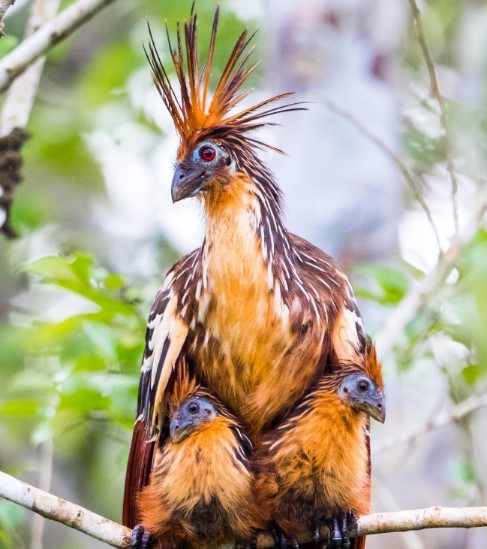
Ecuador’s ‘Stink Bird’ and her chicks.
One-hundred and fifty years ago, a group of the indigenous Siona people searched for a new home. They chose a spot on the Cuyabeno River in northeastern Ecuador largely because of the quantity of pheasant-sized fowl they found perched in the trees along the riverbanks. The colorful bird has a blue face, red eyes, bronze-to-green tail feathers with a white band, a buff-colored throat and a chestnut and black body. The long feathers of its spiky crest earned it the name Opisthocomus hoazin, which means “long hair behind” in Greek.
Unfortunately for the Siona, the community’s expectation to rely on these birds as a food source evaporated as soon as they tried to eat one. When the bird was opened, a disgusting smell rose from it like a toxic yellow cloud. The meat is inedible not only because of its terrible smell and taste, but also because crystals form in the flesh from oxides derived from the plants that it eats, which cause stomach pain and sickness in humans. (However, monkeys, snakes, and hawks find the bird quite tasty!) It is called “hoatzin” in English, but it is known locally as the stinky turkey, and in other places, the stinkbird.
Discovered by zoologists in 1776, hoatzin was originally believed to be related to Archaeopteryx, the earliest known flying animal related to birds (you would recognize its well-known feathered fossil). It has now been determined that the stinky turkey is the only survivor of a genus that evolved 64-million years ago in the Miocene era and has not changed.
Why is the hoatzin the weirdest bird in the world? This relic from the age of dinosaurs has a digestive system unlike any other bird and has been compared to cows and bison. The stinky turkey eats nothing but leaves, which it cuts into small bits with its serrated beak. The leaves are further masticated with muscular pressure and abrasion against nodules in the crop lining. (The crop is a pouch in a bird’s digestive system that temporarily stores food and begins the digestion process, located near the throat at the base of the esophagus.) In the crop, the leaf material basically rots and ferments, causing the stinky turkey to burp delightful poop-scented burps!
The hoatzin can barely fly, as most of the space in its body that would normally support flight-muscle development is taken up by its huge crop, which when filled with food, is so large and heavy that the bird must rest it on a tree branch. It takes 45 hours for it to digest a meal!
When hoatzin chicks hatch, they arrive with thumbs and fingers! They use these, along with their unusually large feet, to clamber about in undergrowth along rivers and in swamps. The finger claw disappears as the chicks’ flight muscles develop. Young hoatzins move with a creepy-crawly motion like human babies! Additionally, when threatened by predators, the chicks can drop from tree branches and can swim underwater for long stretches before using their fingers to climb back into the underbrush.
Stinky turkeys are territorial and INCREDIBLY NOISY! They are known to hiss, grunt, scream, chuff, and yelp, and can be heard from great distances. Another interesting fact about this weird bird is that there is a specific louse (Laemobothrium) that is found only in the feathers of the hoatzin.
Hoatzin do not survive long in zoos. Your best opportunity to admire this odiferous beauty is to visit one of the several eco-resorts in the Cuyabeno area.
In July 2024, my husband and I stayed at Piranha Lodge in Cuyabeno for three nights and five days. We slept comfortably, ate delicious meals, and had twice-daily excursions in motorized canoes with incredibly knowledgeable nature guides. We swam with piranhas, electric eels, and fresh-water stingrays! We saw five species of monkeys and HUGE snakes! So many birds! But because the tannin in the water impedes their development, there were no mosquitos. The only insects that attacked us were butterflies. The cost of our stay? Less than $300 per person.
I want to encourage everyone to visit this delicate and endangered ecosystem. For me, it was a life-changing event. You will learn a lot. You will do things you never imagined doing! I ate a roasted chonta grub, for gosh sakes, and allowed a huge spider to sit on my face! (It’s not a requirement, I’m just nuts.) I was constantly astounded at the magnificent balance of nature and how everything is related to everything else. If you come to Cuyobeno, I swear you will believe in God if you didn’t before.
Did you know that a woman discovered that the bark of a certain Amazon tree prevents the spread of malaria, one of the deadliest diseases known to man? She literally saved millions and millions of lives all over the world! We owe it to humanity to protect these wild areas with all their undiscovered secrets, and that is why it is vitally important for all of us to support eco-resorts. Tourism is the only source of income for the native populations. If they didn’t have our tourist dollars, the people would be forced to resort to eating the monkeys, birds and other endangered species, or to allow the area to be destroyed by petroleum extraction.
Interested in organizing a group tour? I suggest you book through Myra at Guacamayo Ecolodge. Her WhatsApp number is +593 93 906 2779. Our excellent English-speaking guide was Jairo Alvarez. The night before our trip we stayed in Quito at La Gauyunga Hostel.
__________________
 Frances A. Hogg is a writer and editor living in Cuenca for 13 years. She is the founder of the Cuenca Writers Collective and author of What’s Cookin’, Cuenca? A gringo guide to buying and preparing food in Ecuador.