
















Why did Russian missiles target a coffee machine plant in western Ukraine?
By Jonathan Mason
The missile strike in western Ukraine on August 21 drew attention to a factory in Mukachevo that most people outside the region had never heard of. The plant belongs to Flex Ltd., an American company listed on the NASDAQ stock exchange.
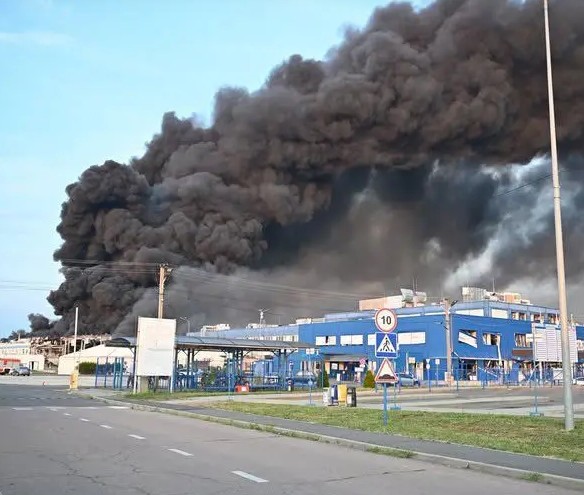
The Flex Ltd. appliance factory burns following a Russian missile attack in Mukachevo, Ukraine on August. 21.
Flex is not a household name because it does not sell products under its own brand. Instead, it is one of the world’s biggest contract manufacturers, the third largest in its field after Foxconn and Pegatron. It builds products for other companies, often with familiar brand names, and usually prefers to stay in the background.
Flex has operated in Ukraine since 2000 and opened the Mukachevo electronics plant in 2012, later adding plastics production. The site employs more than two thousand people and covers more than fifty thousand square meters.
Local reports have linked it to the assembly of Nespresso coffee machines and printer cartridges, along with electronic shelf labels, smart home devices, and other consumer goods.
Nespresso coffee machines are small countertop appliances that brew espresso-style coffee from pre-packaged proprietary capsules. The brand is owned by Nestlé.
Ukrainian business outlets have also said that products from the plant were connected to brands such as Nike, Lenovo, Philips, and Nespresso. None of this production has any obvious link to defense or weapons.
The company itself has said the Mukachevo site is dedicated to consumer and lifestyle products and has never had a role in military work. It emphasized this again in its statement after the attack, noting that the plant accounts for about one percent of Flex’s global revenue.
Independent analysts, such as the Institute for the Study of War, echoed this view by suggesting that Russia’s strike was less about hitting a military target and more about discouraging Western investment in Ukraine. No credible defense source has claimed the factory was making drones or other weapons.
Despite that, the nature of electronics manufacturing always leaves room for suspicion. The Mukachevo plant has the skills to make circuit boards, wiring harnesses, and molded plastic parts. These are the same building blocks used in consumer appliances and in more advanced equipment.
Russia can point to this dual-use potential to justify the strike, while Ukraine insists it was an attack on a purely civilian workplace. In this environment, President Zelenskiy’s firm statement that the plant made coffee machines rather than drones was both a defense of the truth as he understood it and a political response to Moscow’s narrative.
Flex’s leadership has remained quiet beyond the formal press release. That fits the company’s low profile as a contract manufacturer and its need to reassure customers and investors without inflaming political tensions.
By contrast, Ukrainian officials and the American Chamber of Commerce in Ukraine have taken the lead in condemning the strike. The episode highlights how a little-known factory producing ordinary consumer goods can suddenly become a symbol in the wider conflict. and how little the average retail consumer of news really knows about what is going on in Ukraine.