











Will the family like Cuenca?
By Jeremiah Reardon
In preparation for the arrival from New Mexico of Belinda’s brother Arnold Owens and his wife Deborah Van Buren to Cuenca, my wife and I had painted our outdoor patio. With the help of our mechanic Julio, and using Sherwin-Williams paint, the exterior space shone. We asked ourselves, “Why did it take us so long to do it?” For our guests, it took them almost two years to arrange this trip. They also had to arrange for the care of Henry, their Belgian Malinois, and find affordable flights to Ecuador.
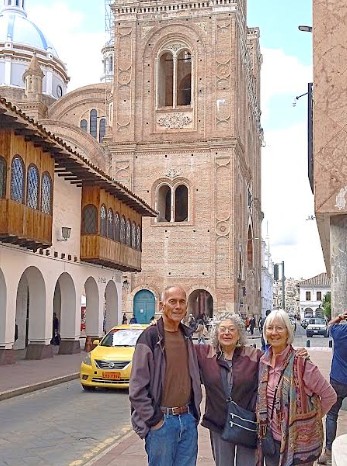
Arnold, Belinda and Deborah in El Centro.
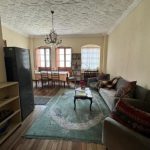
A day before Mother’s Day weekend in 2025, Belinda asked ahead of their arrival, “Do you think they will like Cuenca?” She spread out cushions and pillows on the sofa bed we had built for the occasion. “Yes, dear,” I replied while gathering the clutter in our apartment down to the building’s garage. Little space remained in our bodega after several trips on the elevator.
At the airport, first we saw Belinda’s sister-in-law Deborah enter the crowded arrivals hall. We happily greeted one another before she told us, “Arnold is dealing with our luggage.”
Arnold soon exited from the baggage area, pulling along his bag into the arrivals hall. To my mind, he appeared pensive, adjusting to finally being in our hometown. After greeting him with hugs we caught a cab to Solano Bistro near the Tomebamba River.

Celso Peralta (left) with his music students at Centro Cultural de Los Eucaliptos.
From the patio table we watched people stroll and pause in the river’s lineal park. The food soon arrived, and we shared the spicy dishes created by the Filipina owner, Debbie.
The next day, Friday, marked the Dia de La Madre celebration at Centro Cultural del Parque Los Eucaliptos. For the past year, I studied guitar in one of the center’s music classes. Scheduled to perform our songs first, our class sat in chairs with our guitars at the hall’s far wall. Much to my delight, out a window I glimpsed my family. They had taken a taxi from downtown to attend the show.
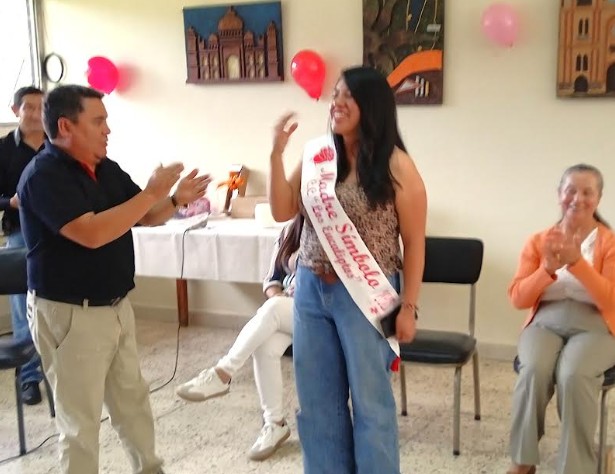
La Madre Simbola de Los Eucaliptos (The Mother who symbolizes L E).
After a delay required to set up the public address system, my class performed two Ecuadorian folk songs honoring mothers. Another class played its songs before Marcelo, the center’s director, took to the stage and announced the selection of “La Madre Simbola de Los Eucaliptos,” the mother who symbolizes Los Eucaliptos.
About ten eligible women joined Marcelo as he narrowed down the group to three with use of numbers on cards drawn by the mothers. Based on luck, popularity and beauty, the winner emerged from the varying levels of applause, preferring her over the other two. Once Marcelo fitted the winner with a red and white sash, Belinda and I hustled our jet-lagged guests from the center to have lunch.
 We went to Parque Calderon, the city’s central plaza and site of Cuenca’s New Cathedral. We entered a former seminary courtyard where cafes and restaurants lined the walls on two floors. From our table, we watched tourists and locals stroll by and snap pictures.
That evening, Deborah accompanied me downtown to the Cuenca Symphony Orchestra’s performance. It offered a varied repertoire in honor of Mother’s Day, including international and Latin American pieces, with songs sung by soprano Veronica Tola and Diego Zamora, a baritone. We enjoyed dodging young people partying in front of clubs and restaurants on our way home.
On Sunday, we took a taxi to Museo Pumapungo. The museum, a national treasure, provided educational exhibits over three floors. A room lined with windows featured our city’s dominant Cañari culture. Clay pottery and silver jewelry displayed the best of the culture’s artisan skills. Deborah and Arnold learned how the Cañari ruled the region before its conquest by the Inca in the sixteenth century.

Deborah and Arnold shop at Casa Mujer.
On another floor, life-sized coastal natives had been arranged in several thatched-straw huts, inviting us to walk through the dioramas. Our family had reservations to spend a week on Ecuador’s Pacific coast, so I explained to them, “These exhibits can provide you with an idea of the cultures you’ll encounter when you go to the coast.”
In our home, at dinner time it’s my turn to cook. With four of us for dinner, I scrambled to come up with appetizing dishes. I quickly learned how cooking for four turned out to be more work than just cooking for Belinda and myself! As I watched sunsets from the window over the sink, I’d call over Deborah and Arnold sitting on the sofa to see the colorful panorama above the Andean mountains.
Monday’s plan involved a trip to El Centro where we visited our Oregon friend Lorena. She has a top floor apartment downtown. Its communal rooftop terrace provided us with fantastic views of the cathedral domes and downtown architecture.
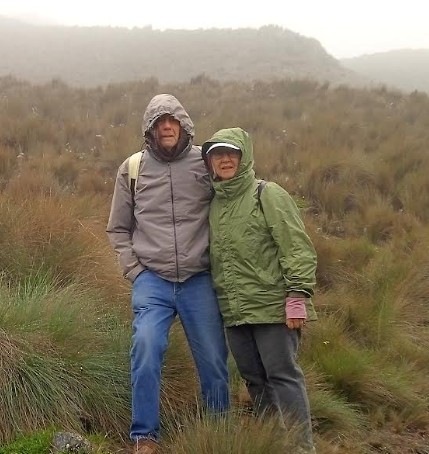
Arnold and Deborah at Tres Cruces in Cajas National Park.
Departing from Lorena’s, we strolled through Plaza San Francisco and stopped in Casa Mujer where CEMUART, the city’s artisan agency, rents “locales” to vendors. We had fun examining handcrafted makana at the locale of our friend César. The head of his artisan family commutes from Gualaceo, located an hour’s bus ride to the east. Deborah found one she liked, paying under $40 for the beautiful ikat shawl.
Just around the corner from César, we tried on Panama hats made of straw cultivated on Ecuador’s coast. Again, Deborah made a purchase. Both she and Arnold took turns wearing a violet-colored one during their visit.
On Wednesday, we awoke early. Deborah, Arnold and I planned to hike in the Cajas National Park. In preparation, a few days earlier we visited the bus terminal to learn the Cajas bus schedule. On a chilly and damp morning, we took a taxi to the Terminal Terrestre where we boarded our bus.
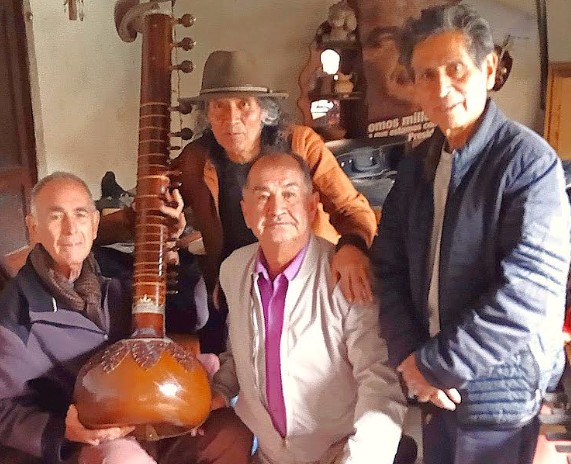
Arnold, Luis Pugo Jimbo, guest and Virgilio Pugo Jimbo (l to r).
We exited the bus into a mist with low visibility. Clouds trapped by 14,000 feet high peaks could easily turn into rain. We had arrived at Tres Cruces, the highest point on the Cuenca-Guayaquil highway named for three young men from Cuenca who died decades ago. They all froze to death after a night spent in frigid weather with inadequate clothing and poor shelter.
Arnold followed me up a metal frame stairway to a lookout point while Deborah waited below. On top, cloud layers enveloped the landscape, an awesome sight. Rejoining Deborah, we retraced the highway downhill. After a half mile walk, I detoured to avoid highway traffic. We climbed across a steel barrier to begin our hike down a steep tree-covered cliff. We held onto low tree branches to keep our footing.
I had erred in assuming that Deborah, almost a foot shorter than me, could handle the quick descent. I enjoyed hiking through the damp forest of trees with paper-like bark and the challenge it offered. Climbing down reminded me of years spent framing houses and working on roofs. We had avoided vehicles, but at the expense of Deborah losing confidence in me as a guide.
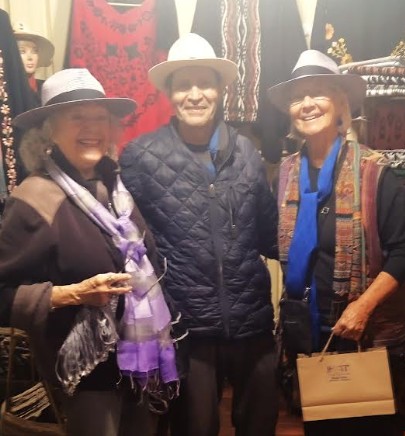
Belinda, César and Deborah in his handwoven makana shop.
Once off the cliff and walking on a stony Incan trail, she chided me. “Jeremiah, if you lead hikers onto that hill, you have to stay with them to help them get down it.” This left me feeling shaken after anticipating a day communing with nature in the Andes.
Our hike concluded after hailing a bus at the Cajas ranger station to arrive at the park’s entrance. Nearby, a few restaurants serve hikers and motorists alike. We found one offering trout dinners. Our meal began with a pitcher of warmed canelazo, a spiced alcoholic beverage. Seated near a wood burning stove, we cheered once the waitress appeared with dishes of fried trout, rice, white corn and salad.
The next morning, Thursday, having thought over what Deborah had complained about during the hike, I apologized to both her and Arnold for misjudging her ability to take my improvised path. In turn, she replied, “Thank you, Jeremiah. I appreciate very much that you said that.”
Later in the morning over breakfast which Belinda had prepared, we excitedly told our guests that we had planned a special day for them. Both Deborah and Arnold play ukulele. Arnold, a fine cabinetmaker, had built one of his own. And I had spent the past two years as an apprentice to luthier Luis Pugo Jimbo who helped me to finish an acoustic guitar started in a previous workshop. For our friend Lorena, I helped Luis repair both her guitar and charango, the armadillo-shaped Andean ten-string instrument.

Belinda, Deborah and Janda Grove with her painting.
We arrived in a taxi on a hillside above downtown at the family’s adobe home. Luis and his furniture-making brother Angel share the dwelling left to them by their luthier father. After taking several stone steps down from the sidewalk, we walked past a lush vegetable garden and rusting vintage vehicles before coming to double wooden doors.
Luis wore a broad-brimmed felt hat and blue jeans when he greeted us. Half a dozen pet dogs vied for human affection. Upstairs in his living quarters next to his skylit workshop, Luis brought out instruments from their cases to show his creativity, ranging from a violin to a standup bass.
From his home a block away, Luis’s older brother Virgilio arrived with his own instruments including a brown-stained ukulele. Soon, the brothers struck up indigenous melodies on guitar and zampoña, a traditional Andean pan flute.
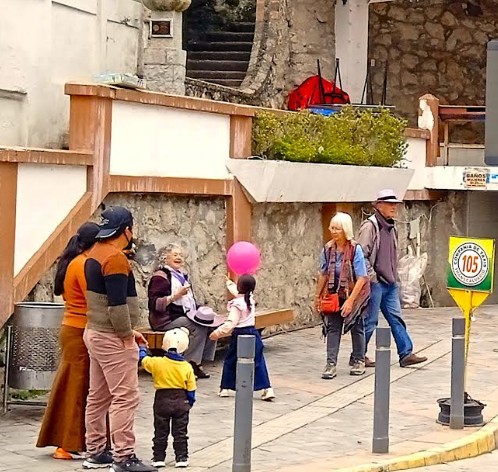
Deborah and girl bat balloon on Turi street.
Both Deborah and I took pictures. My favorite shot has Arnold holding an Indian sitar acquired by Luis in a trade for one of his violins. Arnold sits with the sitar on his lap in the company of the brothers and another guest.
On Friday, Deborah and Arnold rode in a “buseta” on its three-hour journey to Ecuador’s largest city and main port, Guayaquil. The Cuenca van dropped them off at the main bus terminal where they boarded one for Olon. For the next week, they stayed in the sleepy seaside town where Belinda and I had relaxed in 2013 after our arrival in Ecuador from California.
One day they took a bus headed north and visited Puerto Lopez’s commercial fishing port. From there, a ferry ride brought them to Isla de La Plata. On the island, twenty-four miles out in the Pacific, they hiked under a hot sun on trails swarming with blue-footed booby birds which pestered them whenever they approached nests. They also went snorkeling in warm water where they swam with tropical fish, manta rays and turtles.
A week passed before Deborah and Arnold arrived back in Cuenca on a Friday afternoon. Belinda and I agreed that the visit so far had gone well. They appreciated learning about Cuenca from guests in our home. Over coffee and tea, they chatted with our neighbor, the art historian Berenice Cardenas. On another occasion, we had dinner with Ligia, our house cleaner, who came with her husband José and their son Cristián.
Returning to Cuenca, our family felt confident in Guayaquil’s vast terminal to transfer from the Olon bus onto a Cuenca-bound one, to save time by forgoing use of a van service. When they arrived in a taxi at our building, Belinda and I happily greeted the weary travelers.
The next morning, Deborah, Belinda and I returned to Plaza San Francisco to shop. Arnold had been stricken with food poisoning on the coast and rested at home. In town, we learned how electrolyte drinks help people in Arnold’s condition. I quickly brought a bottle back to the apartment. He called to me from the bathroom and said, “Leave it outside the door.”
That afternoon the Peruvian artist Maite Eusebio held a lunch buffet at her home in the country. Belinda, Deborah and I joined about twenty others gathered for the occasion. Deborah enjoyed this great opportunity to meet the hosts, Maite and her artist husband Alberto.
On Sunday, Arnold awoke feeling much better. We visited the artist Janda Grove who lived around the corner with her husband Dan. Deborah and Arnold enjoyed getting to know them and seeing Janda’s paintings. Also, they saw in a hallway and two bathrooms the three ceramic mirrors made by Belinda.
Afterwards, our family group went to the home of Frances Hogg Lochow and her husband Robert. Franny’s the moderator and founder of our Cuenca Writers Collective, and a miniaturist. She and Deborah graduated a few years apart from the same college, California State University in Fresno. We all gathered around her miniature doll house to admire its furniture and decor. In a second-floor bathroom, Franny showed them another one of Belinda’s ceramic mirrors.
On Monday, May 26, the morning of Deborah and Arnold’s trip back to New Mexico, we took a taxi up to Turi, a hillside town to the south of Cuenca. On a clear day we enjoyed fantastic views of the city and the surrounding mountains. We had lunch at a restaurant overlooking the village of Turi and its whitewashed church. Later, across from the church, Deborah and a little girl batted a pink balloon back and forth, to her family’s delight.
In the afternoon, Belinda and I accompanied our visitors to Cuenca’s airport. They quickly acquired boarding passes and checked in their luggage. After a brief goodbye we waved them into the boarding area.
With our family back home in New Mexico, when we chat on the phone or send emails, they have a greater sense of our lives. Gone is that vagueness which accompanied earlier communications between us. Staying in Cuenca and exploring Ecuador has given Deborah and Arnold a new appreciation of the lives we have chosen to live as expats. And, yes, they really do like Cuenca!



Hogar Esperanza News
The Cuenca Dispatch

Week of September 20
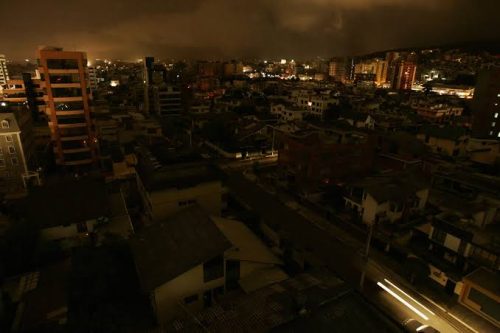
Ecuador turns to industrial power cuts to protect Mazar and keep homes from going dark.

Ecuador raises its 2026 growth forecast, but El Niño could spoil the outlook next year.
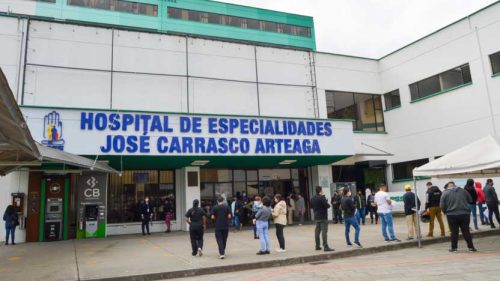
Cuenca retirees challenge medical and therapy changes at IESS senior center.
Fabianos Pizzeria News

Fund Grace News
