













Beyond Machu Picchu: Espíritu Pampa is where the Inca Empire made its last stand against the Spanish
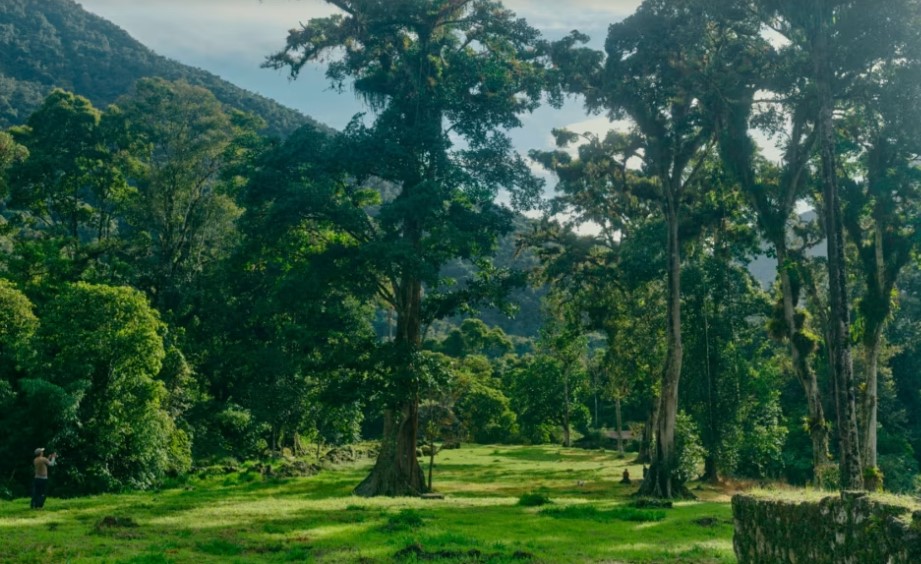
Dense jungle presses in on all sides at Espíritu Pampa. It was identified as the last city of the Incas barely 50 years ago, and only part of the site has been excavated © Nick Ballon
By Laurence Blair
Fifty miles north-west of Cusco, where the Andes crumple into the Amazon, lies Espíritu Pampa: the last capital of Inca resistance against the Spanish invaders. Colossal strangler figs have taken root atop ruined doorways. Crumbling yellow paint coats the walls. Decades after the conquistadors landed in Peru, four Inca emperors held out here, stirring up rebellion.
The explorer Hiram Bingham bushwhacked his way down here in 1911, but another lost Inca city had already caught his eye. “Few romances can ever surpass that of the granite citadel” — he later wrote — “of Machu Picchu, the crown of Inca Land.” Mistakenly proclaiming it the last city of the Incas, he helped ensure its fame: today more than a million visitors cram into the soaring mountaintop city every year, making it the country’s top attraction.
Espíritu Pampa, meanwhile, has yet to capture the attention of the tourist industry. Its caretaker, Ángel Chilla, swings a petrol strimmer to keep the jungle off a labyrinth of cobwebbed chambers. Asked how many visitors turn up in the average week, he stops to ponder. “Between one,” comes the eventual answer, “and zero.”
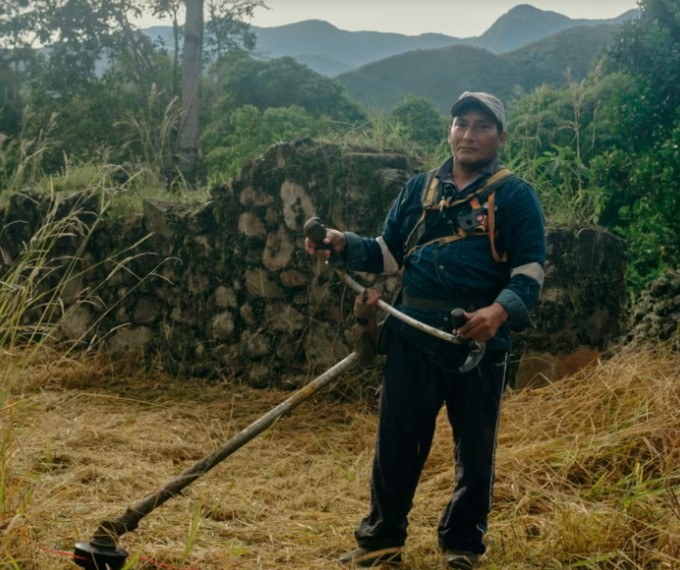
Espíritu Pampa’s caretaker Ángel Chilla, keeping the encroaching jungle at bay with a strimmer © Nick Ballon
I’d come here with photographer Nick Ballon on a personal assignment. His ancestor, Mansio Serra de Leguizamón, was a conquistador and one of the first Europeans to set foot in the Inca Empire, which once stretched from Colombia to Chile. Within a few years of the Spanish conquest in 1532, all that remained was this remote enclave, Vilcabamba, with its court at Espíritu Pampa.
In 1572, Serra, by then an old soldier (later sometimes known as “the last conquistador”) was called out of retirement to help bring the rebel principality to heel once and for all. Yet on his deathbed, he confessed to deep remorse. The Inca realm was a lost paradise, he lamented, where “all things, from the greatest to the smallest, had their place and order”.
Our plan was to trace Serra’s story and the legacy of the Inca Empire, starting in Cusco, its capital until the Spanish conquest. From there, we would journey through the Sacred Valley and the Vilcabamba region to Espíritu Pampa over a week, travelling by public transport, taxi, 4×4 and occasionally on foot.
The regimented harmony Serra spoke of is still evident in Cusco, whose name in Quechua, the language used by the Inca and some 10mn South Americans today, means “the navel of the world”. The city’s passageways are lined with bulging polygons of volcanic rock, expertly cut and joined near-seamlessly without mortar. The masonry is at its most refined at Qoricancha, the Temple of the Sun, the empire’s most important place of worship. Much of the temple was destroyed by the Spanish, who built the church of Santo Domingo on the site, but some of the original walls, and a few of the rooms, remain.
 Inside, an empty niche once held a statue of Inti, the Inca sun god, flanked by sheets of gold. “When the light caught them,” wrote one Spaniard who beheld it, “the idol could not be seen, but only their blazing radiance.” While the Spanish — having captured and murdered the emperor Atahualpa — melted down many of Cusco’s treasures in 1533, some of the surviving goldwork is displayed at the stylish Museo de Arte Precolombino, along with ceramic vessels of stunningly lifelike faces and deer-headed gods.
Next door to the museum sits Serra’s former residence. Built atop a college for Inca nobles, the doorway is decorated by carved snakes — a symbol of wisdom — and his coat of arms. Today, it’s home to a smart hotel, the Belmond Palacio Nazarenas, containing a series of internal courtyards and fountains. One houses Mauka, a restaurant by Pía León (one half of the team behind the celebrated Lima restaurant Central), championing highland ingredients like alpaca carpaccio, tangy mashua tubers and Andean trout ceviche.
William Palomino Gamarra, the in-house restorer of the hotel’s art collection, shows us its colonial-era murals. They seem bucolic: except for the figures missing hands. “Some parents mutilated their children,” says Palomino, “so the Spanish wouldn’t send them down the silver mines.” Cusco school painters, though trained by Jesuits, often included subtle nods to Andean reality. In the city’s cathedral, for example, hangs a Last Supper from 1748 complete with roasted guinea pig. (Quinta Eulalia, a traditional lunch spot, is the best place to try it).

The Velmond Palacio Nazarenas in Cusco. The hotel was a school for Inca nobles and a Jesuit college in its former lives © Nick Ballon
Serra and company crowned a puppet emperor, Manco Inca Yupanqui, but their abuses prompted him into revolt. After raising an army, in 1536, Manco laid siege to Cusco from Sacsayhuaman, a fortress of zigzagging, supersized stonework that today serves as the city’s principal park. On the winter solstice, it hosts Inti Raymi, the Festival of the Sun, revived in 1944 from a description by the historian Inca Garcilaso, the son of a conquistador and an Inca princess.
Nick and I call on Alfredo Inca Roca, a descendant of Peru’s ruling house who has played the Inca emperor in eight editions of Inti Raymi. Local thespians were incensed when Alfredo — who has a patrician bearing but no theatrical training — was first selected in 1995. “I told them, ‘you can learn to be an Inca. I’m Inca every day of my life.’” He proudly shows us a basket of white Peruvian corn from his smallholding, their kernels fleshy and bulbous. Another ear, spray-painted gold, adorns the wooden prop that serves as his sceptre.
Food was power for the Incas. Their prestige rested on their ability to make Peru’s unforgiving terrain — blasted deserts, barren slopes prone to punishing frosts — feed up to 14mn subjects. A clue to how they did it is Moray, two circular terraced depressions, like Colosseum-shaped quarries, carved into the mountainside 90 minutes’ drive from Cusco. This was seemingly an agricultural laboratory, used to test crops at different altitudes. It’s a fitting location for MIL, an experimental offshoot of Central, which offers a “vertical journey” through rare grains, ancient Peruvian potatoes and the ambrosial nectar of the cabuya cactus beloved of the Incas.
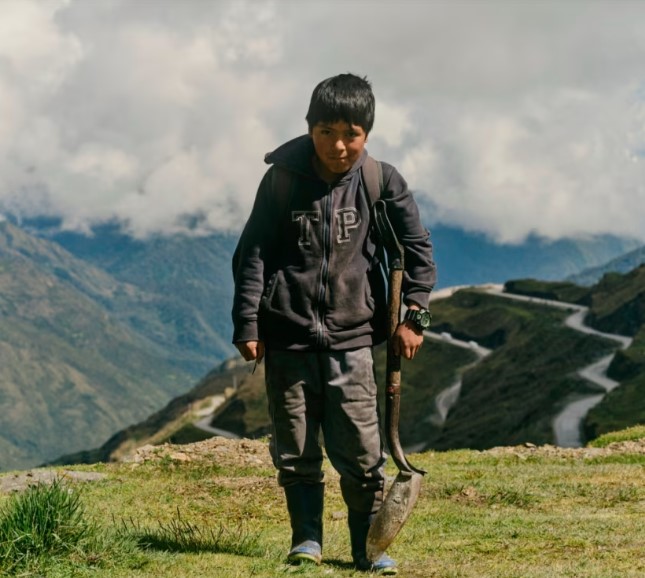
Christian Ispe Quispe, an 11-year-old boy, waits for a lift back down the Abra Malaga pass after spending a day filling in potholes in the hope that passing drivers will give him a few coins.
Our next stop is Ollantaytambo, where the clifftop fortress of sun-dappled stone calls to mind Tolkien’s Minas Tirith. It served as Manco’s rebel headquarters during the siege of Cusco, successfully repelling a Spanish attack in 1537, but when reinforcements arrived in the region Manco was forced to flee towards Vilcabamba. Exploring the peaceful upper reaches, fragrant with muña, an Andean mint, we spot the luxurious tourist train to Machu Picchu, a thread of gold and blue in the valley below.
We’re in for few such creature comforts. A driver speeds us up the switchbacks of the icy Abra Malaga pass, huayno pop music blaring. At the top, we pick up a solemn 11-year-old named Christian Ispe Quispe clutching a spade. His parents have sent him to fill in potholes in the hope of a few soles from passing truckers.
As we descend, the scenery turns greener and steamier. From Quillabamba, the gateway to the Peruvian Amazon, an eviscerated minibus takes us along a bumpy track high above the Vilcabamba River, past a statue of Manco on horseback trampling a conquistador. We’re caught at roadworks for an hour, and make do with a lunch of crackers and Inca Kola.
We come across Jorge Cobos, a seasoned local guide, in the single-street village of Huancacalle. He’s been working on a restoration project at the nearby Inca shrine of Yuraq Rumi, a sculpture garden of rocks the size of battle tanks, scored with channels that once ran with the blood of sacrificial guinea pigs. Perched on the hilltop above, Vitcos — Manco’s temporary capital — glints in a shaft of sunlight.
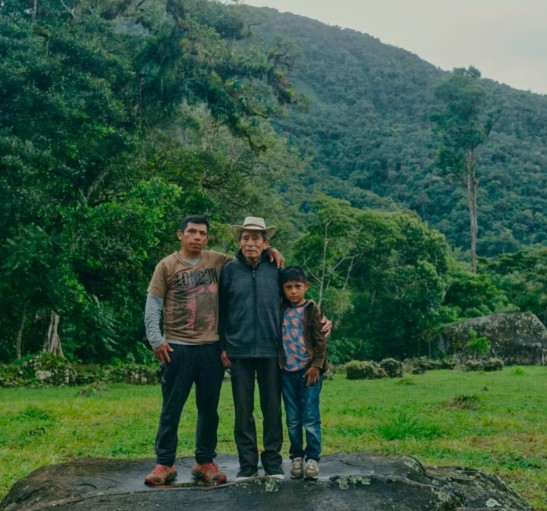
Our guide Jorge Cobos, with his eight-year-old son Danilo and father Flavio, 93, amid the ruins of Espíritu Pampa © Nick Ballon
We pass through trapezoidal doorways of white granite to the grassy plaza where Manco was fatally stabbed in 1545 by a renegade group of Spaniards to whom he had been offering protection. His terrified heirs retreated deeper into the wild at Espíritu Pampa. “Never have honest dealings with such people as these,” he told them with his last breath, “for I was fooled by their honeyed words.”
Climbing into a borrowed truck the following morning, I find Danilo, Jorge’s eight-year-old son, and his father Flavio, 93, squeezed in the back. Flavio was born at Espíritu Pampa, and returned with explorers to conclusively identify it some 60 years ago. “It might be dad’s last chance to see where he grew up,” Jorge explains.
Espíritu Pampa can be reached on foot from Huancacalle over several days through dripping cloud forest. The route — which follows part of the Qhapaq Ñan, the Inca road network — has no amenities; hikers should come with local guides, tents, supplies and machetes. But it’s an adventurous, little-trod alternative to the Inca trail, and can be added on to trips to Machu Picchu and its sister city, Choquequirao.
Our impromptu family outing instead sets out along a winding dirt road that has recently been completed: a transformative event for isolated local farmsteads. Up on a misty moor, we meet a wizened figure with a frayed sack around his waist. Francisco Huaman Villegas lives alone in a stone hut with eight cows for company. He’s a little over 60 — he tells Jorge in Quechua — but can’t be sure: he’s an orphan, and never received a birth certificate.
Late that afternoon, having crossed a dozen boulder-strewn streams, we reach Espíritu Pampa. The electronic honk of yellow-rumped caciques rings through the forest clearing. Shimmering blue morpho butterflies flit from temple to tomb. Other than from Ángel, the groundskeeper, there’s no information to be had, so I pull up some pre-downloaded maps.
With a little effort, you can imagine acolytes laying platters of guava and sweet lucuma before Manco’s mummified body; his sons holding court in a great hall with 24 doorways, fallen lintels now entwined by roots. “The Incas,” reported a contemporary, “did not miss the opulence, pleasures and grandeur of Cusco in that distant land of exile.”
In 1572, Serra enlisted in an expedition to finally subdue Vilcabamba. The army braved ambushes by Amazonian archers, rolling boulders, and fierce fighting with the Inca captains dubbed orejónes, “big ears,” for their gem-studded lobes. But the young Inca, Túpac Amaru, set fire to Espíritu Pampa and fled into the jungle with his pregnant wife, tracked by a squad of conquistadors.
Among them was Serra’s half-Inca son, Juan, who promised Túpac Amaru mercy if he came quietly. The Inca was led back to Cusco in a golden chain and sentenced to death. Chiefs from across his grandfather’s empire crowded the balconies, rooftops, and hillsides. As the executioner’s sword fell, their cries of grief were drowned out by church bells ringing out across the navel of the world.
Espíritu Pampa lay forgotten for centuries, outshone by Machu Picchu. Peru’s perennial instability has disrupted promising excavations. The late archaeologist Javier Fonseca, who unearthed a pre-Inca lord in silver armour at Espíritu Pampa in 2010, told me he was once held at gunpoint by guerrillas mid-dig.
Eighty years ago, “this was all jungle”, says Flavio. He recalls hunting wild pigs through tunnels of root and stone. Danilo, so far engrossed with his father’s phone, gazes around the ancient trunks. As if to break the spell, a teenager on a motorbike bumps down a mossy stairway and revs over the Inca bridge where Bingham posed above his porters. That night, bedded down in a shed belonging to Jorge’s relatives, I’m lulled to sleep by the burble of guinea pigs roaming the earthen floor.
Bigger upheavals than roads are coming. From late 2026, overseas visitors will descend in jumbo jets through the Sacred Valley, landing at a new international airport near Moray before being funnelled to Machu Picchu.
Thousands of jobs have been promised. But the strain on the photogenic royal retreat in the clouds, already surpassing visitor limits recommended by Unesco, will only grow.
If Peru were to better promote sites like Vitcos and Espíritu Pampa, the benefits of tourism could be spread more evenly. And perhaps it would put right a historical wrong, defying the Spanish viceroys who erased Manco Inca and his sons from the official record.
So wished Inca Garcilaso, the Cusco-born historian, who brought to a close his Royal Commentaries of the Incas with the execution of Túpac Amaru, his cousin. “I hope I have as well done justice to the Spaniards, who have conquered this Empire”, he concluded, “as to the Incas, who were its true lords and possessors.”
_________________
Laurence Blair is the author of ‘Patria: Lost Countries of South America’, a new history of the continent, published by Bodley Head.