

















Build a better digital wallet and they might come: Ecuador should dust off an old (better) idea
As Cole Porter wrote and Louis Armstrong once sang in a duet to Ella Fitzgerald, “Let’s do it, let’s fall in love.” These days in Cuenca, it seems everyone’s doing it, only they are falling for digital transfers instead. Not cards, not cash, just a quick hop from your account to theirs. Taxi drivers do it. Dentists, cafés, and half the shops around Feria Libre do it. Even Cuenca gringos do it. The phone is whipped out, a QR code appears, and the deal is done before you know it.
Banks around these parts do differ a bit, but Banco de Pichincha calls its system Deuna (de una vez = instantly). You don’t have to use QR codes, if you want to go the long way around, entering someone’s account number, but Deuna and its banking brothers and sisters are snappier, and, I suppose, cooler.
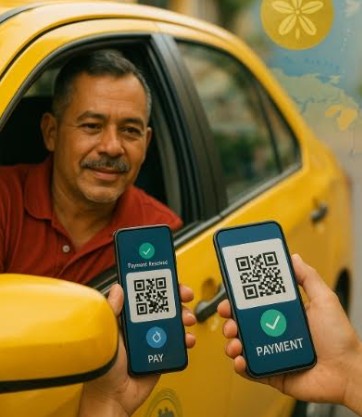 The curious part is that Ecuador already invented this idea years ago. It was called Billetera Móvil, or BIMO for short, and it was supposed to revolutionize the way Ecuadorians paid each other. The central bank launched it in 2020 with lots of pomp and almost no marketing. You could send money from one phone to another, instantly and free. It worked perfectly well, except that hardly anyone used it. At least not in Ecuador, but read on.
The private banks weren’t keen on BIMO. They had their own apps and saw no reason to promote a competitor owned by the government. So BIMO faded into the background while the banks built their own QR systems. Now every big bank has a slightly different one, and none of them talk to each other. It is a bit like Cuenca’s bus system before the tram arrived and you had to pay each driver in cash.
Meanwhile, in the Caribbean, small island nations are doing something Ecuador once dreamed of. Jamaica has JAM-DEX, a full central bank digital currency. Barbados runs Ezpay+, which works for taxis, shops, and even government offices. And the Bahamas has the Sand Dollar, the region’s first fully digital currency, already in daily use.
The Sand Dollar was created because many Bahamians live on outlying islands with few or no bank branches. When hurricanes strike, roads close and cash runs short. The Central Bank of The Bahamas built a system that lets people pay each other instantly by phone, even across islands, without needing Visa or Mastercard. Every digital dollar equals one Bahamian dollar, which equals one US dollar, so it is as stable as cash but safer to carry.
The beauty of the Sand Dollar is that it works like cash in your pocket but is issued directly by the central bank of the Bahamas. Merchants can accept it using a QR code, and transfers cost nothing. It keeps money circulating inside the country, reduces risk after storms, and brings financial services to people who never had a bank account. That is the kind of public-spirited innovation Ecuador could easily copy, an earthquake-proof system adapted to its own geography.
That is the reason many Ecuadorian merchants ask for transfers rather than card payments. A transfer costs them nothing. A card payment costs them up to four percent and it is a week, sometimes two weeks, before they see the money in their account. (Trust me on this, I have first-hand information from a Datafast user.)
 But under current Ecuador law, they are not allowed to add that four percent onto the advertised price, only to offer a discount for cash. The rule made sense when cards like Visa and Mastercard were the only game in town. It looks absurd now that digital payments can go straight from bank to bank with no middleman at all.
If Ecuador wants more financial inclusion, it needs a system that works for everyone, not just the banks. A new version of BIMO could do that. Imagine a phone app that works the same for Banco Pichincha, Banco Guayaquil, JEP, or a taxi driver’s cooperative. The merchant would pay no commission, the customer would see one clear price, and the government would still have a digital trail for taxes like IVA, which is what the government really, really cares about. That would be progress.
BIMO failed partly because it was ahead of its time. Now, with every Cuencano taxi driver acting as an unofficial fintech pioneer, maybe the time has caught up. Ecuador just needs to dust off the old idea, give it a better name, and this time, make sure it actually leaves the station.
As Mick Jagger once sang in an update of a 1920’s Robert Johnson blues classic, “When the train left the station, it had two lights on behind.” Let’s hope Ecuador doesn’t miss the train again, else it will be another missed connection on the digital platform and all in vain.



Hogar Esperanza News

The Cuenca Dispatch

Week of August 23

Ecuador’s economy grew 2% during the first half of 2026 compared with the same period a year earlier, according to new Banco Central del Ecuador data.

Cuenca gets a prime view of next week’s deep partial lunar eclipse.

Ecuador’s economy grows 2% in the first half of 2026.
Property Manabi

Fund Grace News

Nice apartment banner

Fabianos Pizzeria News
