













Come fly with me
Every few years, usually around election season, someone digs up the old slogan “Make America Great Again” and waves it around as if it were a detailed policy document rather than a vague memory of something that may never have existed.
If we could actually wind the clock back, exactly how far would we go, and to which version of the country.
Would it be the mid-1950s, often remembered as a period of confidence and stability, even though it was also an era of deep social exclusion and unspoken fears. Would it be 1956, which, from a musical point of view at least, may have been one of the greatest years in the history of recorded sound.
 By then, the new LP technology, using 33⅓ rpm records, had taken hold, alongside 45 rpm singles. Old 78 rpm limitations were disappearing. Record companies began rerecording classic material in better sound, while musicians suddenly had the space to stretch out. The result was an avalanche of revived standards, new compositions, and extended performances that simply would not have fitted on the old three-minute discs.
It was not nostalgia. It was technology meeting talent.
Great when, exactly, great for whom, and great in what sense are questions that rarely receive serious answers.
The phrase floats in the air like a nostalgic perfume, hinting at an America where everything worked, Americans could dream, everyone was polite, wages were fair, music was better, and nobody ever shouted in airport lounges. It is a comforting idea, rather like believing that bread used to taste better and doctors used to listen longer.
But suppose, just for a moment, that we took the slogan literally and tried to define “great” in cultural terms rather than political ones.
For me, one obvious starting point is a live music recording.
Sinatra at the Sands, recorded live with the Count Basie Orchestra, remains one of the highest expressions of American popular culture ever put on tape. It is relaxed, witty, technically flawless, and quietly confident. Nobody is trying to impress anyone. Nobody is grandstanding. Everyone already knows they belong there.
Some people complain that it sounds too smooth, too polished, too comfortable, but that is precisely why it is great.
It captures artists who have done the work, paid their dues, learned their craft, and no longer need to prove anything. It sounds like a country that trusted its own abilities.
On my shelves, there is also an old recording called The Swinging Mr. Wilkins, the first half of what later became known as The Everest Years. It is big-band music played with precision, swing, and intelligence, tearing through popular film and musical tunes from the 1950s with complete confidence.
Some critics complain that the tracks are too short, but I think that misses the point. Each piece arrives, says exactly what it needs to say, and leaves before it becomes self-indulgent. In that sense, it resembles good journalism, good editing, and good conversation.
For my money, taken as a whole, it may be the finest American jazz instrumental album ever recorded, not because it is flashy, but because it is complete.
That same America produced Count Basie’s economy, Frank Sinatra’s phrasing, Ella Fitzgerald’s ease, Duke Ellington’s authority, and Hoagy Carmichael’s gift for writing melodies that felt as if they had always existed.
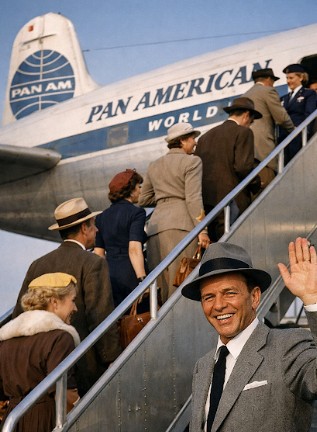
It was also an America that celebrated movement and possibility. Jet travel had arrived, and Sinatra sang “Come Fly with Me” as if boarding a plane were a social occasion rather than a security exercise. Space exploration followed, and “Come Fly with Me” was echoed by “Fly Me to the Moon.”
Before that, there had been the great age of trains, memorialized in “Chattanooga Choo Choo,” with its promise of “dinner in the diner, nothing could be finer,” a line that still sounds more civilized than most modern fast-food menus and sandwiches wrapped in cling film.
It produced Otis Redding singing as if the song might break him in half, Aretha Franklin turning respect into a constitutional demand, Ray Charles stitching together gospel, blues, and country, and the Tamla Motown song factory proving that discipline, songwriting, and elegance could thrive inside popular music.
It produced the close harmonies of doo-wop groups learning by ear under railway bridges and in school hallways. It produced Elvis Presley absorbing gospel, blues, and country and turning them into something that unsettled parents and electrified teenagers. It produced Sister Rosetta Tharpe playing electric guitar in a fur coat and high heels long before anyone decided women were allowed to do that.
It produced Willie Nelson and Johnny Cash carrying country music beyond novelty and into moral storytelling, and Woody Guthrie insisting that songs could be tools of citizenship.
It produced great tunes like “Perfidia,” “Starlight,” and “I Will Survive,” songs that endured because they were well made, emotionally honest, and endlessly adaptable. The last of these titles was still blasting out in Kywi last week as I shopped for a glue gun.
That era also produced spectacle grounded in craft. The Nicholas Brothers turned dance into airborne architecture, combining athleticism, elegance, and musical intelligence. The Glenn Miller Band created a sound so distinctive that a few bars still summon an entire shared era.
For a brief period after the Second World War, despite Cold War fears and deep social injustices, America experienced something like collective confidence. After a century of almost continuous wars to end all wars that never quite did, there was global peace, prosperity, expanding education, and a widespread belief that life might continue to steadily improve.
That belief fed culture.
In literature, it produced writers who treated ordinary life seriously. As a teenager in London, with only the vaguest idea of what America was really like, I began reading John Updike’s Rabbit novels and watched one flawed, restless man age across decades. It produced F. Scott Fitzgerald capturing both glamour and emptiness, John Steinbeck giving dignity to migrant families, James Baldwin demanding honesty, and Ray Bradbury warning against cultural shallowness.
In film, Billy Wilder trusted audiences with intelligence, Katharine Hepburn made independence look normal, and James Stewart specialized in moral hesitation. Films such as It’s a Wonderful Life, On the Waterfront, 12 Angry Men, and The Grapes of Wrath treated ethics as serious entertainment.
It produced Woodstock, chaotic and idealistic, flawed and sincere, as a moment when a generation briefly believed that music, community, and decency might be enough.
In painting and photography, Edward Hopper showed loneliness without melodrama, Dorothea Lange photographed poverty without exploitation, and Andy Warhol held up a mirror and walked away.
Then there was Mister Rogers, who treated children as moral equals, and Studs Terkel, who listened to ordinary citizens as if democracy depended on it.
What links all these people and moments is not nostalgia or ideology. It is discipline, seriousness about work, respect for audiences, and the belief that popularity and quality do not have to be enemies.
They practiced, revised, rehearsed, and polished their style. They learned from forebears and slowly improved.
From my apartment in Cuenca, where the afternoon soundtrack is usually a mixture of bus engines, street vendors, and distant reggaeton, it is easy to forget how much American culture once depended on patience.
Today, everything is faster, louder, and more monetized. Travel is stressful. Music is disposable. People seem angry about a lot of things.
So when I hear “Make America Great Again,” I think less about factories and flags and more about rehearsal rooms, libraries, newsrooms, recording studios, dance studios, editing desks, and railway diners.
Bring back the America that produced Basie and Otis, Smokey and Hoagy, Rosetta and Elvis, Guthrie and Cash, the Nicholas Brothers and Glenn Miller, Updike and Fitzgerald, Hopper and Rogers, Sinatra at the Sands and Ernie Wilkins in three perfect minutes.
Bring back the America that believed excellence was something you earned over time, not something you declared in capital letters.
I think that would be a start.