













Confronting the enemy within: To fight illegal mining, the government must first put its own house in order
Corrupt government employees are major facilitators of illegal mining in Ecuador. This is one of the conclusions of a new report by the United Nations Office on Drugs and Crime. “To effectively combat the rapid increase of illegal gold mining, the government must identify corruption among its own offices and employees that engage with criminal organizations,” UNODC said in its “Mineral-Related Crimes: Illegal Gold Mining” report released June 1.
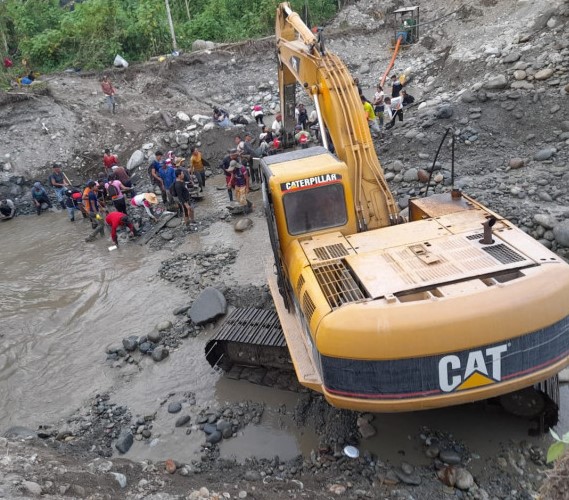
Illegal mining has increased 625% in South America in the last decade. According to the United Nations, much of the growth has been aided by government corruption.
The document summarizes an investigation conducted from March through early May in Ecuador, Colombia, Peru and Bolivia.
The report said that much of the “engagement” with criminal groups in Ecuador involves government employees being paid to “turn a blind eye” to illegal mining activities, UNODC says, but just as much involves employees with “direct participation” with illegal mining.
UNODC cited a February report by the Organization of American States confirming its findings. “Our investigations have uncovered widespread corruption within Ecuador’s Mining Regulation and Control Agency (Arcom) and in the Ministry of Energy and Mines,” the OAS said.
Unless the government is willing to conduct a thorough review of its operations, as well as a vetting of its employees responsible for overseeing mining operations, illegal mining will continue to expand, UNODC says.
University of San Francisco-Quito economics professor Kleber Moreno says the corruption goes far beyond government mining agencies. “It involves banking and auditing functions that do not follow the mining money leaving the country and circulating within the country’s banks,” Moreno says. “Isn’t it strange that in less than two years, in a stagnant economy, Ecuador’s banks have seen a 35% increase in dollars flowing through their system?”
He adds: “Hundreds of millions of dollars are passing through the mining networks, much of it laundered drug money. This is an obvious area of focus, but there is not the will to do it, partly because powerful officials and business interests may be involved.”
Corruption is also widespread within law enforcement and the military, Moreno says. “Look at the ambush last month that killed 11 soldiers in Orellana Province. This continues to be presented as the act of armed invaders from Colombia, yet this massacre was the result of a tip provided by military personnel paid by mining interests.”
Although the military command knows its own men were involved, no information has been released publicly, Moreno says. “The publicity the government wants the public to hear is all about the murder of the soldiers by a criminal army,” he says.
According to the UN Drug Office, corruption involving illegal mining is shared with other countries in the region. “Corrupt officials play a major role in illegal mining in Brazil, Venezuela, Colombia, Ecuador, Peru, and Bolivia,” it says. “Within the past decade, illegal mining across northern South America has increased 625%, with almost half of the increase coming since 2022. Corruption plays a major role in this growth.”