
















Constitutional Court suspends some provisions of Noboa’s anti-crime laws; City bus owners threaten service disruption; Conaie supports Loma Larga fight
The Constitutional Court on Monday temporarily suspended 25 provisions of three recently passed laws aimed at fighting organized crime. The court said its primary concern about the Intelligence, Integrity and National Solidarity laws sponsored by President Daniel Noboa, is that they may “violate fundamental human rights guaranteed by the constitution” and grant “excessive” power to the president.
The court is responding to 22 lawsuits challenging the constitutionality of the laws and judges say they need more time to conduct further review.
Most of the court’s objections were to the Intelligence Law, which expands the authority of law enforcement and the intelligence service to gather information about residents without a court order. The judges are also questioning Noboa’s definition of “internal armed conflict” and “terrorism” used to justify some provisions of the law.
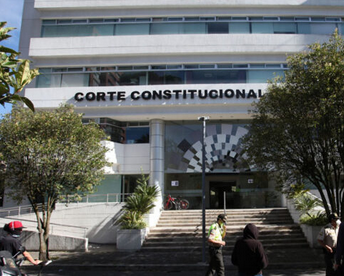
The Constitutional Court in Quito.
The court is also questioning a provision of the National Solidarity Law that allows the president to pardon convicted criminals for “humanitarian or exceptional public interest reasons, including for acts committed during the armed conflict.”
The court is expected to provide a final judement within 15 days.
City bus owners threaten to strike
The companies that operate Cuenca’s municipal buses said Monday that they may suspend operations if the city council does not increase bus fare. Diego Idrovo, president of the Chamber of Transportation of Cuenca, said bus owners are losing patience as a result of the city’s delay in increasing the fare.
“There has not been a fare adjustment in seven years, during which time our costs have increased 35%,” Idrovo said.
In a meeting with city councilors and Mayor Cristian Zamora, Idrovo said bus owners “cannot maintain their service” at the current fare. “Anything that happens in regard to bus service will be the responsibility of you councilors, and you, Mr. Mayor,” Idrovo said. “Unless action is taken immediately to install a new fare agreeable to all parties, we cannot guarantee that the buses will continue to run.”
Although Zamora says the delay is due to review of “a subsidy table” for disadvantaged groups, Idrovo claims it is the result of “indolence and lack of resolve to make a final decision.”
On Monday morning, bus owners announced they would concentrate on high-demand routes and schedules and may discontinue routes with low ridership.
Conaie supports Loma Larga opposition
Marlon Vargas, president of the Confederation of Indigenous Nationalities (Conaie), says he stands ready to “join the struggle” against development of the Loma Larga gold mine in the Victoria del Portete parish. During a two-hour meeting at the headquarters of the Yaku Wasi, Vargas said he will coordinate “necessary action” to protect access to clean water of residents near the proposed mine.
Among those attending the meeting were members of the Federation of Peasant Organizations of Azuay, the managers of Tarqui-Victoria del Portete Water System, and members of other indigenous and campesino organizations.
“I recognize the 30-year struggle against mining companies that your communities have sustained and Conaie will support your efforts to protect the water and natural integrity of Kimsacocha,” Vargas said.