














Enjoy the landscape and wildlife of the Galápagos on Isla de la Plata, 22 miles off Ecuador’s coast
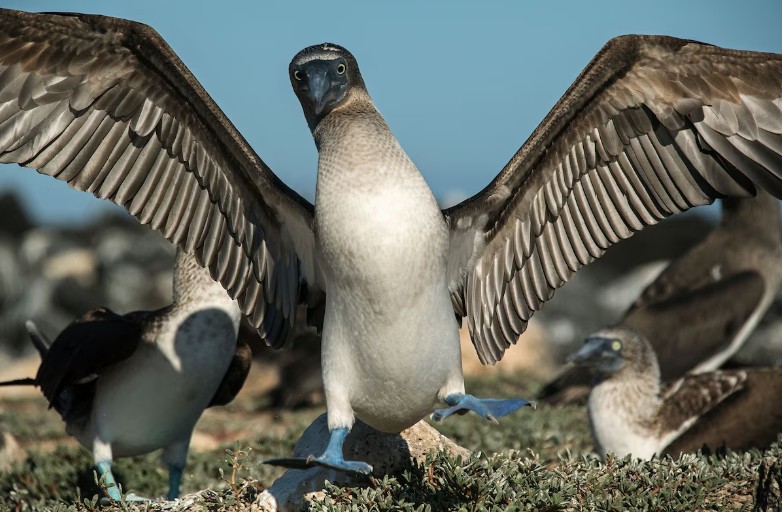
A blue-footed booby protects her chicks on the Isla de la Plata.
By Nick Dauk
A blue-footed booby welcomes hikers at the trailhead, whistling in hopes that a potential suitor is within the small group. Boots of brown, black, and burnt orange clash with the azure webbed feet that waddle together up the wooden staircase. Females croak and quack in suggestive reply from the barren bushes dotting this arid island. With waved albatrosses, frigatebirds, and red-footed boobies soaring across the sky, a snapshot of this scene could pass as a postcard for the famed Galápagos Islands.
But these popular ambassadors of the Enchanted Isles are also found on Ecuador’s Isla de la Plata, an island 22 nautical miles west of the mainland where species like the blue-footed booby have a geographical advantage.

The rugged shoreline of Isla de la Plata
“The males from the Galápagos are smaller in comparison to the males here because there’s more competition there,” says Silvano Quimiz Barzola, a guide with Palo Santo Travel and park ranger at Machalilla National Park. “In the Galápagos, the blue-footed boobies have one, maybe two, babies. But here, they have three or four babies on many occasions.”
Although both national parks adhere to a strict daily visitor limit, Isla de la Plata welcomes far fewer guests than the Galápagos. Even the four-month high season’s total visitor count is often a fraction of the number of travelers visiting Galápagos National Park in a single month, offering an intimate and budget-friendly opportunity to view as many as six of the “Big 15” Galapagos species.
Species native to the Galápagos also live on Isla de la Plata
While both Isla de la Plata and the Galápagos’ Genovesa Island harbor arid climates, the two islands share significant differences in wildlife populations.
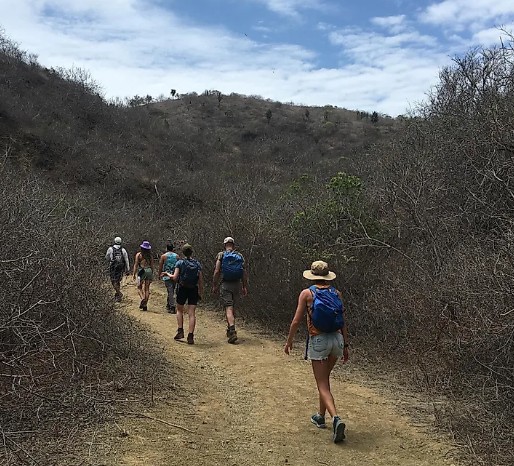
Hikers cross the arid landscape of on Isla de la Plata.
Visitors can view both red-footed boobies and blue-footed boobies on Isla de la Plata, as well as frigatebirds, Nazca boobies, waved albatrosses, and the Galápagos sea lion. On Genovesa Island, it’s unlikely to spot waved albatrosses and blue-footed boobies roosting among the red-footed booby and Nazca booby hatches.
Ecuador’s coastal fishing regulations preserve this safe haven for migrating and mating birds, particularly boobies. Silvano noted that over the last decade, fishing became heavily restricted within a two-mile radius of Isla de la Plata.
“That’s why the population of blue-footed boobies here is better than Galápagos, because here they don’t have many problems with the fishermen. They have a lot of food; it’s like a free restaurant here.”
Overfishing in international waters surrounding the Galápagos Islands during the pandemic has also led to an increase in Nazca booby breeding on Isla de la Plata. Genovesa Island may flaunt the “bird island” nickname, but Isla de la Plata is home to numerous bird species, as well.
The islands, beaches, and archaeological sites of Machalilla
Isla de la Plata was a place of worship for the Indigenous Manteños before it was privately purchased and partially developed. When the Ecuadorian government repurchased the island for national park protection, it underwent rehabilitation efforts to restore the ecosystem and eliminate invasive cats and rats introduced by its former owners. Machalilla National Park was established in 1979.
Today, a single building remains on this uninhabited island where national park rangers spend week-long shifts. All visitor food, beverages, and disposable items, except bottled water, are banned to ensure its preservation.
Machilla National Park’s boundaries also include the small island of Salango, another popular spot for blue-footed booby, sea lion, and migratory humpback whale sightings. Most of the national park, however, is stretched between two prominent mainland features: Los Frailes Beach and Agua Blanca.
The crescent shoreline of Los Frailes rests just north of Puerto Lopez, close enough for quick access yet while retaining a secluded charm that’s absent at the village’s beachline. Farther inland, the pre-Columbian archaeological site of Agua Blanca dates back to 800 A.D. Its small museum showcases artifacts from Manteño culture while the sulfur-filled natural pool entices visitors to absorb its purported medicinal properties.
With nearly half of the Galápagos’ Big 15 in view for a fraction of the price, Isla de la Plata affords visitors an opportunity to encounter endemic species, indulge in Ecuadorian coastal fare, and unwind at a leisurely pace without the price tag that accompanies a traditional trip to the Galápagos archipelago.
_________________
Credit: National Geographic