











Evangelical churches flourish among Indigenous communities in Ecuador
By Michael Fox
On a Sunday evening in downtown Quito, near the city’s main square, businesses shut down early. But just two blocks away, the “El Tejar” Quichua Alliance Church was bustling. The church is squeezed into a block of old buildings with a two-story yellow façade.
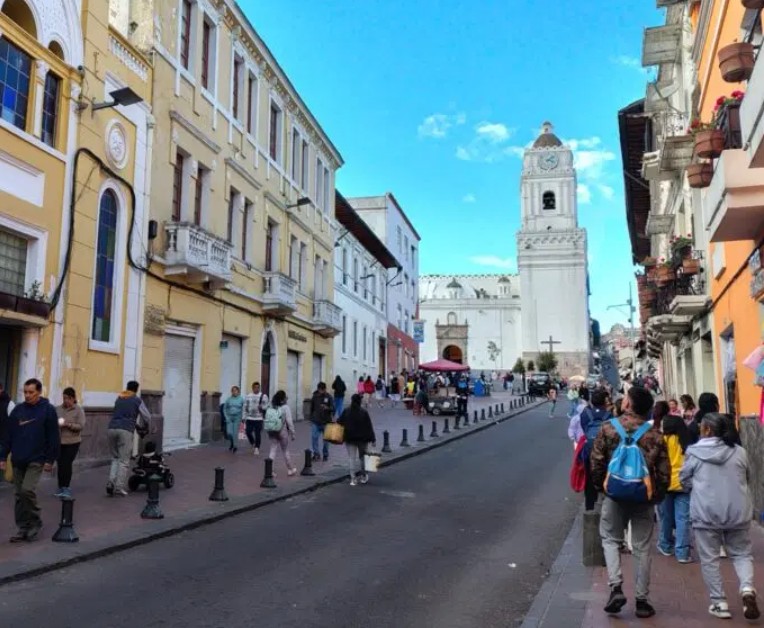
The “El Tejar” Quichua Alliance Church in Quito offers services in Spanish and in Kichwa in the city’s historic district.
About 100 people filled the rows of wooden pews. It might seem like an average modern-day evangelical church. There’s a four-piece band. The pastor even drops a line from the late U.S. televangelist Billy Graham in his sermon. But this particular church is special.
The pastor speaks not just in Spanish, but also in Kichwa, the native dialect of the Kichwa people of the highlands of Ecuador.
The Indigenous evangelical church is one of over 100 in and around Quito, among 1,000 in the country. The institutions have grown at a feverish pace in many parts of Latin America, and in Ecuador they’re helping people practice their faith while also preserving their culture.
“We’ve been here since 1980,” said Pastor Ricardo David. “We are celebrating our 45th anniversary, serving God, the community and the Indigenous population settled here.”
Missionaries from the United States first brought the evangelical church to the region about a century ago, promising development, health and education. But the churches really took off across Kichwa communities about 50 years ago.
Susana Andrade teaches at the Catholic University in Quito. She’s one of the foremost researchers on Indigenous evangelical churches in Ecuador. She said there are many reasons why so many Kichwa communities have left the Catholic Church, but the foremost is that they were not allowed to transform the services to fit their culture. “These are Indigenous churches, I mean, they pray in Kichwa,” Andrade said. “They run it themselves. The pastors are Kichwa. It wasn’t like that with the Catholics. They never held mass in Kichwa.”
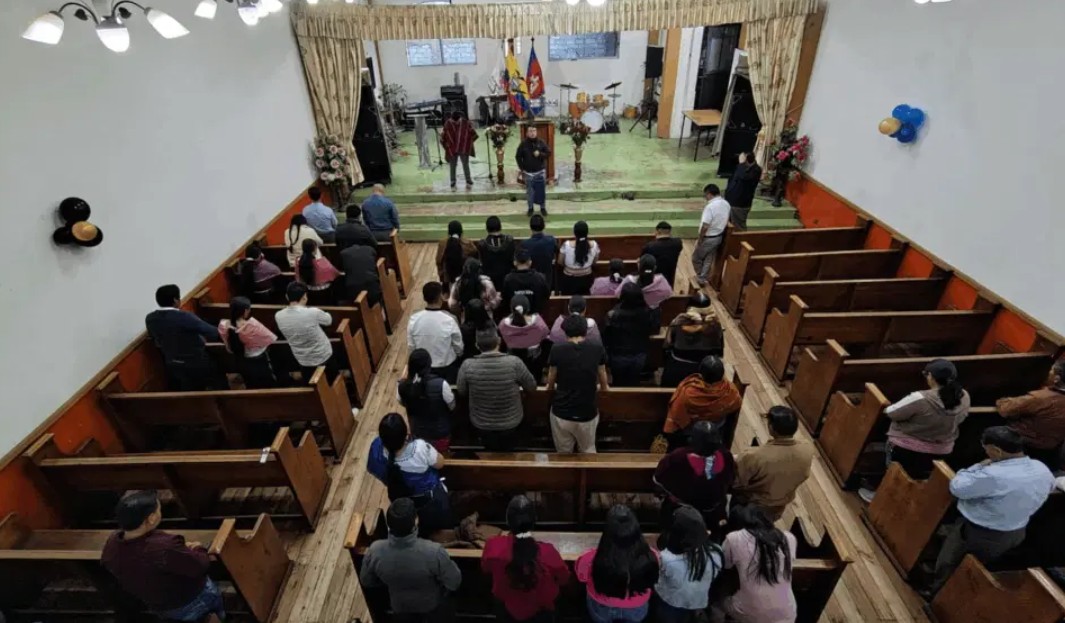
A church service at “El Tejar” Quichua Alliance Church. Only about 15% of Ecuador’s total population is evangelical today, with the rest being mostly Catholic.
The San Francisco Catholic Church service just a block away from the “El Tejar” Quichua Alliance Church has a completely different vibe. Its centuries old and was built by the Spanish, literally on top of the ruins of a former Incan emperor’s palace. It has a huge domed ceiling and is covered in gold.
But aside from the services, there is another major difference between Catholic and evangelical churches.
As a nod toward Indigenous communities, the Catholic Church has long condoned community festivals. Like Inti Raymi, the festival of the sun. It’s the largest celebration of the Incan empire, celebrated in late June. Today, it’s still a significant occasion across the Andean countries, with festivities that can last for days.
But these community festivals are prohibited by the evangelical churches. “So we, as evangelical Christians, don’t celebrate it because we know that the only one who should and deserves to be worshipped, is Jesus, because he came to us and saved us,” said Vilma Yunga, the communications director for Fierpi, the Federation of Indigenous Evangelical Churches Residents in Pichincha — the province where Quito is located.
Yunga and other members say that on the flip side, the churches have their own ways to celebrate Indigenous culture. That was on full display during a Sunday evening worship at “El Tejar” Quichua Alliance Church.
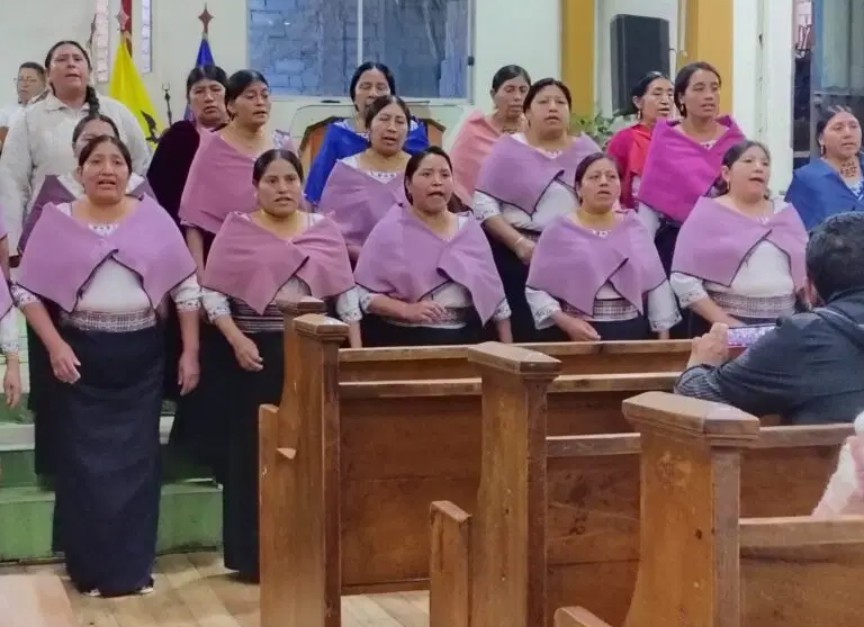
Indigenous women singing at an evangelical church service in Ecuador.
A group of 20 women in traditional Indigenous outfits and purple shawls moved in unison and sang in front of the church service. The song was in their native Kichwa language, in the style of traditional Ecuadorian folk music, but praising God.
Members say their churches have done a lot to protect indigenous language and culture, and provided support for those who have left their native communities and moved to the city.
Manuel Lema locked up “El Tejar” Quichua Alliance Church after the service. He said he’s been attending church there for 35 years. His story is common. He arrived in Quito for work 35 years ago from his home in the Indigenous highlands of Chimborazo, a few hours south. The church offered a support network and a means of continuing his own language and culture — and not only through church services, but other activities.
On an evening in late June, members of the church met at a soccer field in Southern Quito to kick off a month’s-long soccer tournament. Teams competed against each other from dozens of different Indigenous evangelical churches. It was a friendly match, played among pastors and church leaders.
“Well, sport always unites us and brings us together,” said theologian Carlos Pilamunga, who attends service at “El Tejar” Quichua Alliance Church. “Our motto in Kichwa is ‘Ñukanchik pura,’ which translates to ‘among us.’” He said the tournament was a way for them to get together, play and build bonds. That’s something that, despite changing times, Indigenous evangelical churches have been successful at doing.
Only about 15% of Ecuador’s total population is evangelical today, up from 7% 25 years ago. Almost everyone else professes to be Catholic, although less than 20% attend church regularly.
But in Chimborazo Province, 80% of the Indigenous community belongs to Indigenous evangelical churches. It’s also the region with the largest Indigenous population in the country. “So there’s a religious Indigenous movement that’s strong,” Andrade said.
“And with all of its imperfections, it contributes to Indigenous pride, where they are no longer subjects of the mestizos [mixed race], the whites and the priests, and where they are the principal actors.”
_________________
Credit: The World