


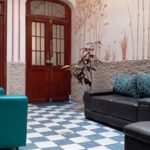





For one long-time expat, Cuenca’s El Vado neighborhood is a ‘little piece of heaven’
By Richard Westcott
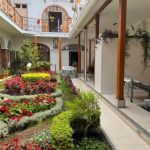
I have often heard Cuenca described as “my little piece of heaven.” Let me tell you of my little piece of heaven within Cuenca. To get there you should start at the beginning of Calle Tarqui where La Condomine rises up from the river and Tres de Noviembre begins.
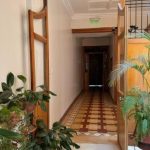
Within a few feet of your walk you will come to Hotel del Vado, a Michelin-rated hotel with two beautiful doors adorned with floral stained-glass panels. As you walk along Tres de Noviembre you will encounter several plaques on the wall to your left. The “Widow of the Lantern,” who legend says appears just after midnight looking for the soul of the young daughter she killed and abandoned in a ravine because she had a new lover and the daughter’s presence became an obstacle to their love.
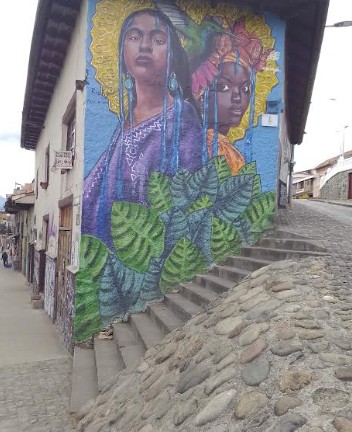
A mural on the stairs leading to La Cruz del Vado.
Further on. you will see a portrayal of “Maria y su Wawa” which portrays a local legend about a woman who, after experiencing trauma and loss, wanders the streets carrying a baby-sized bundle of rags, symbolizing a child she lost. She is known for her erratic behavior and her anger. She has been known to appear on the local streets, and chase people with a stone in her hand.
On your right, if you look up at the rooftop of one of the buildings you will see sculptures of several animals. I cannot find an explanation for this beyond the whimsical artistry. The donkey looks like the one Eddie Murphy portrayed in “Shrek”.
There is another plaque depicting “El Cura Sin Cabeza,” a priest who some say broke his priestly vows by having an affair and was decapitated by the infuriated indigenous people. Others say the priest was killed during a revolt in which he fought, side by side with the oppressed campesinos. After his capture the victorious authoritative government decapitated him.
This is the third iteration of the priest since we arrived here 14 years ago. There was a plaque opposite the current one on one El Vado buildings. Here the señorita stands topless looking out her window. This was replaced after someone broke off her exposed nipple. The earliest example I know of took up the entire wall of a building further down from El Vado.
The priest is said to ride the streets at night with his head in his hands. The deed is commemorated in the song, “Calle De La Secreta”. My wife swears that, on the darkest nights, she can hear hoofbeats along Presidente Cordova, the street in which the song takes place and the street we live on.
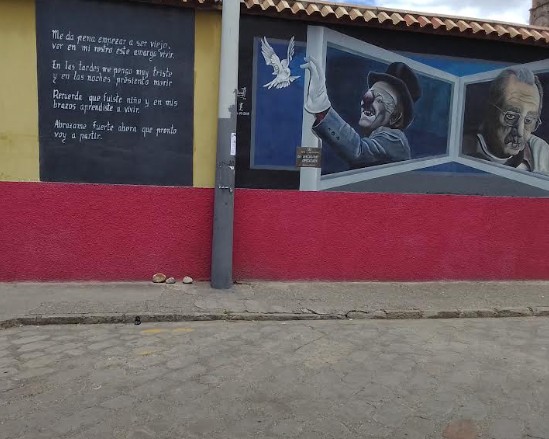
A poem about getting old is inscribed on a church wall on Calle Estevez de Toral.
After that you will pass La casa de la Lira with its beautiful green glass tiled front and lyre mounted on its balustrade. The house has been restored and reflects architecture from both the Colonial and the Republican eras. It is one of my favorite sites along the walk.
If you descend from El Vado by the stairway and follow the road down to where it meets La Condomine, you will encounter one of the loveliest examples of portraiture I have encountered in Cuenca.
Next you will arrive at La Cruz del Vado, originally constructed of stone and placed by the Spainards upon their arrival in 1557. It was exchanged for a marble cross, placed on a limestone and brick pedestal in 1881.
The words “El Vado” refer to the ford of the Rio Tomebamba that the early settlers needed to cross from the Paucarbamba (the original name of Cuenca) floodplain to reach the road that ascends to the city proper. Originally the plaza was populated with jewelers and bakeries. Directly across from El Cruz there are two three dimensional portrayals of bakers.
The street that rises from the Tomebamba to Calle Tarqui is named for Charles Marie de la Condomine, a French explorer, mathematician, geographer and member of the French geodesic mission. He collected the seeds of sasparilla, guaiacum, cacao, vanilla and others. He spent ten years in Cuenca and is responsible for measuring the degree of latitude at the equator preparing the first map of the Amazon, discovering rubber and quinine as well as inventing the metric system of measurements.
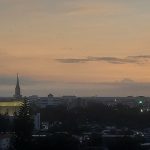
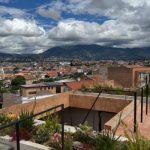
I have been practicing Taichi daily at El Vado for almost the entire time we have been living in Cuenca. It is one of the most beautiful spots I know. I usually get there via Juan Montalvo and, when the buildings end and I can see the mountains, I am continually agog at the sight. At times the mountain tops are sticking through the cloud cover. I have seen the setting moon perched on a mountain top and a rainbow that covered the expanse of my vision there.
Walk north for about nine blocks on Estevez de Toral (one block West of Juan Montalvo, where Mangiare Bene is located) and you will see a wall surrounding a Catholic Church sponsored nursing home with a beautiful poem on aging.
It gives me great pain to begin to be old,
To see in my face bitter life.
In the evenings it makes me very sad
And, at night I feel like dying.
Remember that I was a boy,
And in my arms, I learned to live.
Embrace me strongly now that soon I will depart.
Following the wall you will see a mural with retratos (portraits) of the aged paintings of la naturaleza Further along the street are other murals portraying children’s games and activities.
Que disfruten de la hermosa Cuenca!
________________
Rich Westcott is a 14-year resident of Cuenca.



Hogar Esperanza News

The Cuenca Dispatch

Week of August 16

Azuay stays under state of exception as authorities track criminal groups expanding around Cuenca.

Older adults and people with disabilities can now request vehicle tax break online.
That unresolved bank complaint has another place to go and the service is free.
Property Kuralt

Fabianos Pizzeria News

Fund Grace News

Property Manabi

Property Amazon
