

















Government calls off Imbabura talks, blames strikers of violating agreements reached last week
The government announced Sunday it will not participate in talks to end the indigenous strike scheduled for Monday in Otavalo. It said its decision was based on “multiple violations” of the conditions agreed to last week, including the continued blockage of highways in Imbabura Province.
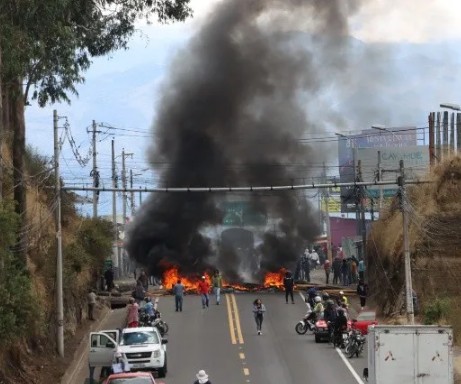
The government said it will not negotiate with strikers until all roadblocks in Imbabura Province are cleared.
The scheduled talks would have been a follow-up to those held last week between the Union of Indigenous Peasant Organizations of Cotacachi, the Federation of Kichwa Peoples of the Northern Sierra and Government Minister John Reimberg.
“There is no reason to continue with the process of dialogue with the indigenous sector to end the strike,” the ministry said in a statement. “The government will not accept pressure or blackmail and will act firmly within the framework of the law to guarantee the rights of the majority of Ecuadorians who want to live in peace.”
In a Sunday interview, Government Minister Zaida Rovira said a lack of good faith from indigenous leaders and general “confusion regarding the actors” made talks pointless. “Almost all the agreements reached last Wednesday have been violated, including the agreement to end the blockage of roadways,” she said.
“The lack of clear leadership of the strike has become a serious obstacle for negotiation,” Rovira said, adding that the 13 indigenous organizations in Imbabura Province have separate agendas for resolving the conflict. “Only when we have clarity about who can speak for all parties, and who can act in good faith, will we consider resuming a dialog.”
Rovira said the government will proceed with previous plans to remove roadblocks in the province but did not say when the action would begin.
Also on Sunday, Confederation of Indigenous Nationalities (Conaie) President Marlon Vargas said Conaie would agree to the elimination of the diesel subsidy if the government increases the minimum salary to $650, currently $470. “If the fuel prices go up, salaries should go up,” Vargas said. “You cannot continue to increase the financial burden on the poorest people.”
Several Conaie member organizations rejected Vargas’ offer, insisting reinstatement of the subsidy should be non-negotiable, highlighting the leadership problems among striking organizations.