














Government claims progress in crime fight but the situation on the ground tells a different story
By Gavin Voss
Ecuador’s government marked two years in office by trumpeting the results of its hardline anti-crime policies. But its claims of progress don’t present a clear picture of the country’s security realities.

President Daniel Noboa gives a pep talk to the troops.
Ecuadorian President Daniel Noboa entered office on November 23 two years ago, when Ecuador was facing its worst security crisis in history, fueled by the rise of powerful organized crime groups like the Choneros, Lobos, and Tiguerones. The president responded to the crime surge by labeling these groups “terrorists” and unleashing the military to bring them in.
Referencing the two-year milestone, Ecuador’s Ministry of the Interior published a series of infographics on its X account, presenting crime statistics that the government claims show the progress Noboa’s hardline policies have made against crimes like extortion and drug trafficking.
The extortion infographic shows that security forces conducted 1,134 operations against extortion networks in Noboa’s two years, resulting in 2,858 detainees and $9.9 million seized.
The graphic compares those figures to numbers from November 2023, in which only 160 operations against extortionists had resulted in 329 detained and $3 million seized. There is no indication, however, as to which time period the 2023 figures refer.
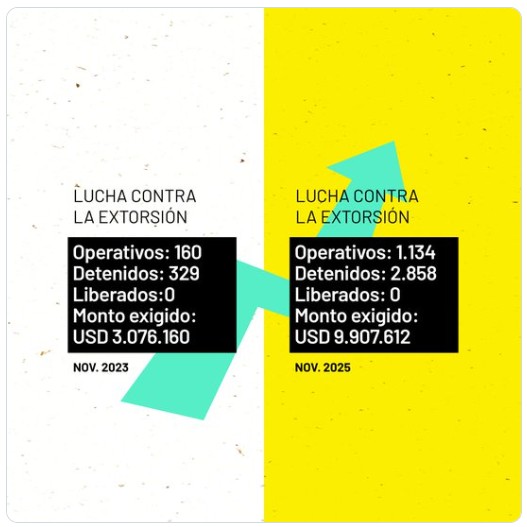
Ecuador’s Ministry of the Interior published a chart comparing police operations against extortion in 2023 and 2024. There is no indication, however, as to which time period the 2023 figures refer.
What’s more, the metric of police operations to measure extortion cited by the ministry’s post says little about the true levels of the crime. Police statistics shared with InSight Crime show reports of extortion jumped from 13,627 in 2023 to 14,579 in 2024, before falling to 5,314 in the first nine months of 2025.
There’s a similar problem with the drug trafficking infographic, which compares 513 tons of seizures during the Noboa administration with 221 tons in November 2023. The date range is once again unclear, making comparison impossible.
Meanwhile, our own reporting shows that cocaine seizures jumped from 195 tons in 2023 to 252 tons in 2024. While complete data for 2025 is not yet available, the government said seizures are on pace to break the 2024 record. “The State responds with greater force to guarantee the security of all Ecuadorians. The figures demonstrate it,” the post reads.
But the latest figures are unclear at best, and misleading at worst. Without a clear time interval for the 2023 data, it is impossible to draw a one-to-one comparison with the figures from Noboa’s administration, and its claims muddy the understanding of security wins and losses.
The Ministry of the Interior did not respond to InSight Crime’s requests for clarification on the statistics by the time of publishing.
Noticeably absent from the statistics presented by the Interior Ministry are homicides. Noboa took office at the end of Ecuador’s most violent year in history, in which the country saw a staggering 47 homicides per 100,000 residents, up from just 6 per 100,000 in 2018. After a slight drop in 2024, homicides are once again spiking, with Ecuador on track to record a homicide rate of over 50 per 100,000 in 2025.
In the prison system, which has long been a logistics hub and cash cow for Ecuador’s gangs, violent deaths remain high. Three prison massacres, stemming from disputes between gangs, have left over 60 dead in three separate events since September, despite Noboa making government control of the prisons a key pillar of his security policy.
The Kingpin Strategy
President Noboa’s emphasis on security force operations and international collaboration has put significant pressure on the leadership structures of Ecuador’s crime groups. But rather than dismantling organized crime, these takedowns have served to reshuffle the criminal chessboard.
Pressure has led to the capture of its most notorious leaders, including Tiguerones leader William Alcívar Bautista, alias “Willy” in October 2024; Choneros leader Adolfo Macías Villamar, alias “Fito,” in June; and Lobos leader Wilmer Chavarría, alias “Pipo,” on November 16. Security forces have also captured dozens of regional and local gang commanders.
But when a leader is removed, various factions once loyal to that leader battle each other for territory and to fill leadership vacuums. In one example from March, a faction of the Tiguerones in Guayaquil, the Fénix, attacked another faction called the Igualitos, leaving at least 22 people dead. The massacre, police told InSight Crime, was due to disputes within the group about who would assume command following Willy’s capture. Around the country, similar cycles of retribution remain, and without a comprehensive plan to mitigate local gang conflict and dismantle criminal infrastructure, violence and insecurity will likely continue apace.
Ultimately, the government must address the deeper question of why people turn to organized crime in the first place, according to a Guayaquil social leader who works with youth living in gang neighborhoods and asked to remain anonymous for security reasons. “There are no parks, no vocational programs, no cultural activities, nothing,” the leader told InSight Crime in April. “When the state withdraws, the mafias move in.”
________________
Credit: InSight Crime