














How Quito has become an architectural design hotspot in Latin America
By Liam Hess
The first thing I noticed when I woke up on my first morning in Quito was a physical sensation: a slight dizziness, a shortness of breath, a sense of fatigue after returning from a long (and very jet-lagged) morning walk around the city’s La Carolina park. And no, this isn’t because I was overcome by the sheer beauty of the place — although Quito is indeed very beautiful — but mostly because the Ecuadorian capital is one of the highest altitude major cities in the world. (It’s second only to Bolivia’s La Paz, in fact, which pips it to the top post by some 790 meters.)

Quito’s historic district shows off architectural splendor of the past. (Getty Images)
But back to the beauty: The second thing I noticed while wandering the streets of Quito was the overwhelming presence of nature. With the peaks of volcanoes on every horizon and the abundant foliage of the parks patchworked across the city, everywhere you turn you’ll spot some form of greenery.
But the third, and arguably most important, thing I noticed? The city’s seriously impressive architectural wonders. For my first few nights in the city, I was staying in an apartment with dramatic floor-to-ceiling windows and sweeping views in the La Carolina district, housed in the 32-story wonder that is the Iqon building. Designed by Bjarke Ingels, the 133-meter-tall skyscraper features hundreds of cascading concrete balconies elegantly unfurling across its curved facade, offering sweeping views across the topography of the city.
From my vantage point at the rooftop pool, I could see buildings designed by a who’s who of international architects: the groovy stack of terraces making up the Moshe Safdie building Qorner a little further down the street; on the other side of the park, I could just about make out the unusual shape of the Unique building designed by Carlos Zapata, with its slice of multiple open-air floors right through the middle.
As for how these architectural curiosities landed in Quito? That’s largely thanks to Uribe Schwarzkopf, a local, family-owned property development firm that specializes in ambitious residential projects by global starchitects that have transformed the landscape of the city — and encouraged a new generation of local architects to scale up their ambitions.
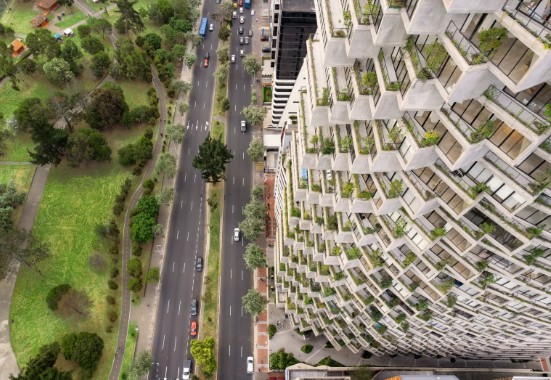
The Epiq building by Ingels Design overlooks Parque Carolina.
“I don’t know any other capital in South America that has so many buildings made by star architects as Quito,” says Joseph Schwarkopf, the son of the family patriarch, Tommy, who first began transforming pockets of the city in the early 1970s. “Nowadays, I see young people walking through the park, taking pictures of themselves with the buildings and the trees. And there’s this community that has grown out of that, which is really interesting and nice to see. It’s our country, so we feel like we have to try and put in the effort as citizens to make it better.”
On my first morning in the city, I headed to their latest project, Epiq: another Ingels design, the 24-story “vertical neighborhood” of interlocking layers of pink cement tiles and floor-to-ceiling panes of glass offering sweeping views across the city, artfully stacked to create outdoor terraces overflowing with palm trees and succulents. It served as a neat case study in how affluent, design-conscious Quiteños live today: given the metropolis’s notoriously intense traffic (partly due to the geographical quirks of it stretching north-south along a valley in the Andean foothills), it’s easy to understand why those who can afford it want all their amenities — a rooftop pool, a gym, shops, and even a music room — within the building they live in. (After all, if they need to stretch their legs, they’re just steps away from the southern end of La Carolina park — and indeed, there are few corners of the city that aren’t in close proximity to a public green space of some kind.)
Having absorbed the city’s most cutting-edge architecture, it was soon time to check out some of its design wonders from centuries past. Taking the shiny new underground metro system a few stops south, I emerged blinking into the sunlight, stepping past the lively bustle of food stalls to cross the breathtaking Plaza de San Francisco, with the imposing edifice of the Basilica and Convent of San Francisco framed by the even more imposing backdrop of the looming Pichincha volcano beyond.
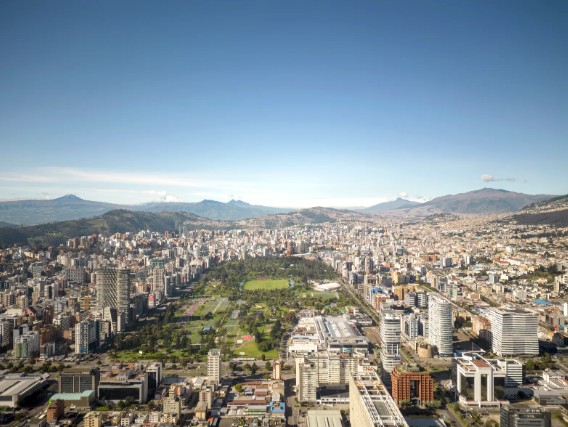
Many new projects are springing up around Parque Carolina.
As the sun receded behind the clouds and a downpour of rain began — the weather here is famously unpredictable due to the altitude and its position near the equator, often cycling through what feels like multiple seasons in a day — I ducked into the Jesuit church of La Compañía with its dazzling gilded interiors, then up onto the roof for a view across the rickety rooftops of the Old Town. Named one of the first UNESCO World Heritage Sites all the way back in the ’70s, it’s now one of the best-preserved (and most atmospheric) historic centers in all of the Americas. As the rain relented and tendrils of sunset orange light made the silvery clouds glow, and the enormous statue of the Virgin Mary was silhouetted atop the hill of El Panecillo in the distance, it felt as if I’d stepped back in time by several centuries.
It wasn’t long, however, before I was brought firmly back to the present day. The next morning, I paid a visit to Casa Kohn, a modernist residence completed in 1951 by the Czech immigrant architect Karl Kohn — and an impressively preserved masterpiece of elegant mid-century design. (This was a particular highlight not least thanks to the presence of its charismatic current owner, Kohn’s niece Katya Bernasconi, who regaled us with tales of Quito past and present.) Then, it was time to head over the road and wander the streets of La Floresta, the beating heart of the city’s art scene: after stumbling into the charming Villa Fauna, a boutique store and studio space run by the ceramicist Natalia Espinosa, I picked up a leaflet guiding me through a series of artists’ studios dotted around the colorfully painted houses that lined the neighboring streets.
Eventually, I ended up at Impaqto, a former blues bar that had been thoughtfully converted into a rabbit warren of a coworking space (and, next door, the buzzy restaurant, Clara), where I struck up conversation with the architect María Isabel Paz, who was there working on a collaborative project with rug makers from the regional city of Guano that she was planning to take to the Venice Biennale.
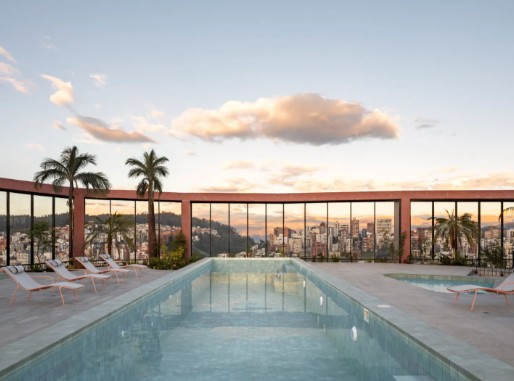
A rooftop swimming pool in Quito’s La Carolina district. (Andres Fernandez)
It was a reminder that while the jaw-dropping buildings sprouting up in the city center may be the most visible marker of Quito’s status as a fast-rising design capital, if you want to dig deeper into the design and architecture scenes here, the best scale to experience it at is a human one. Perhaps my most fascinating outing was to the offices of Diez + Muller, who set up their HQ on the top floor of a mixed-use development of their own design in the leafy neighborhood of Tumbaco; named Natura, the building is surrounded by swathes of acacia and jacaranda trees, while the striking, light-filled atrium—complete with an elegant diagonal walkway across the middle — features palm fronds and vegetation cascading off every balcony.
After heading up to their top-floor studio, I sat down with co-founder Gonzalo Diez, who expounded on the unique challenges — and unique rewards — of keeping their roots firmly in Quito, even as their fast-growing practice has seen them increasingly beckoned to work on projects in the U.S. and Europe. “Our work is always in dialogue with Ecuadorian design traditions, and there’s nowhere I feel more inspired than here,” he noted.
It came as little surprise to learn that Diez + Muller’s success had come in part thanks to the patronage of Uribe Schwarzkopf: their philosophy is not only about bringing global starchitects to Quito to help foment the local design scene, but encouraging the growth and influence of a new guard of Quiteño architects leveling up to create seriously accomplished work around the globe.
“Young architects started coming to see the projects, and then the bar was set higher,” says Schwarzkopf. Now, the architects here are world-class, because they got to compete with all these buildings. It happened really fast.” It’s a spirit of ambition that has extended to other disciplines, too: “Architecture, design, food, fashion. Everything except music,” Schwarzkopf says, with a laugh. “We Ecuadorians have never been so talented with music, to tell you the truth—not like the Colombians for example. Although maybe I’m just not familiar with what’s happening here in the music scene.”
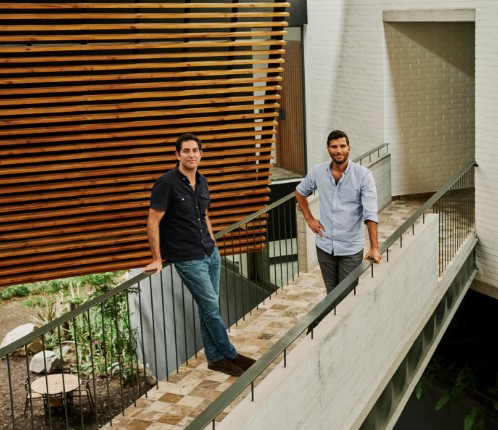
Young architects at Diez + Muller’s,
A recurring theme in talking to the various creatives and craftspeople I met over my days in Quito, however, was the difficulty of actually getting people to visit. It’s not like Ecuador doesn’t already have a thriving tourism sector: over the past three decades, the number of foreign visitors arriving annually has boomed, growing from 440,000 in 1995 to nearly 1.3 million in 2024. (The latter figure was impacted slightly by a breakout of civil unrest last year that has since settled down.)
The problem, however, is that the majority of these tourists are merely stopping for the night en route to visiting the natural wonders of the Galápagos Islands, which have long served as the country’s biggest draw. How, then, to encourage tourists — especially the kind of curious, creative visitor you might find heading to Mexico City or São Paulo — to give Quito a proper shot?
If my week in Quito taught me anything, it’s that there’s no shortage of reasons for anyone to spend several days here: whether sampling the imaginative spirit of the local restaurants, taking in its impressive museums, or embarking on the high-altitude hikes that thread their way through across the slopes of its volcanoes. And of course, for design-heads, to spend time exploring the treasure trove of first-rate architecture, from head-spinning skyscrapers to mid-century modern residences to the grand colonial homes and churches that sprawl across the Old Town.
“We have talented young people, we have talented architects, we have talented entrepreneurs,” says Schwarzkopf. “We ought to show it to the world.” If you build it, they will come—and one imagines it won’t be long before design-conscious tourists begin coming in droves.
If my week in Quito taught me anything, it’s that there’s no shortage of reasons for anyone to spend several days here: whether sampling the imaginative spirit of the local restaurants, taking in its impressive museums, or embarking on the high-altitude hikes that thread their way through across the slopes of its volcanoes. And of course, for design-heads, to spend time exploring the treasure trove of first-rate architecture, from head-spinning skyscrapers to mid-century modern residences to the grand colonial homes and churches that sprawl across the Old Town. “We have talented young people, we have talented architects, we have talented entrepreneurs,” says Schwarzkopf. “We ought to show it to the world.” If you build it, they will come—and one imagines it won’t be long before design-conscious tourists begin coming in droves.
________________
Credit: Vogue