
















Portable vs. HSG generators and solar: How long can you rely on them when the power goes out?
By Chris Deziel
A home standby generator is an essential home appliance in the Santa Cruz mountains where I live because power outages occur so frequently. They happen in the winter, of course, when high winds blow off the Pacific and down trees and power lines, but they also happen during fire season in the late summer. Pacific Gas & Electric calls these outages Power Safety Power Shutoffs, and they conduct them to decrease the risk of electricity-related wildfires.

A customer checks out a portable generator at a Cuenca hardware story. Local merchants say almost all generators sold in Ecuador are manufactured in China.
During the winter of 2023, my neighborhood experienced a series of back-to-back “atmospheric rivers” (aka “big storms”) that resulted in extended outages cumulatively lasting close to 30 days. During this time, we had to run our 22kW propane generator for 14 hours a day daily to keep the lights on.
The generator ultimately stopped working and had to be replaced, which led me to wonder: “Did we overuse our generator, or was the breakdown an anomaly?”
As part of the research for this post, I contacted Shawn Budiac from Batteries Plus and Clement Feng from Briggs & Stratton, and the information in this post is based on what they told me.
Home Standby Vs. Portable Generators
Feng says a home standby generator (HSG) “is permanently installed by a professional and sits on a concrete slab at least five feet away from windows, doors and fresh air intakes.” It’s connected directly to the main panel and typically has an automatic transfer switch to disconnect it from the grid when the power goes out, and it starts supplying backup power. Most of the HSCs in our area have automatic transfer switches. In fact, it’s a code requirement.
By contrast, a portable generator typically sits in a garage or other protected area when it isn’t in use and has to be moved into a safe position outdoors and manually started when the power goes out. Unlike an HSG, it usually isn’t permanently wired to the house panel (although it can be). It has power ports for extension cords.
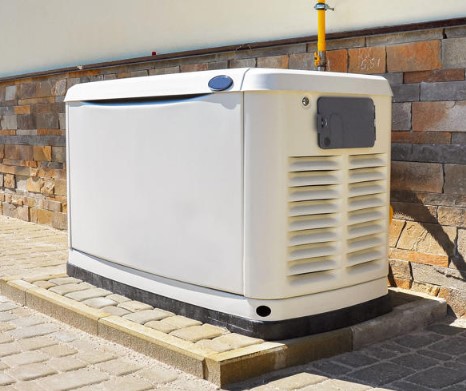
An installed home standby generator.
A portable generator typically supplies less power than an HSG — 1 to 12 kW as opposed to 7 to 22 kW or more. Because it usually isn’t permanently connected to a fuel source, you have to manually refill the tank with gas or diesel fuel — or replace the propane tank, if that’s the kind you have — if you want it to keep running.
How Long Can an HSG Run Continuously?
This is the ten-thousand-dollar question. Budiac says that, depending on the model and manufacturer of the home standby generator (HSG), they can run anywhere from 50 to 200 hours without interruption. He qualifies this by saying: “Manufacturers of HSGs typically have a maintenance schedule to ensure you’re getting the best performance possible. These maintenance schedules usually include topping off the generator with engine oil or changing it altogether at set intervals based on hours of use.”
We stayed well within these limits of continuous use during the storms of 2023, even though we had to use the generator daily. We kept the oil topped off and had the unit serviced during one of the rare periods when the power was on, but it failed anyway. Considering that a generator motor isn’t unlike an automobile motor, the most likely explanation is that it experienced an unforeseen mechanical failure, just as some car engines do. In other words, our brand-new unit was probably a lemon, which is no doubt why the company replaced it under warranty.
How Long Can a Portable Generator Run Continuously?
“Depending on the model,” says Feng, “portable generators can run for 6 to 18 hours.” But he goes on to say that the runtime is dependent on the fuel supply, and that depends on tank capacity. A tank that is large enough for eight hours of continuous service is fairly standard, but some tanks can be larger. If your generator runs on propane, there’s no limit to the size of the external tank to which you can connect it.
Of course, you can always stop the generator, add fuel, and start it right up again. That may or may not damage the engine — it probably won’t if you add oil as well as fuel — but before you do something like that, take Budiac’s advice: “When in doubt, you should always consult with the user manual of your particular model.”
How Long Will a Solar Generator Supply Power?
A solar generator isn’t so much a generator as it is a system that stores electricity and makes it available when the power goes out. It consists of an inverter and a battery bank. You can charge the battery with solar panels (many solar generator manufacturers also supply solar panels) or you can plug the inverter into an outlet and charge the battery using grid power.
Unless you have your home fully outfitted with a huge amount of solar panels and an exceptionally beefy inverter, you probably won’t be able to use much power for very long on solar power alone. And you’ll need solar power if you’re experiencing a grid outage.
Most portable solar generators capture enough energy to power a fridge continuously (or as long as the sunshine holds out), but not much else simultaneously. Expect to use your portable solar generator for only the most basic needs and only some of the time. The upside is that these units never need refueling.
_________________
Credit: Markets Today