











Saturday’s Women’s Day march commemorated 50 years of struggle for equal rights in Cuenca
Hundreds marched through Cuenca’s historic district Saturday, marking the 50th anniversary of International Women’s Day and the beginning of the city’s “March 8 Movement.” Following the march, some of the pioneers of the equal rights movement talked about their experiences at a symposium at the Escuela Central.
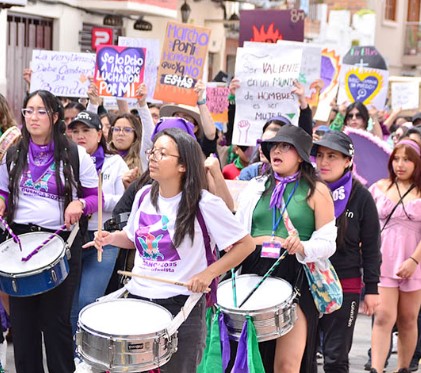
Marchers celebrated International Women’s Day Saturday and paid special tribute to the Cuenca pioneers of the equal rights “March 8 Movement.” (El Mercurio)
Even before the United Nations declared 1975 the International Women’s Year and March 8 International Women’s Day, a small group of women were meeting in Cuenca to promote equality for women.
Ecuador’s dictatorship took notice of the fledging movement in Cuenca and Quito and President José María Velasco pronounced it “part of an international communist conspiracy that will be responded to accordingly.”
Several Cuenca organizers were arrested for posting signs and hosting organizational meetings while others received death threats. In three cases, activists were asked to leave the Catholic church.
During the first March 8 Movement march in Cuenca, in 1978, an estimated 200 marchers were pelted with rocks, sticks and rotten food, according to newspaper accounts. El Mercurio reported that 500 soldiers, armed with machines guns, stood watch over the marchers but did nothing to stop those attacking them.
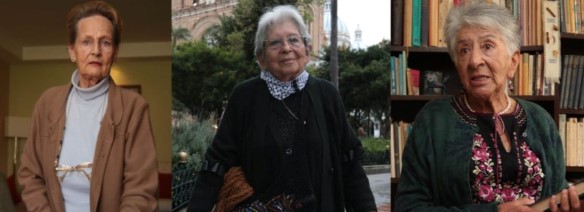
Cuenca women’s rights movement pioneers look back over 50 years: Heidi Gallegos, Cecile Durán and Gioconda Vanegas.
During Saturday’s women’s rights symposium, titled “Huellas de Mujeres” (Footprints of women), the movement’s pioneers were honored, with several of them describing the hardships they faced in the early days of the movement.

Margarita Maldonado was an early activist for women’s rights. Later, she established a school for immigrant children who were not allowed to attend Ecuadorian schools.
“The movement had to overcome many barriers in the early years,” said Gioconda Vanegas. “We faced extreme discrimination, limitation as mothers, caregivers of the home, and exclusion from political participation.” She added that the movement was broad-based, focusing not just on women’s rights but on education, work, health care, and the rights of peasant workers.
“Our efforts have a trajectory that has been present throughout history,” Vanegas said. “I remember the privations of the Second World War, then the struggles for social and national liberation in Asia, Africa and Latin America. We were part of that history.”
Heidi Gallegos, one of the founders of the Cuenca movement, recalls her arrival in Cuenca in 1967. Originally from Leipzig, Germany, her childhood deeply affected by World War II, she found discrimination against women in Ecuador similar to that in Germany. “We all realized that ours was an international struggle, not just one based in Ecuador and Latin America,” she said.
Another early member of the equal rights movement, Cecile Durán, said the struggle has always been a collective effort. “It has been about building organizations that represent all women and girls, it has never been about individuals and, until this day, we understand we are all in this together.”
Durán says she has seen amazing progress in women’s right through the years. “Things are much better today and we must acknowledge that we have made great progress. On the other hand, we also recognize there remains much work to be done.”
According to the symposium organizers, the 1975 activists included Heidi Gallegos, Matilde Galarza, Margarita Maldonado, Cecile Durán, Gioconda Vanegas, Lina Astudillo, Cecilia Muñoz, Nidia Carrión, Soledad Estrella, Magdalena Molina, and Piedad Moscoso.