













Survey shows an ‘approaching tsunami’ of demand for expat assisted health care Cuenca; Can it be met?
By Harry Watkins
How would a single expat living alone cope with everyday living if he broke his hip after stepping in a Cuenca pothole and couldn’t stand long enough to cook dinner? Where would my wife turn if my health took a turn for the worse and she needed help getting me out of bed? These are the questions that began to run through my mind as I worked with friends to help a couple in their late 80’s transition from independent living to an assisted care facility last November. The process was traumatic for them and for us as we coped with the fact that they had no plan or ability to make good decisions on their own.

There is a shortage of qualified home health care services in Cuenca.
After meeting with my doctor and theirs to discuss their care and the broader issue of long-term care for expats, I decided to run an online survey to determine how Cuenca expats envisioned coping with the long-term health care needs they may face in the future and their interest in some potential service concepts that might help meet these needs. The results were enlightening
An online survey was published in November 2024 and ads were run three times each in GringoPost and Cuenca Highlife inviting response participation. The confidential responses were informative and in greater numbers than anticipated.
Demographics of the Respondents
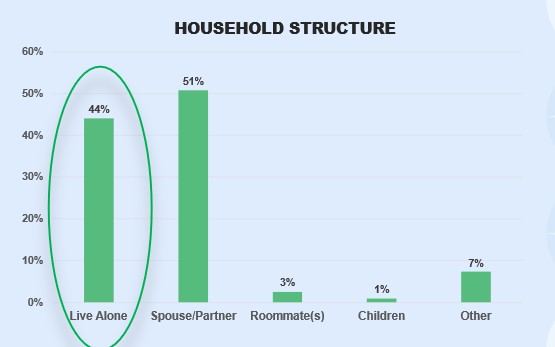
The results reflected that most expats come to Cuenca to retire. Over 92% of the respondents were over 60 years of age and over 61% were over 70 years of age. While 51% of the respondents live with a spouse or partner, fully 44% were singles who live alone! The large number of single expats living alone was surprising to me and concerning in that they are even more at risk if calamity hits due to a lack of family here in Cuenca.
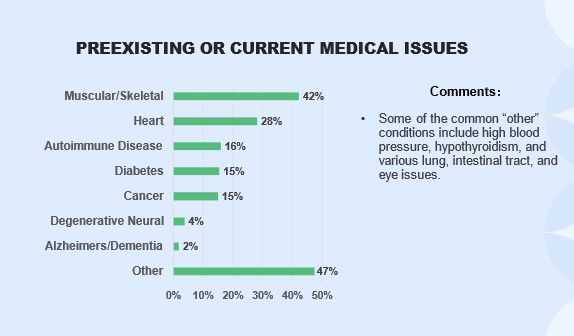
Over 57% of the respondents have lived in Cuenca more than 6 years. Fully 80% reported speaking no better than intermediate Spanish, suggesting that most expats will need English-speaking caregivers if they need long-term care. Finally, many respondents reported current or past challenges with muscular/skeletal problems and all of the typical health challenges of aging were also commonly mentioned.
Strategies for Managing Long-Term Health Care Needs
The survey questionnaire asked how respondents would cope with everyday living needs – cooking, shopping, banking, etc. – if they were incapacitated for a few weeks or months. Respondents most frequently indicated that they would turn to spouses/partners, and/or friends to help manage these basic needs. In contrast, if they were facing “Activities of Daily Living” (ADL) challenges such as toileting, transferring, feeding, medications management, etc., they were most likely to point to their spouses and/or to hired in-home caregivers as their support givers. Finally, the survey asked how respondents would cope if facing ADL challenges over a protracted period.

A fourth of the respondents indicated they had no plan and no idea how to find resources for these challenges. Among the respondents who did have plans, couples were more likely to point to in-home care givers as an option, while singles living alone were more likely to prefer assisted living facilities as a possible solution. In written commentary, many singles expressed concern about inviting “strangers” into their homes to provide care when they were disabled. Perhaps the most significant result from this question was that only 8% of the respondents indicated that they would move home to their country of origin, either to live with family or to move into assisted living facilities there. Most expats would prefer having available options here in Cuenca and not to uproot and return to the U.S. after establishing themselves here.
The long-term health care challenge
The North American news media have been filled recently with articles noting the many challenges facing seniors seeking long-term health care. Space in “continuing care retirement communities” (CCRC’s) and assisted living facilities are scarce and expensive. Home health care is also expensive and marked by extensive care-giver turnover due to poor salaries, training, and difficult working conditions. Many seniors are left to depend on their families for support if it is available.
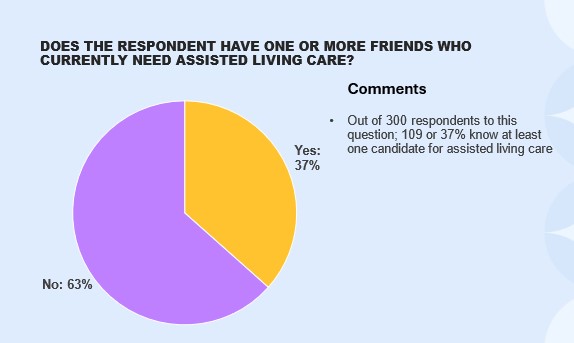
Here in Cuenca the aging expat community generally has no family to depend on. Recent estimates suggest that there are at least 8,000 expats in Cuenca. If 80% of these are 65 and older, that suggests about 6,400 retirement age expats. Research in the United States suggests that 70% of people who reach the age of 65 will need assistance with one or more ADL’s before they die. This suggests that more than 4,000 expats will need long-term assistance over the next 10 to 15 years. Another way of looking at the challenge comes from longitudinal research in the United States which suggests that roughly 10% of seniors 65 or older have challenges with at least two ADL’s. Assuming Cuenca expats have the same health profile of United States citizens this suggests that over 600 Cuenca expats may need long-term assistance today! A final data point on the challenge came from the results of our survey. The respondents were asked if, within their circle of friends, they know one or more candidates for assistance with ADL’s. Three hundred respondents answered this question, and collectively they knew at least 109 candidates for such support! As one of my professors used to say to me: “Do the math!”
The problem with this approaching tsunami of expat assisted care needs is that Cuenca isn’t prepared for it. There are roughly 30 small, assisted care facilities in Cuenca, offering perhaps 450 beds. They are mostly full, their staff generally do not speak English, and most do not meet the amenity expectations of North American expats.
Similarly, there is a shortage of qualified home health care services in Cuenca. With one or two notable exceptions, the health care facilitators who advertise their services to expats are not medically trained. Similarly, the care givers hired for home-based care frequently have little or no medical training, are not bonded, and often have no supervision in spite of the medical issues that might be present.
A Solution in the Works?
While it is premature to share details, a team of expats and locals are working to address these challenges. We will have more to announce publicly in the next few months as our plans take shape. If you are interested in learning more as we make progress, or if your background or your financial resources suggest that you might be able to contribute to this effort, please contact me! Thank you!
_________________
Harry Watkins, Ph.D. can be reached at 099-948-0708 or hwatkins@pointloma.edu.



Hogar Esperanza News

Fabianos Pizzeria News

Fund Grace News

Property Manabi

The Cuenca Dispatch

Week of August 23

Ecuador’s economy grew 2% during the first half of 2026 compared with the same period a year earlier, according to new Banco Central del Ecuador data.

Cuenca gets a prime view of next week’s deep partial lunar eclipse.

Ecuador’s economy grows 2% in the first half of 2026.
Nice apartment banner
Property Kuralt