
















The first gold record in history
There are certain songs that do not so much belong to a period as continue living inside it, like a station clock that still keeps perfect time long after the timetable has ceased to matter, and Chattanooga Choo Choo is one of those, appearing simple on first hearing but revealing, on closer inspection, a complete and now largely vanished way of organizing everyday life.
The song was written in 1941 by Mack Gordon and Harry Warren for the film Sun Valley Serenade, and recorded by Glenn Miller and his orchestra with vocals by Tex Beneke, whose relaxed delivery contributes greatly to the conversational ease of the piece; it went on to become the first gold record in history, which is a rather grand outcome for a song that is, at least on the surface, about catching a train and having something to eat along the way.
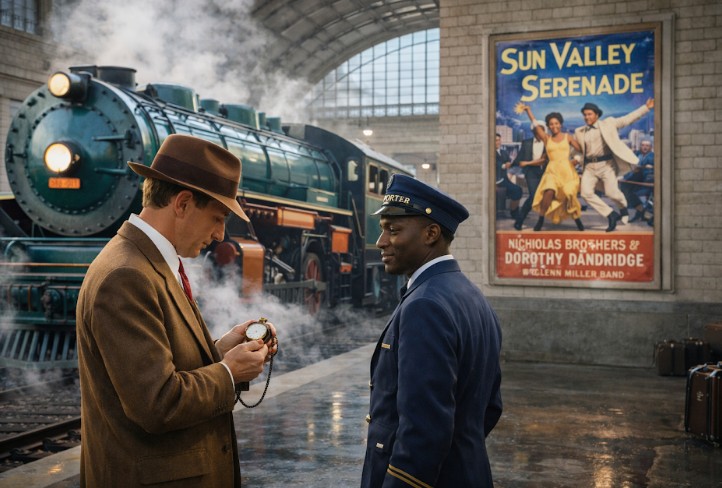 It is not really about the train, but about a world in which trains mattered sufficiently that people organized their lives around a 4:30 departure from New York without consulting a device, refreshing a screen, or assuming delay as the default condition of travel.
“Pardon me, boy, is that the Chattanooga Choo Choo?” is a line that now carries more weight than it originally did, since the phrasing reflects a level of public politeness that has largely disappeared while the word “boy,” which would have passed without comment in a railway setting at the time, now sits in a more complicated historical context, reminding us that language accumulates meanings long after its original use has faded.
The timetable that follows is equally revealing, because “You leave the Pennsylvania Station ’bout a quarter to four” is presented not as a technical detail but as part of the shared experience, something that listeners would immediately recognize and trust, whereas a modern equivalent would sound more like a public announcement than the opening of a popular song.
By the time the traveler reaches the Carolinas, it is time for dinner, and dinner turns out to be ham and eggs, which sounds quaint only if one forgets that eggs and cured ham were available at any hour and that nobody was particularly concerned with whether they were eating breakfast food at the wrong time of day, since the dining car was not an afterthought but an integral part of the journey, complete with table service, coffee poured properly, and the gentle sway of the carriage as the train continued southward.
The passing reference to a shoe shine, which might seem decorative to a modern listener, in fact points to a service culture that was once routine, where personal presentation was maintained as part of public life and where such services were expected and readily available, while also hinting, without comment, at the social structure of the time in which many of these roles were filled by Black workers within a segregated economy.
Musically, the piece is just as distinctive, since the Glenn Miller sound is immediately recognizable through that smooth blended lead in which a clarinet rides above the saxophone section while the trombones move beneath with a steady, mechanical motion that suggests the pistons of a steam engine, creating an arrangement that not only accompanies the idea of travel but subtly imitates it.
If one turns from the recording to the film, the picture becomes more vivid, because the performance sequence in Sun Valley Serenade featuring the Glenn Miller orchestra, the Nicholas Brothers, and Dorothy Dandridge is staged around a stylized railroad carriage into and out of which the dancers move with remarkable precision and athleticism, producing an effect that remains impressive not because of spectacle alone but because of the control and timing required to make it appear effortless. It is one of the greatest song-and-dance numbers in history.
Dandridge brings a presence that suggests a career larger than the opportunities she was ultimately given, while the Nicholas Brothers perform with a level of confidence that makes the entire sequence feel both exuberant and slightly beyond the reach of ordinary performers, reinforcing the sense that this is a polished world operating at full capacity.
What is perhaps most striking is that none of this feels heavy when one listens to the song, because it does not attempt to explain or justify its setting, instead presenting it as entirely normal, which allows the modern listener, if inclined, to notice the underlying assumptions about time, travel, service, and social organization without being instructed how to interpret them.
In Cuenca, where buses arrive when they are ready and the tram moves with a kind of quiet inevitability that does not depend on precise adherence to a published schedule, the idea of structuring one’s day around a fixed departure from a grand station in New York carries a certain appeal, suggesting a world in which the journey, the meal, and the arrival all formed part of a coherent and dependable experience.
Even if it is just ham and eggs.