











When people who help people need your help
By Frances Hogg Lochow
When she walked through the doors of her high school in Cuenca for the last time, Rocío Illescas knew that the world that opened before her was not big enough. Though she loved children, the life of a housewife did not appeal to her, nor did the idea of joining her family’s business sewing school uniforms in their barrio of Chilcapamba. An understanding nun offered an alternative. “Come with me to our convent in Bergamo, Italy!” So along with two other girls from her class, that’s what Rocío did.
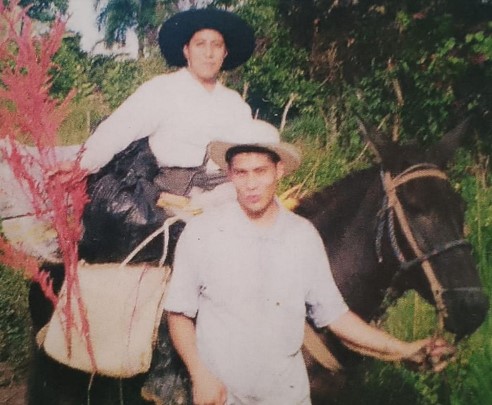
Rocio, her horse, and Telmo.
It was not a fun experience for the teenagers. “There were many rules, I missed my family, and the food was terrible,” says Rocío. “We cried a lot.” But she finished a three-year course in theology and learned to speak Italian and English. While the other girls went on to become nuns, Rocío had always dreamed of being a missionary. So, she completed an additional year of training and learned to speak the Luo language. When a position opened at the San Camilo hospital in the rural town of Kissie, Kenya, Rocío went there.
From 1992 to 1996, Rocío helped doctors with their rounds, dressed wounds, and cared for patients during the height of the AIDS epidemic. “Every week more than ten children and several adults died from HIV.” Rocío sat at their bedsides as they died and traveled to outlying villages to tell others how to avoid the disease. The work was brutal, but every day convinced Rocío even more that this was her true calling – to make life on Earth more bearable for God’s children.
But dark news came. Rocío’s beloved mother Lucy, only 43 years old and now with a three-year-old son, had breast cancer. “We need you here,” said her father, Carlos. Rocío returned to care for her mother until she died. Her little brother Andres was only seven and her 19-year-old sister Janeth was in university. Rocío knew her work cooking, cleaning and helping her younger siblings was important but she ached when she heard what her missionary friends were doing. With her father’s remarriage to a wonderful woman named Maria who brought with her a daughter, Mayris, Rocío was again free to do the work that called to her.
Rocío accepted a position in the Esmeraldas, working with a Colombian mission. During a training, she met a young priest named Telmo Girón Pardo. In 2000, he invited her to help him develop a mission in San Francisco del Vergel, in the Zamora-Chinchipe, along with three other missionaries. Telmo warned her it was a two-hour walk through the jungle, past where the road ended South of Vilcabamba. “Oh yeah,” he said. “Bring boots.”
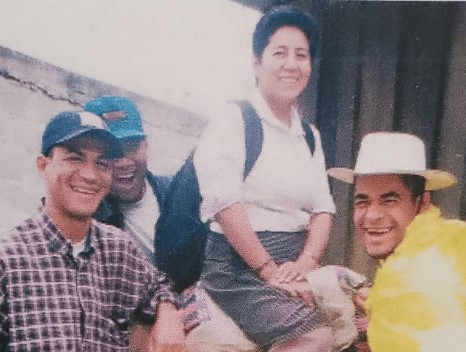
Rocio with the medical team.
The group started out at daybreak for the mission, but Telmo’s two-hour estimate was a tad optimistic. They didn’t reach the mission until nightfall. There they found nothing but a wooden house, a tiny, crumbling church, a grinning Padre Telmo, and the promise of years of hard work. The people in the region had migrated there after a great drought in the 1960s looking for food but they had no means of making money. Their health was bad and their poverty, gut-wrenching. They had no electricity and no clean water.
The missionaries developed a three-part plan to make life better. Rocío and Telmo invited medical practitioners to the mission, where dozens of people died annually from infection and parasites. They next taught the people how to cultivate and market coffee. Rocío made the seven-hour ride on horseback every day through ankle-deep mud, either bringing medicine and supplies to the community or hauling coffee and other agricultural products to sell in the city. Rocío established a market to sell used clothing that raised enough money to buy a refrigerator for storing medicine.
The biggest project was to being electricity to San Francisco del Vergel. A group of engineers came from Cuenca to see if the dream was possible. Telmo organized 100 volunteers from all parts of Ecuador to erect the utility poles. “They all worked so hard,” said Rocío. “They worked until their hands bled.” A tragedy ruined the rejoicing when the electricity was turned on. A cable snapped, hitting one of the young engineers and killing him.
Their mission complete, Rocío went next to Yakuambi in the Amazon region where she taught Shuaar women about hygiene. There, she experienced stomach pains on and off, but during Easter week of 2007, her pain became unbearable. The visiting bishop took her to a hospital where she was injected with painkillers. She was then sent to Cuenca, where it was discovered that her appendix had burst. She received immediate surgery, but the infection was relentless. Every day for eight months she had to return to the hospital to have her incision drained and cleaned.
Rocío wanted to continue her work in Yacuambi, but her doctors forbade it. She felt deflated, denied the challenge of the life and work she had loved. Then, in a dream, her deceased mother appeared to her and told her, “Open a school for babies.”
By this time, Rocío’s sister Janeth was married with small children, and worked as an educational specialist, testing children in Cuenca for learning disabilities. She had begun a preschool in her home for a few neighborhood toddlers. “Maybe we can build something together,” Janeth suggested.
The sisters named their program CETAP-Lucy (Centro de Estimulación Temprana y Apoyo Psicopedoagógico) after their mother. They built a small school on land Lucy had left for her daughters. Telmo, who was studying in Rome, suggested that Rocío apply for a grant from an Italian charitable organization, asking for a building fund and money to hire teachers. CETAP-Lucy was the only South American country to win the grant. When a delegation came in 2010 to inspect the finished project, the electricity flickered off, leaving everyone in darkness. The Italians donated a solar electrical system.
At the end of the grant period, Rocío, Janeth, and their adopted sister, Mayris, operated the school alone. They knew the services they were providing to children (some with autism, hearing loss, psychological issues and other learning disabilities) were important, but it was a daily struggle.
A chance encounter with American expat Cody Hamilton changed everything by bringing the program to the attention of the fledgling charitable foundation, Hearts of Gold. Hearts of Gold set up a sponsorship program for families in need of services who could not afford the nominal tuition. Regular income from the sponsorships allowed Rocío to hire more teachers and make Social Security payments for all the staff.
The expat community became more involved, with volunteers signing up to distribute school shoes and supplies to poor children, to donate computers and other equipment, to make repairs and paint, and to install flooring and plumbing in the building. They continued to tutor students with English, provide homework help, and assist with the pre-school children.
CETAP-Lucy has continued to thrive, even managing to provide services during the pandemic. Rocío started a Saturday market to distribute food to the community and with her brother Andrés, a trained chef and baker, turned the temporarily unused psychologist’s office into a bakery.
After COVID, the bakery expanded to become Lucy Bakery and Grill. The business has been successful; however, the current climate emergency has required the purchase of expensive equipment for smoke exhaust and emergency lighting. Rocío temporarily took over responsibility for paying the building mortgage, depleting her savings.
Unfortunately, the health issues that kept Rocío from returning to missionary work she loved in the jungle have continued to plague her, causing multiple hospitalizations over the yeras. Recently, she was diagnosed with a life-threatening issue with her esophagus which requires immediate surgery and aftercare that she cannot afford. Will you please help? You may make donations through Cooperativa JEP.
Account #406002082400
Illescas Ortega Rocío Rocio Emperatriz
C.I. 0102818952
Thank you!


Hogar Esperanza News
Fabianos Pizzeria News

Fund Grace News

The Cuenca Dispatch

Week of August 23

Ecuador’s economy grew 2% during the first half of 2026 compared with the same period a year earlier, according to new Banco Central del Ecuador data.

Cuenca gets a prime view of next week’s deep partial lunar eclipse.

Ecuador’s economy grows 2% in the first half of 2026.
Property Manabi

Property Kuralt

Nice apartment banner